c.curionodeThe Nobel Archive

1992 · Physiology or Medicine

A reversible mark regulates proteins

Fischer and Krebs showed how adding and removing phosphate groups controls protein activity.

protein phosphorylationkinasesphosphatasescellular regulation
1992Physiology or Medicine

Visual guide

The prize, pictured

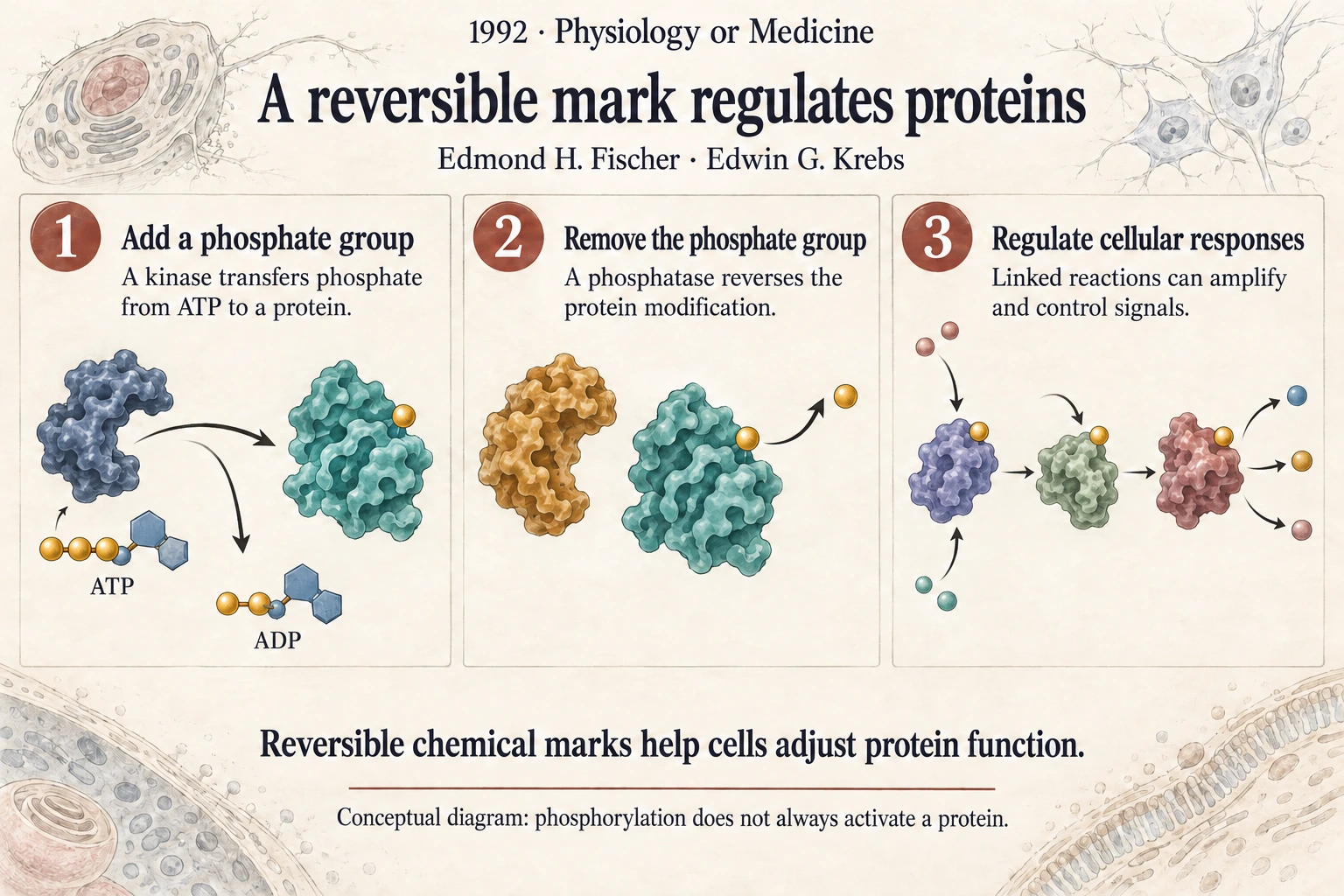
Infographic explaining A reversible mark regulates proteins
Original AI-generated infographic. A conceptual overview; the explanations and sources below provide context.
Read the poster text

Reversible chemical marks help cells adjust protein function.

  1. Add a phosphate group

    A kinase transfers phosphate from ATP to a protein.

  2. Remove the phosphate group

    A phosphatase reverses the protein modification.

  3. Regulate cellular responses

    Linked reactions can amplify and control signals.

Conceptual diagram: phosphorylation does not always activate a protein.

01 · The discovery

The idea, in everyday language

Cells need to change what their proteins do quickly, without rebuilding every molecule. Fischer and Krebs studied glycogen phosphorylase in muscle, an enzyme involved in using stored carbohydrate. In the mid-1950s, they showed that a kinase could transfer a phosphate group from ATP onto the protein, changing its activity.

A phosphatase could remove that group and reverse the modification. Together, the reactions provided a biochemical mechanism for regulation. Later work revealed many kinases and phosphatases, regulated pathways and signal amplification. Depending on the protein and modification site, phosphorylation can increase activity, decrease it or change interactions and location.

Why it matters

Reversible phosphorylation helped explain how signals connect to metabolism, growth and other cellular responses. Understanding disrupted regulation also became important in disease research and the development of targeted treatments. The original finding established a general kind of control, not an immediate cure for every condition involving a kinase.
02 · The people

Who brought the idea to life?

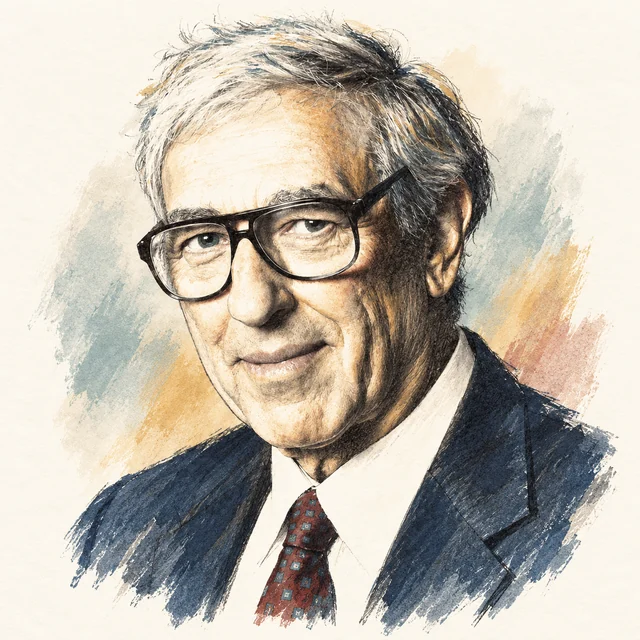
Illustrated portrait of Edmond H. Fischer

Edmond H. Fischer

Prize share · 1/2

Fischer and Krebs showed that a protein’s activity could be regulated by attaching and removing phosphate groups. Their mid-1950s experiments on muscle phosphorylase established the opposing roles of a kinase and a phosphatase. The covalent modification can change protein function without making a new protein. Effects vary with the protein and site; adding phosphate is not an instruction that always switches every protein on. Fischer and Krebs each received half the prize.

Read the biography ↗
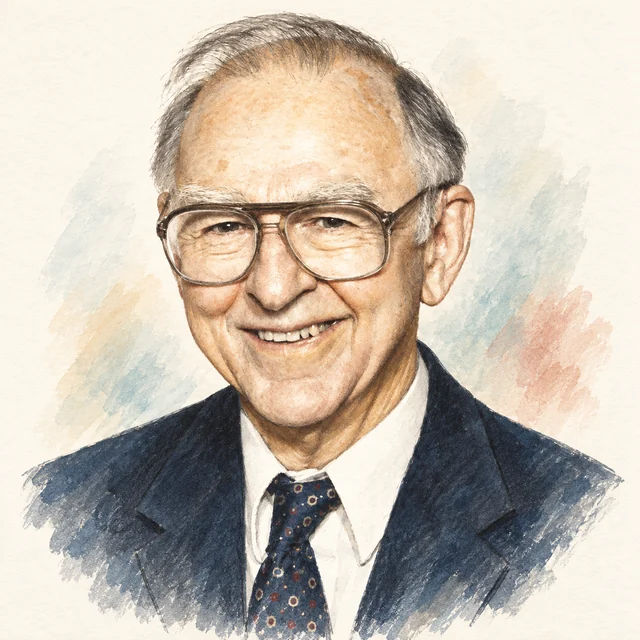
Illustrated portrait of Edwin G. Krebs

Edwin G. Krebs

Prize share · 1/2

Krebs shared the discovery of reversible protein phosphorylation and later investigated how cyclic AMP controls a protein kinase. Kinases and phosphatases can form regulated chains that amplify signals and adjust cellular processes. This connected a biochemical modification to the organisation of cellular responses. His discovery is distinct from the Krebs citric-acid cycle, associated with Hans Krebs, and phosphorylation is one regulatory mechanism among many.

Read the biography ↗

03 · Years in the making

The path here

  1. Mid-1950s

    Muscle phosphorylase studies establish reversible phosphate-dependent regulation.

  2. 1968

    Work in Krebs’s group identifies a cyclic-AMP-dependent protein kinase.

  3. 1992

    Fischer and Krebs share the Medicine Prize equally for the regulatory mechanism.

04 · Read further

From the original sources

Original explanations by Curionode, based on the official records below. Biographical details and affiliations refer to the award year.

  1. Official announcement nobelprize.org

More in Physiology or Medicine

Browse this subject ↗