c.curionodeThe Nobel Archive

1992 · Physics

Turn particle tracks into electronic signals

Charpak’s multiwire chamber made fast, electronically recorded particle detection possible.

particle detectiongas ionisationelectronic readoutexperimental physics
1992Physics

Visual guide

The prize, pictured

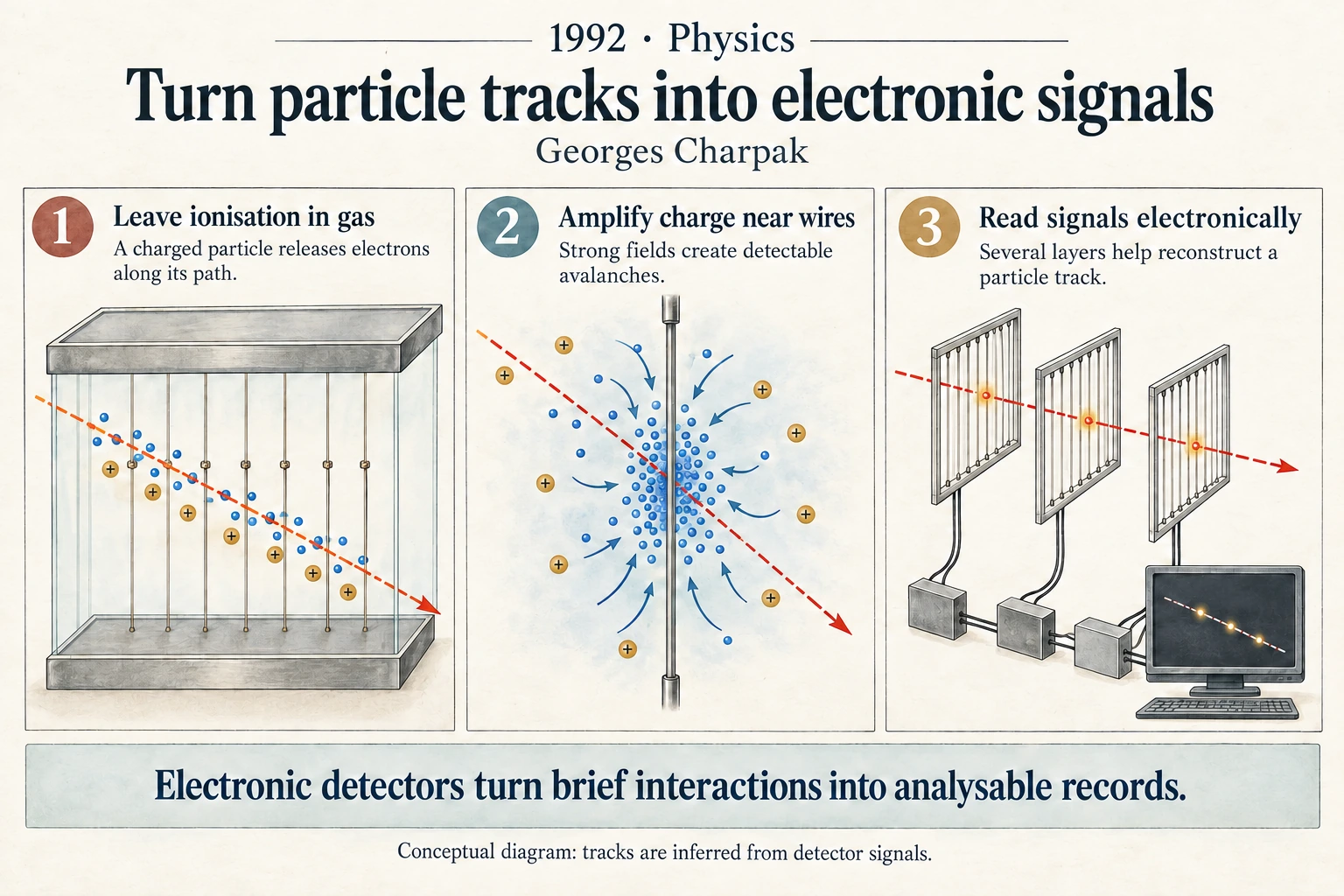
Infographic explaining Turn particle tracks into electronic signals
Original AI-generated infographic. A conceptual overview; the explanations and sources below provide context.
Read the poster text

Electronic detectors turn brief interactions into analysable records.

  1. Leave ionisation in gas

    A charged particle releases electrons along its path.

  2. Amplify charge near wires

    Strong fields create detectable avalanches.

  3. Read signals electronically

    Several layers help reconstruct a particle track.

Conceptual diagram: tracks are inferred from detector signals.

01 · The discovery

The idea, in everyday language

A particle track had often meant a photograph that someone had to measure. That approach limited how quickly experiments could inspect collisions. Charpak’s multiwire proportional chamber used a gas-filled detector with many thin, parallel anode wires. A passing charged particle ionises the gas, leaving electrons and positive ions rather than a visible photographic line.

An electric field moves the freed electrons toward anode wires. Close to a wire, a strong field produces an avalanche of further ionisation, giving a detectable electrical signal. Each wire has its own readout. Computer recording and signals from multiple layers allow researchers to infer track positions rapidly, helping experiments investigate rare interactions amid many ordinary events.

Why it matters

The chamber helped move particle physics into an era of electronic detection and computer analysis. Later detector designs built on the principle, contributing to major experiments. Related techniques also found uses in radiation imaging and biological research, where appropriate detector design and exposure remain essential.

02 · The people

Who brought the idea to life?

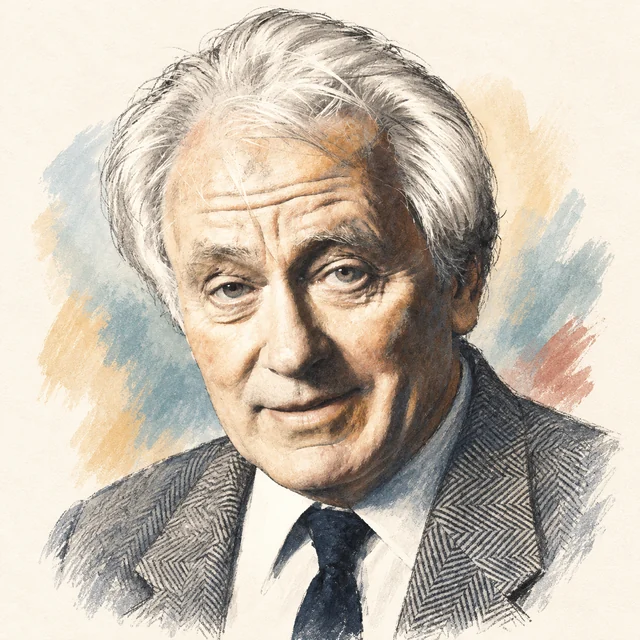
Illustrated portrait of Georges Charpak

Georges Charpak

Prize share · 1

Charpak invented and developed the multiwire proportional chamber, introduced in 1968. A charged particle ionises gas; freed electrons move toward fine anode wires and multiply near them. Individual electronic readouts locate signals, and several detector layers help reconstruct a track. The advance made rapid, computer-based recording practical. It identifies interactions through their signals rather than photographing the particles themselves, and its performance depends on the detector design.

Read the biography ↗

03 · Years in the making

The path here

  1. 1959

    Charpak joins CERN and develops experimental instruments.

  2. 1968

    The multiwire proportional chamber introduces independent electronic wire readouts.

  3. 1974

    He develops spherical drift chambers for protein X-ray diffraction studies.

  4. 1992

    The Physics Prize recognises his invention and development of particle detectors.

04 · Read further

From the original sources

Original explanations by Curionode, based on the official records below. Biographical details and affiliations refer to the award year.

  1. Official announcement nobelprize.org