c.curionodeThe Nobel Archive

1993 · Physiology or Medicine

A message assembled from separate parts

Split genes showed that a mature RNA message can join sequences separated in the DNA that encodes it.

split genesRNA splicingexons and intronsgene expression
1993Physiology or Medicine

Visual guide

The prize, pictured

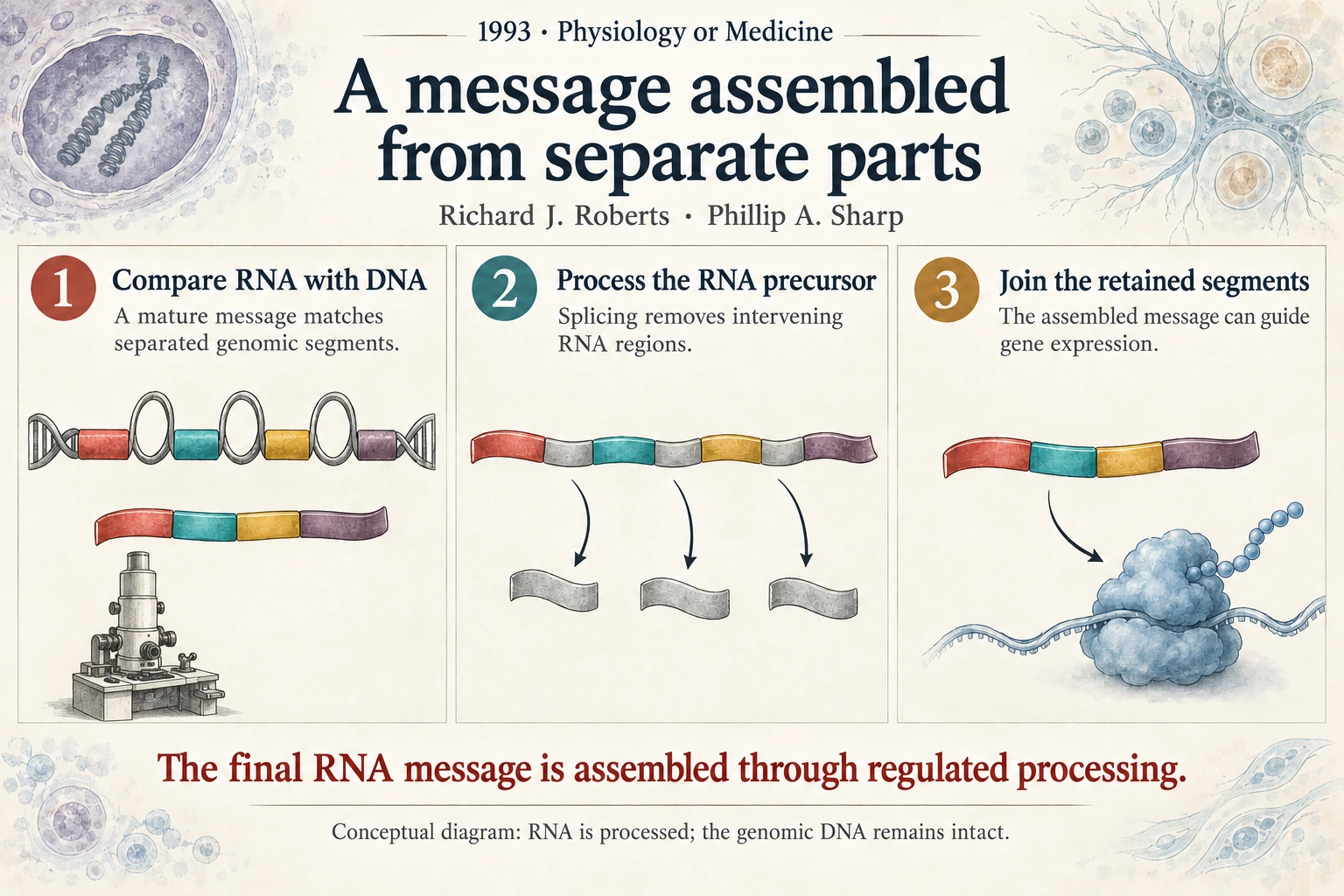
Infographic explaining A message assembled from separate parts
Original AI-generated infographic. A conceptual overview; the explanations and sources below provide context.
Read the poster text

The final RNA message is assembled through regulated processing.

  1. Compare RNA with DNA

    A mature message matches separated genomic segments.

  2. Process the RNA precursor

    Splicing removes intervening RNA regions.

  3. Join the retained segments

    The assembled message can guide gene expression.

Conceptual diagram: RNA is processed; the genomic DNA remains intact.

01 · The discovery

The idea, in everyday language

A simple view of a gene treated its message as the copy of one uninterrupted DNA segment. In 1977, Roberts’s and Sharp’s groups independently found a different arrangement in adenovirus. A mature messenger RNA matched several separated DNA regions. In RNA–DNA hybrids, intervening DNA formed loops because those stretches had no counterpart in the mature message.

The result pointed to an additional processing step. A longer RNA precursor contains retained regions, called exons, and intervening regions, called introns. Splicing removes the intervening RNA and joins retained segments. Later research showed how alternative splicing can produce different mature messages from the same gene. The genomic DNA is not cut apart each time a message is processed.

Why it matters

The discovery changed understanding of gene structure, expression and evolution. It created new questions about how cells recognise splice sites and vary RNA messages. Splicing errors can contribute to disease, so gene interpretation requires more than simply reading a continuous stretch of DNA.

02 · The people

Who brought the idea to life?

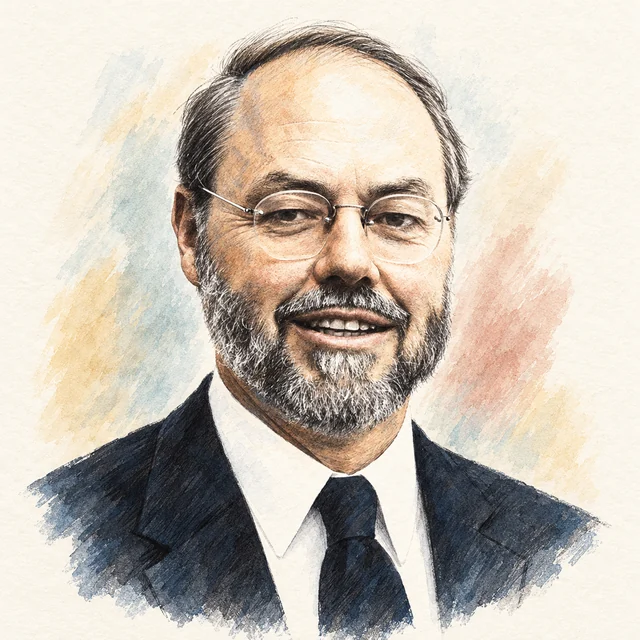
Illustrated portrait of Richard J. Roberts

Richard J. Roberts

Prize share · 1/2

Roberts’s group found that parts of an adenovirus messenger RNA came from separated stretches of viral DNA. Biochemical clues and electron microscopy, with collaborators including Richard Gelinas, Louise Chow and Tom Broker, established the discontinuous arrangement in 1977. Sharp’s group independently reached the same central result. The discovery challenged the assumption that a gene’s expressed sequence was always one uninterrupted DNA stretch, revealing the need for RNA splicing.

Read the biography ↗
Illustrated portrait of Phillip A. Sharp

Phillip A. Sharp

Prize share · 1/2

Sharp’s laboratory, including Susan Berget and collaborators, compared adenovirus messenger RNA with the DNA that encoded it. Their 1977 experiments showed that the message joined sequences separated in the genome, independently of Roberts’s group. This supported a model in which a longer RNA precursor is processed by removing intervening RNA and joining retained segments. The prize recognised split genes, not the claim that every gene must contain introns.

Read the biography ↗

03 · Years in the making

The path here

  1. 1977

    Independent adenovirus studies reveal mature RNA matching separated DNA segments.

  2. After 1977

    Research establishes RNA splicing and explores alternative message combinations.

  3. 1993

    Roberts and Sharp share the Medicine Prize for split genes.

04 · Read further

From the original sources

Original explanations by Curionode, based on the official records below. Biographical details and affiliations refer to the award year.

  1. Official announcement nobelprize.org

More in Physiology or Medicine

Browse this subject ↗