01 · The discovery
The idea, in everyday language
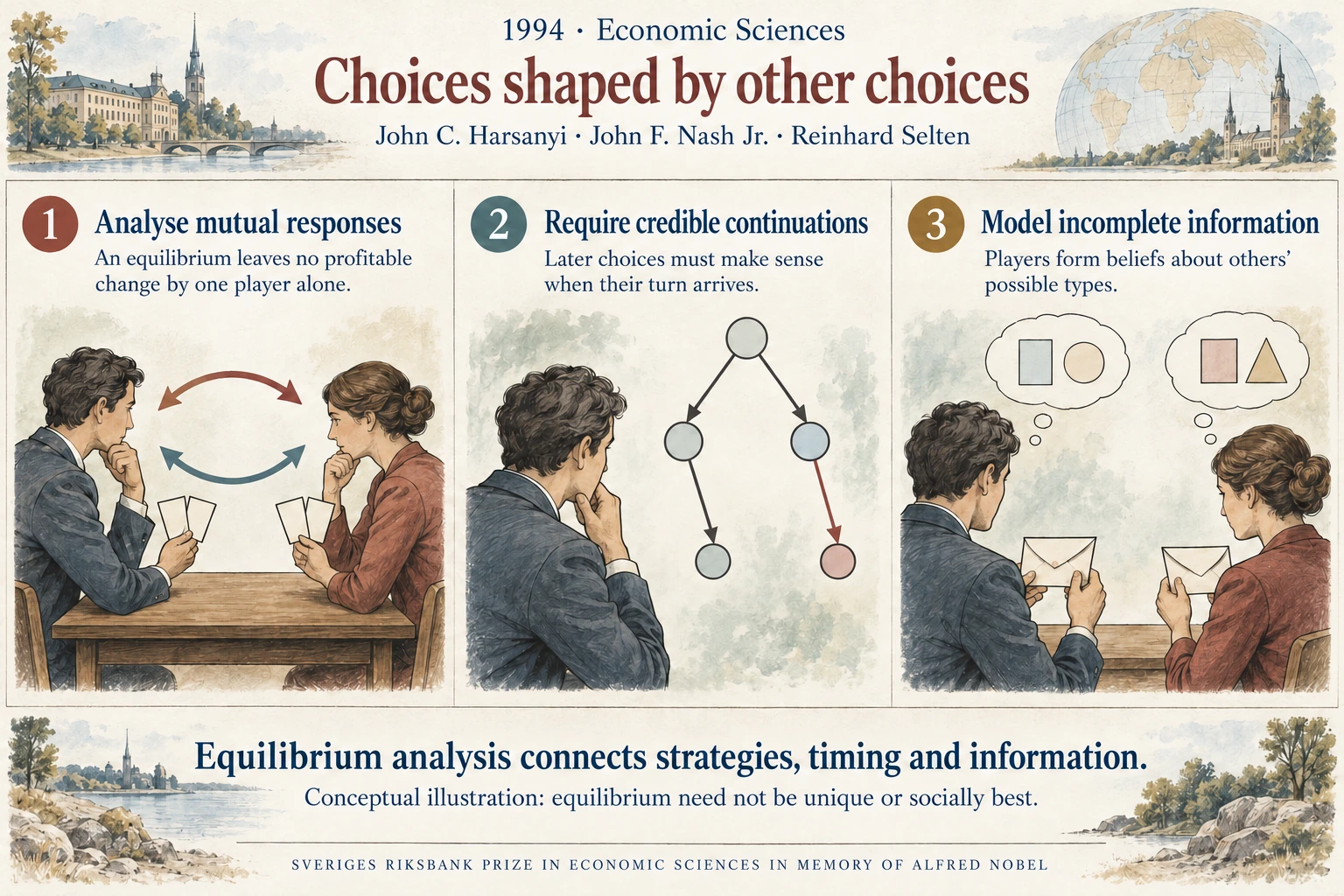
A firm setting a price, a negotiator making an offer or a policymaker announcing a rule may need to anticipate others’ responses. Nash supplied a general equilibrium concept: with everyone else’s strategies fixed, no player can improve their own payoff by changing alone. For games with finite players and finite strategy sets, mixed strategies allow an existence theorem beyond two-person zero-sum situations.
Selten refined equilibrium for decisions that unfold over time, requiring credible behaviour in later stages rather than relying on threats a player would not actually carry out. Harsanyi developed analysis of incomplete information by representing players as possible types with beliefs about one another. The three contributions form related tools for strategic interaction, not one claim that every real-world game has a unique predictable winner.
Why it matters
The work gave economists a framework for analysing bargaining, competition, institutions and information. It also influenced other disciplines where outcomes depend on interacting choices. The three laureates received equal shares for equilibrium analysis in non-cooperative games, complementing rather than replacing empirical investigation of behaviour.