c.curionodeThe Nobel Archive

1996 · Economic Sciences

Rules for what people know privately

A good institution must account for incentives when participants know things the designer cannot observe.

The Sveriges Riksbank Prize in Economic Sciences in Memory of Alfred Nobel.

asymmetric informationincentivesoptimal taxationsecond-price auctions
1996Economic Sciences

Visual guide

The prize, pictured

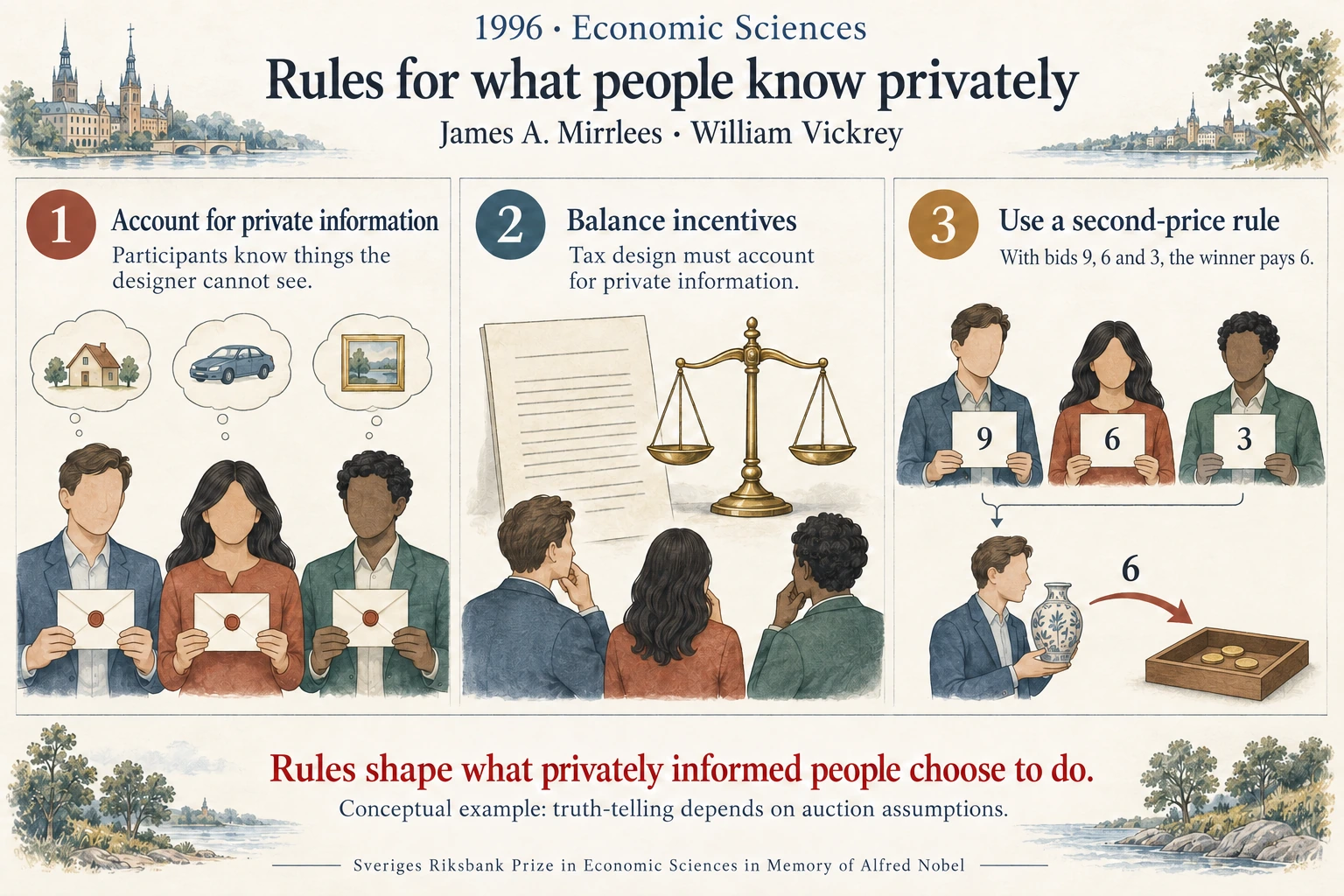
Infographic explaining Rules for what people know privately
Original AI-generated infographic. A conceptual overview; the explanations and sources below provide context.
Read the poster text

Rules shape what privately informed people choose to do.

  1. Account for private information

    Participants know things the designer cannot see.

  2. Balance incentives

    Tax design must account for private information.

  3. Use a second-price rule

    With bids 9, 6 and 3, the winner pays 6.

Conceptual example: truth-telling depends on auction assumptions.

01 · The discovery

The idea, in everyday language

A policymaker or auctioneer rarely knows every participant’s ability, effort or valuation. Simply asking for that information does not guarantee an honest answer, because the rules can make concealment or exaggeration attractive. Mirrlees and Vickrey made these information and incentive constraints central to economic analysis.

Mirrlees developed methods for designing income taxes and contracts when private information or hidden actions shape behaviour. Vickrey analysed how auction rules affect bidding. In a single-item sealed-bid second-price auction, the highest bidder wins and pays the second-highest bid. Under the standard private-value assumptions, truthful bidding is a dominant strategy: raising or lowering a bid cannot improve the result compared with bidding one’s valuation. These are different applications of the same need to design rules around participants’ choices.

Why it matters

The work helped establish the modern analysis of incentives under asymmetric information, with applications to taxation, contracts, insurance and auctions. It clarified why apparently attractive policies can change behaviour in ways a designer must anticipate. A model can expose a tradeoff even when it does not supply one universally best real-world rule.
02 · The people

Who brought the idea to life?

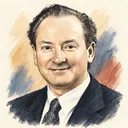
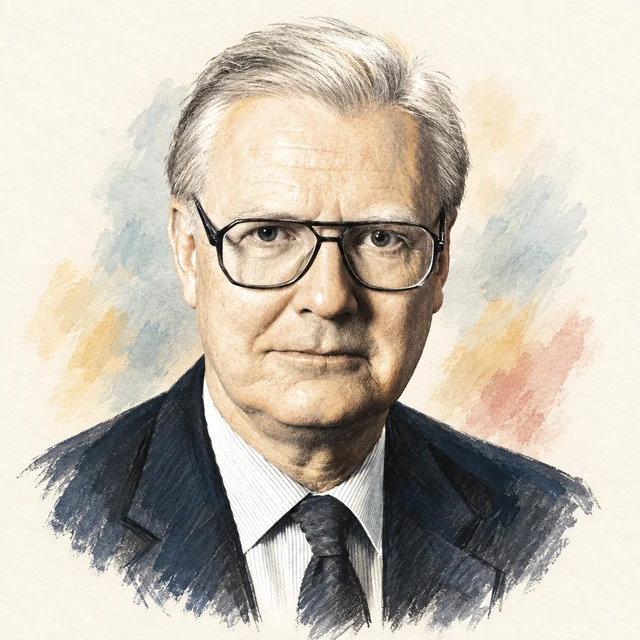
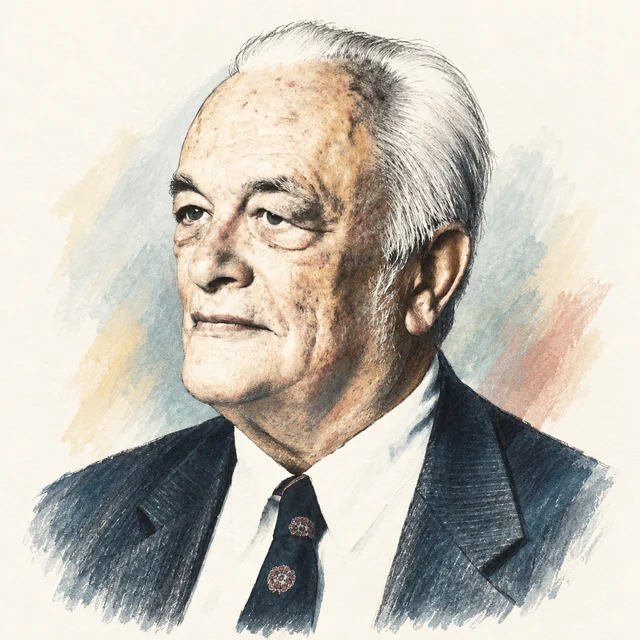
Illustrated portrait of James A. Mirrlees

James A. Mirrlees

Prize share · 1/2

Mirrlees developed an analysis of income taxation when a government can observe income but not each person’s productivity or effort directly. A tax system must balance redistribution with the incentives that shape people’s choices. His methods also helped analyse contracts and hidden actions. They made information constraints part of policy design rather than assuming a planner already knows everything about each participant.

Read the biography ↗
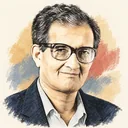
Illustrated portrait of William Vickrey

William Vickrey

Prize share · 1/2

Vickrey analysed how auction rules affect what privately informed bidders choose to reveal. In a sealed-bid second-price auction, the highest bidder wins but pays the second-highest bid. Under the standard private-value assumptions, bidding one’s actual valuation is a sound strategy. His work helped establish that good allocation depends on the rules and incentives, not merely on asking participants for truthful information.

Read the biography ↗

03 · Years in the making

The path here

  1. 1961

    Vickrey publishes foundational analysis of auction rules, including second-price bidding.

  2. 1970s

    Mirrlees develops methods for optimal taxation and incentives involving hidden actions.

  3. 1996

    Mirrlees and Vickrey share the Economic Sciences memorial prize; Vickrey dies after the announcement.

04 · Read further

From the original sources

Original explanations by Curionode, based on the official records below. Biographical details and affiliations refer to the award year.

  1. Official announcement nobelprize.org

More in Economic Sciences

Browse this subject ↗