c.curionodeThe Nobel Archive

1995 · Economic Sciences

Policy changes what people expect

Evaluating a new policy requires asking how people’s expectations and decisions will change with the rules.

The Sveriges Riksbank Prize in Economic Sciences in Memory of Alfred Nobel.

rational expectationsLucas critiquepolicy regimesmacroeconomic models
1995Economic Sciences

Visual guide

The prize, pictured

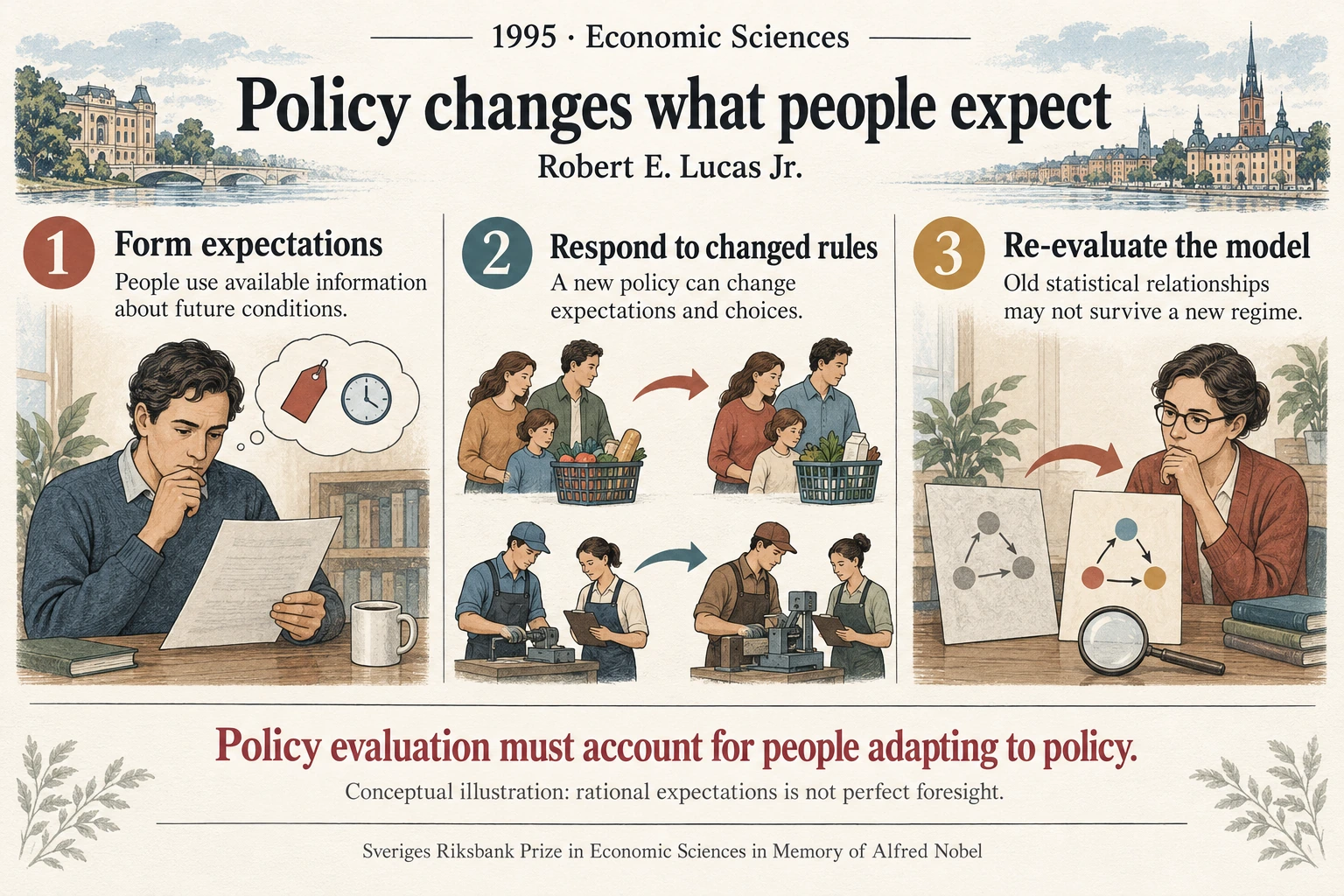
Infographic explaining Policy changes what people expect
Original AI-generated infographic. A conceptual overview; the explanations and sources below provide context.
Read the poster text

Policy evaluation must account for people adapting to policy.

  1. Form expectations

    People use available information about future conditions.

  2. Respond to changed rules

    A new policy can change expectations and choices.

  3. Re-evaluate the model

    Old statistical relationships may not survive a new regime.

Conceptual illustration: rational expectations is not perfect foresight.

01 · The discovery

The idea, in everyday language

An economic policy acts on people who can anticipate it. Households and firms form expectations about prices, wages and future conditions, and those expectations shape what they do now. Building on Muth’s rational-expectations hypothesis, Lucas made this forward-looking behaviour central to macroeconomic models. Expectations use the information specified in the model; they do not grant people perfect knowledge of future events.

The Lucas critique explains a problem with using yesterday’s statistical relationships to evaluate tomorrow’s policy regime. A relationship estimated under an old rule may partly reflect how people adapted to that rule. Change the rule, and their decisions can change too. A model that simply holds the old relationship fixed may therefore give a misleading forecast. Lucas argued for analysing choices, constraints and expectations when comparing policy regimes.

Why it matters

The work transformed macroeconomic modelling and the evaluation of economic policy. It strengthened the demand to connect aggregate outcomes with individual decisions and to distinguish anticipated policies from surprises. Later models retained attention to expectations while also studying learning, limited information, sticky prices and other frictions.


02 · The people

Who brought the idea to life?

Illustrated portrait of Robert E. Lucas Jr.

Robert E. Lucas Jr.

Prize share · 1

Lucas developed and applied rational expectations in macroeconomic analysis, building on John Muth’s earlier formulation. He showed how expectations could change conclusions about inflation and employment, and why relationships estimated under one policy regime might fail under another. His 1976 critique helped redirect policy evaluation toward models of decisions, constraints and expectations. The hypothesis does not mean everyone predicts perfectly or that every policy has no effect.

Read the biography ↗

03 · Years in the making

The path here

  1. 1961

    Muth gives the first precise formulation of rational expectations.

  2. 1972

    Lucas applies rational expectations to inflation and employment in a macroeconomic model.

  3. 1976

    The Lucas critique challenges policy evaluation using relationships tied to past policy.

  4. 1995

    Lucas receives the Economic Sciences memorial prize for developing and applying rational expectations.

04 · Read further

From the original sources

Original explanations by Curionode, based on the official records below. Biographical details and affiliations refer to the award year.

  1. Official announcement nobelprize.org

More in Economic Sciences

Browse this subject ↗