c.curionodeThe Nobel Archive

1995 · Chemistry

Small reactions, a planetary shield

Trace gases can drive catalytic cycles that change the stratospheric ozone layer far from where pollutants were released.

stratospheric ozonecatalytic cycleschlorofluorocarbonsenvironmental chemistry
1995Chemistry

Visual guide

The prize, pictured

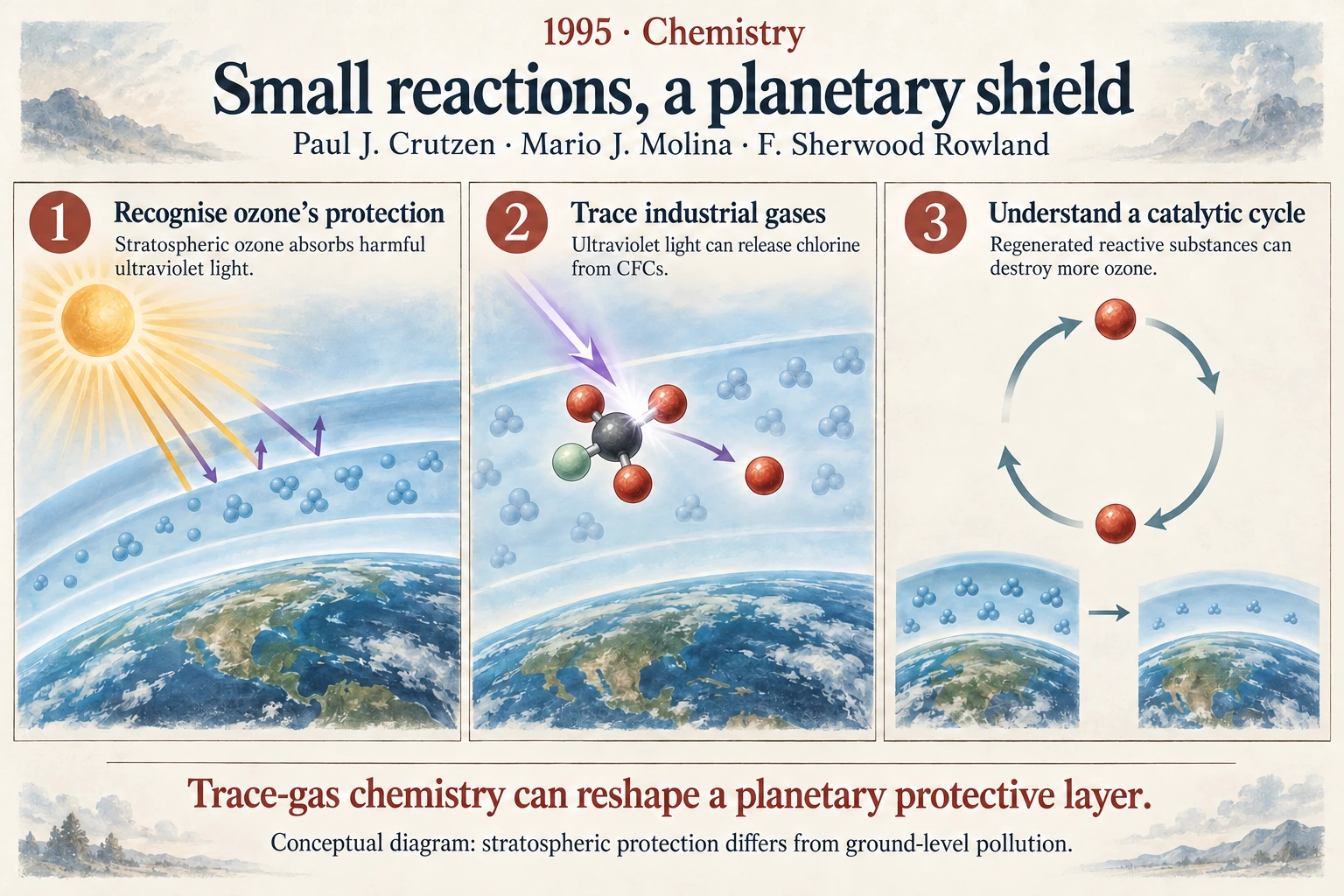
Infographic explaining Small reactions, a planetary shield
Original AI-generated infographic. A conceptual overview; the explanations and sources below provide context.
Read the poster text

Trace-gas chemistry can reshape a planetary protective layer.

  1. Recognise ozone’s protection

    Stratospheric ozone absorbs harmful ultraviolet light.

  2. Trace industrial gases

    Ultraviolet light can release chlorine from CFCs.

  3. Understand a catalytic cycle

    Regenerated reactive substances can destroy more ozone.

Conceptual diagram: stratospheric protection differs from ground-level pollution.

01 · The discovery

The idea, in everyday language

Ozone in the stratosphere absorbs much harmful ultraviolet radiation. Its amount depends on competing reactions that create and destroy it. Crutzen showed in 1970 how nitrogen oxides participate in catalytic ozone destruction: a reactive substance is regenerated and can repeat the process. Understanding these cycles made it possible to ask how small concentrations could have large consequences.

Molina and Rowland then investigated the fate of industrial chlorofluorocarbons. Their 1974 work showed why stability in the lower atmosphere was a problem: CFCs could persist, rise to the stratosphere and be broken apart by ultraviolet light, releasing chlorine that catalytically depleted ozone. Later measurements and research, including Antarctic ozone chemistry, connected molecular mechanisms to an environmental threat and strengthened the scientific basis for international controls.

Why it matters

The work helped transform ozone depletion into a problem that could be explained, measured and addressed through emissions controls. The 1987 Montreal Protocol emerged from international negotiations informed by a wider scientific effort. Long-lived gases and atmospheric transport mean that reducing emissions does not instantly restore the ozone layer.


02 · The people

Who brought the idea to life?

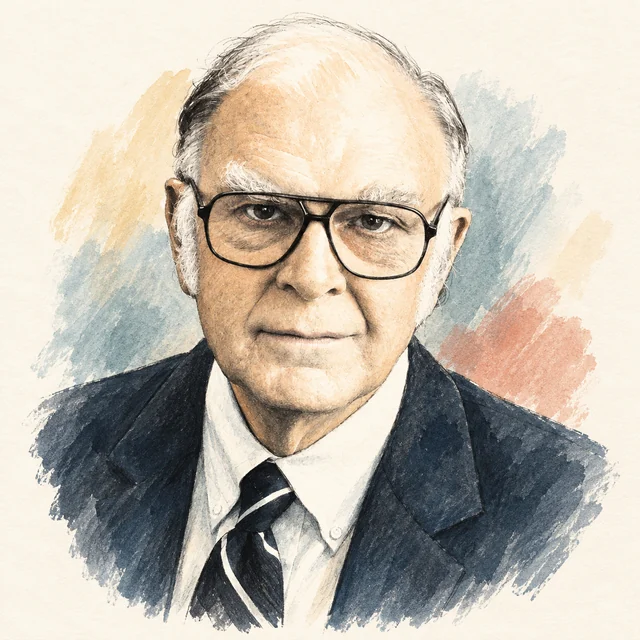
Illustrated portrait of Paul J. Crutzen

Paul J. Crutzen

Prize share · 1/3

In 1970 Crutzen showed how nitrogen oxides can catalytically destroy stratospheric ozone. A catalyst can participate in a reaction and then be regenerated, so a small amount can affect many ozone molecules. This helped explain natural controls on the ozone layer and the possible effects of human emissions. He shared the prize equally with Molina and Rowland, whose related work traced the threat from industrial chlorofluorocarbons.

Read the biography ↗
Illustrated portrait of Mario J. Molina

Mario J. Molina

Prize share · 1/3

Molina and Rowland proposed in 1974 that chlorofluorocarbons could survive in the lower atmosphere, reach the stratosphere and release chlorine under ultraviolet light. Chlorine could then catalytically destroy ozone. Molina also investigated reactions important to polar ozone depletion, including chemistry on icy surfaces. His contribution connected molecular processes to a global environmental risk, rather than treating chemical stability near the ground as proof of safety everywhere.

Read the biography ↗
Illustrated portrait of F. Sherwood Rowland

F. Sherwood Rowland

Prize share · 1/3

With Molina, Rowland developed the 1974 explanation of how CFC-derived chlorine could catalytically deplete stratospheric ozone. He also worked to communicate the implications and argued that the findings required a public response. Laboratory chemistry, atmospheric measurements and subsequent research by many groups strengthened the case for controls. The Nobel recognition concerned the chemical discovery, not a claim that the two researchers alone negotiated the Montreal Protocol.

Read the biography ↗

03 · Years in the making

The path here

  1. 1970

    Crutzen explains catalytic ozone destruction involving nitrogen oxides.

  2. 1974

    Molina and Rowland publish the CFC–chlorine threat to stratospheric ozone.

  3. 1985

    Farman and colleagues report severe Antarctic ozone depletion.

  4. 1987

    The Montreal Protocol establishes international controls on ozone-depleting substances.

  5. 1995

    Crutzen, Molina and Rowland share the Chemistry Prize equally.

04 · Read further

From the original sources

Original explanations by Curionode, based on the official records below. Biographical details and affiliations refer to the award year.

  1. Official announcement nobelprize.org

More in Chemistry

Browse this subject ↗