01 · The discovery
The idea, in everyday language
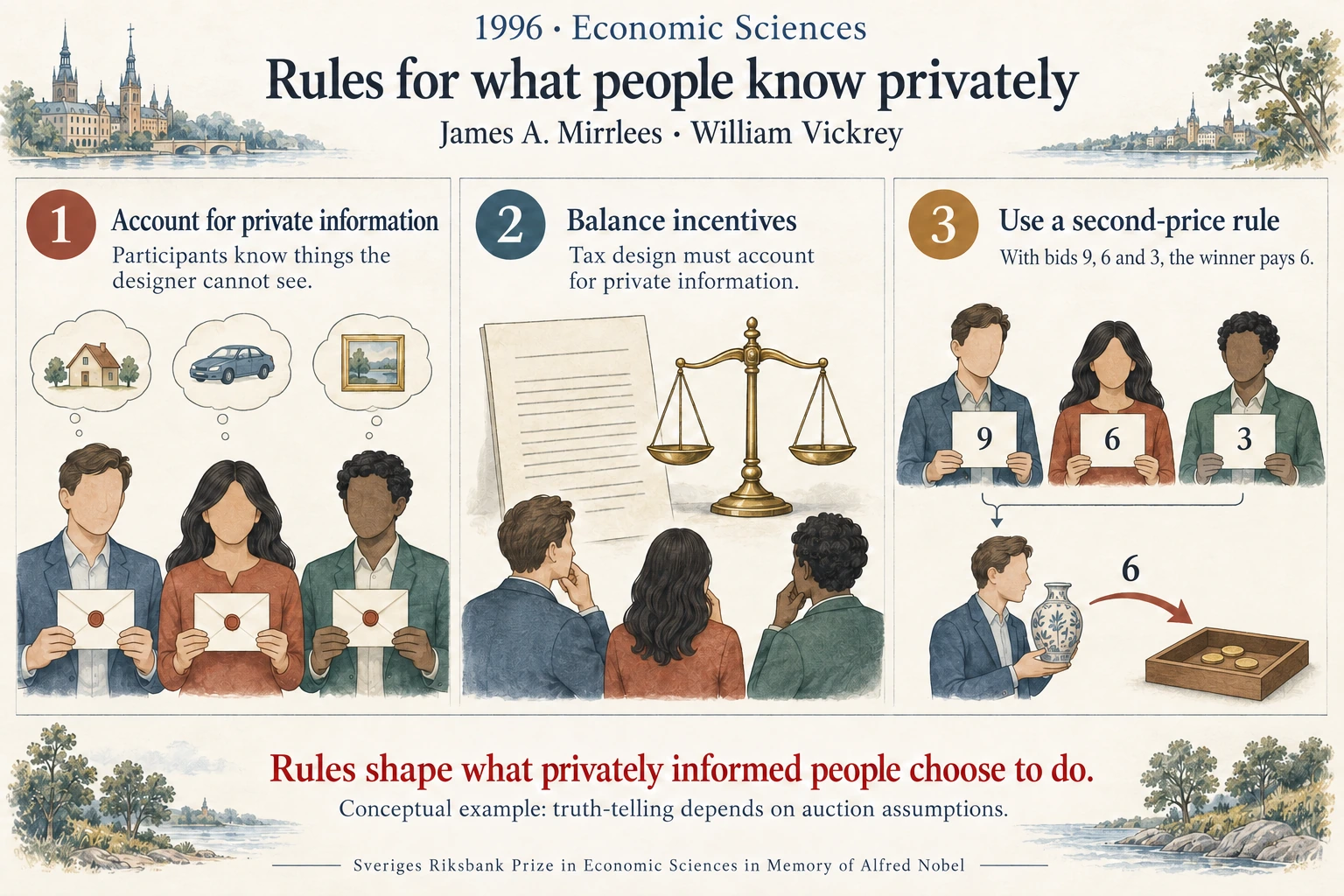
A policymaker or auctioneer rarely knows every participant’s ability, effort or valuation. Simply asking for that information does not guarantee an honest answer, because the rules can make concealment or exaggeration attractive. Mirrlees and Vickrey made these information and incentive constraints central to economic analysis.
Mirrlees developed methods for designing income taxes and contracts when private information or hidden actions shape behaviour. Vickrey analysed how auction rules affect bidding. In a single-item sealed-bid second-price auction, the highest bidder wins and pays the second-highest bid. Under the standard private-value assumptions, truthful bidding is a dominant strategy: raising or lowering a bid cannot improve the result compared with bidding one’s valuation. These are different applications of the same need to design rules around participants’ choices.
Why it matters
The work helped establish the modern analysis of incentives under asymmetric information, with applications to taxation, contracts, insurance and auctions. It clarified why apparently attractive policies can change behaviour in ways a designer must anticipate. A model can expose a tradeoff even when it does not supply one universally best real-world rule.