c.curionodeThe Nobel Archive

2002 · Physiology or Medicine

How cells know when to leave

A transparent worm revealed how genes guide development and regulate the controlled death of particular cells.

developmentC. eleganscell lineageprogrammed cell death
2002Physiology or Medicine

Visual guide

The prize, pictured

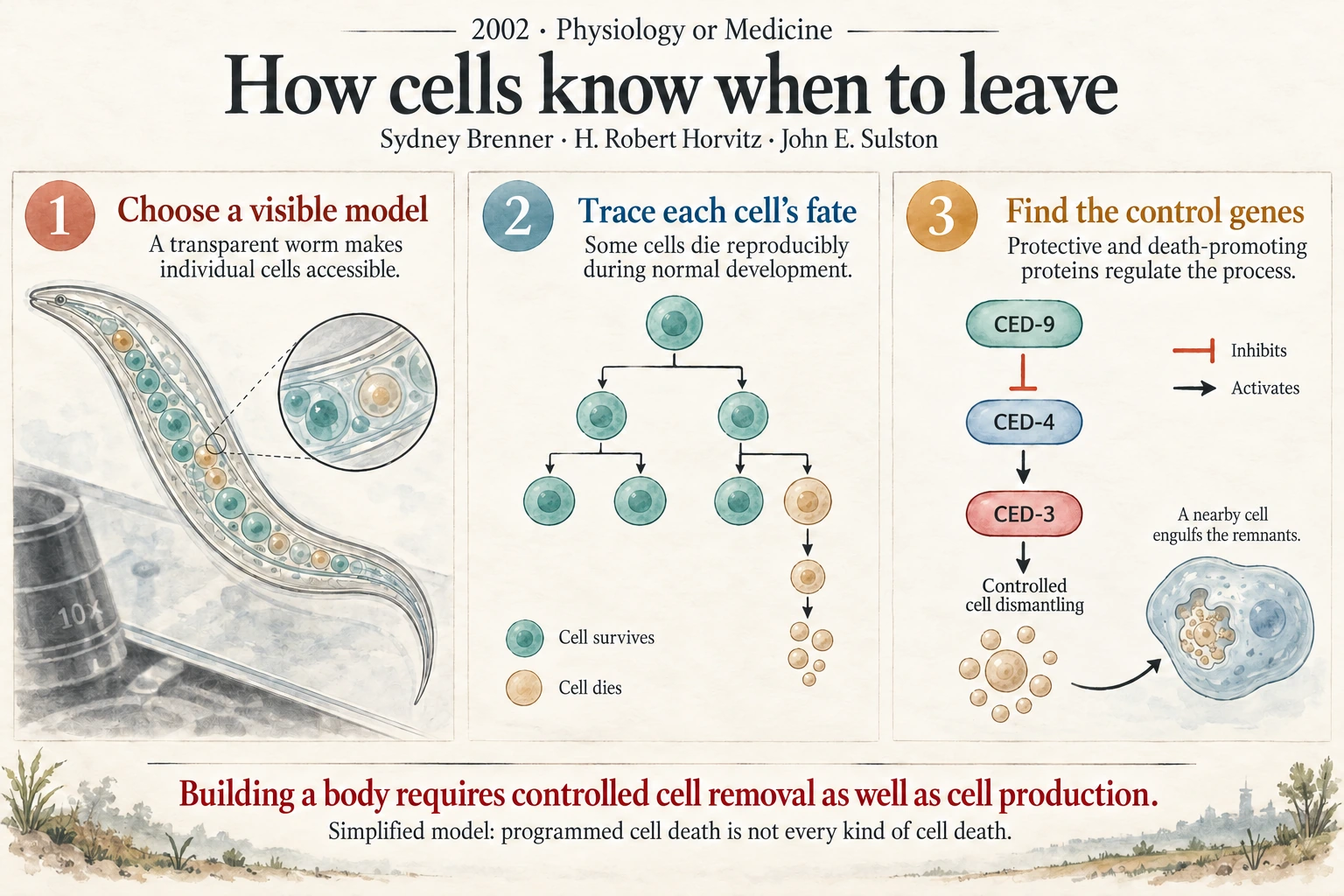
Infographic explaining How cells know when to leave
Original AI-generated infographic. A conceptual overview; the explanations and sources below provide context.
Read the poster text

Building a body requires controlled cell removal as well as cell production.

  1. Choose a visible model

    A transparent worm makes individual cells accessible.

  2. Trace each cell’s fate

    Some cells die reproducibly during normal development.

  3. Find the control genes

    Protective and death-promoting proteins regulate the process.

Simplified model: programmed cell death is not every kind of cell death.

01 · The discovery

The idea, in everyday language

Building an animal involves more than making new cells. Cells divide, become specialised and, in some cases, are deliberately eliminated through a regulated biological process. Brenner established the small roundworm C. elegans as a model in which researchers could alter genes and observe the consequences. Its transparency made individual cells visible under a microscope.

Sulston traced cell lineages and found that particular cells die at reproducible stages of normal development. Horvitz then identified genes that control this programme: some are needed to execute cell death, while others protect cells by restraining the pathway. Finding related machinery in humans showed that the worm could reveal principles extending far beyond one small species.

Why it matters

The work connected genetic experiments with the life histories of individual cells. It established an experimental route to understanding programmed cell death and helped identify conserved molecular pathways. These pathways matter in development and tissue maintenance, and their disruption can contribute to disease. The discoveries provided foundations for later medical research rather than a single treatment for every disorder involving cell loss.


02 · The people

Who brought the idea to life?

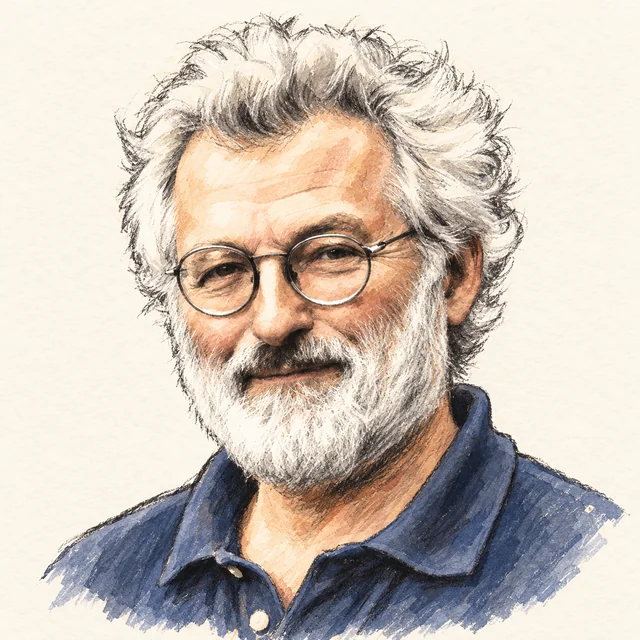
Illustrated portrait of Sydney Brenner

Sydney Brenner

Prize share · 1/3

Brenner established methods for breeding C. elegans, inducing mutations and connecting genetic changes with observable traits. His 1974 work helped turn the worm into a tractable model for studying how genes influence development and behaviour. Because its cells could be followed under a microscope, genetic experiments could be linked with detailed observations of cell division, specialisation and death. This platform enabled Sulston’s lineage studies and Horvitz’s analysis of cell-death genes.

Read the biography ↗
Illustrated portrait of H. Robert Horvitz

H. Robert Horvitz

Prize share · 1/3

Horvitz and his collaborators identified genes needed for the normal cell-death programme. Work reported in 1986 showed that ced-3 and ced-4 are required for many of these deaths; later studies showed that ced-9 protects cells by restraining the pathway. Related genes were found in humans. This established cell death as a regulated biological process and gave researchers molecular tools to investigate what happens when its control is disturbed.

Read the biography ↗
Illustrated portrait of John E. Sulston

John E. Sulston

Prize share · 1/3

Sulston mapped cell lineages and showed that particular cells die reproducibly during normal worm development. His 1976 work described part of the developing nervous system and helped make these deaths experimentally accessible. He also identified mutations affecting the process, including nuc-1, which is needed to degrade DNA from dead cells. Mapping what normally happens made it possible to ask which genes change the pattern, rather than treating cell death as random damage.

Read the biography ↗

03 · Years in the making

The path here

  1. 1974

    Brenner established powerful genetic methods for C. elegans.

  2. 1976

    Sulston described a cell lineage and reproducible developmental cell deaths.

  3. 1986

    Horvitz identified ced-3 and ced-4 as genes required for programmed cell death.

04 · Read further

From the original sources

Original explanations by Curionode, based on the official records below. Biographical details and affiliations refer to the award year.

  1. Official announcement nobelprize.org

More in Physiology or Medicine

Browse this subject ↗