c.curionodeThe Nobel Archive

2007 · Physics

Reading tiny magnets with a metal sandwich

Giant magnetoresistance turns changes in magnetic alignment into a measurable electrical signal.

giant magnetoresistancemagnetic reading headsspintronics
2007Physics

Visual guide

The prize, pictured

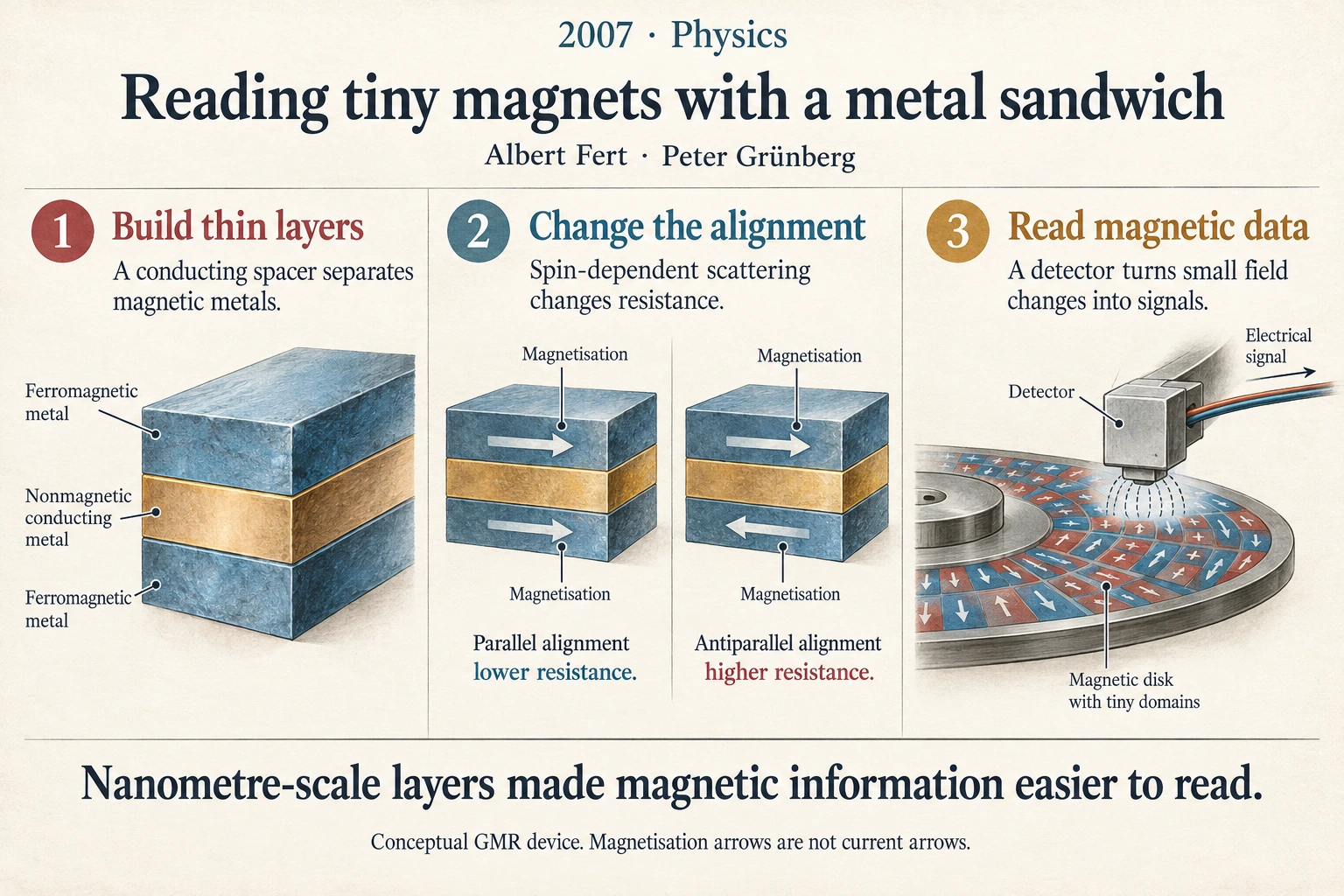
Infographic explaining Reading tiny magnets with a metal sandwich
Original AI-generated infographic. A conceptual overview; the explanations and sources below provide context.
Read the poster text

Nanometre-scale layers made magnetic information easier to read.

  1. Build thin layers

    A conducting spacer separates magnetic metals.

  2. Change the alignment

    Spin-dependent scattering changes resistance.

  3. Read magnetic data

    A detector turns small field changes into signals.

Conceptual GMR device. Magnetisation arrows are not current arrows.

01 · The discovery

The idea, in everyday language

A magnetic hard disk stores information in tiny regions with different magnetic arrangements. Reading smaller regions calls for a detector that can sense small magnetic changes. Fert and Grünberg independently found that a stack of extremely thin magnetic and non-magnetic metal layers could change its electrical resistance far more strongly than familiar magnetoresistive materials.

The key is electron spin and how it affects scattering. In a simple layered example, parallel magnetisations let one spin channel pass relatively easily. With opposite magnetisations, each spin channel encounters stronger scattering in one of the magnetic layers, so the total resistance rises. A magnetic field can change the relative alignment. A circuit then detects a change in resistance, converting magnetic information into an electrical signal.

Why it matters

Commercial GMR reading heads appeared in 1997 after further materials and engineering advances, including work on scalable fabrication. They helped make densely packed magnetic data readable. The discovery also strengthened spintronics, which uses electron spin as well as charge. The historical achievement is a sensitive detector, not the invention of the whole computer or hard disk.


02 · The people

Who brought the idea to life?

Illustrated portrait of Albert Fert

Albert Fert

Prize share · 1/2

In 1988 his group discovered a large change in electrical resistance in alternating layers of iron and chromium when their magnetic arrangement changed. Independently, Peter Grünberg’s group found the same underlying effect in a different layered structure. Fert helped establish giant magnetoresistance as an effect involving electron spin and scattering, opening a route to sensitive magnetic detectors and spintronics.

Read the biography ↗
Illustrated portrait of Peter Grünberg

Peter Grünberg

Prize share · 1/2

His group discovered giant magnetoresistance independently of Albert Fert’s group in 1988, using iron layers separated by chromium. The resistance depended strongly on the relative directions of magnetisation. Grünberg recognised the practical promise and pursued a patent alongside scientific publication. Turning the discovery into commercial reading heads also required later work by other researchers and engineers.

Read the biography ↗

03 · Years in the making

The path here

  1. 1988

    Fert’s and Grünberg’s groups independently discovered giant magnetoresistance.

  2. 1997

    The first commercial GMR hard-disk reading heads appeared after further engineering.

  3. 2007

    The Physics prize recognised the discovery of giant magnetoresistance.

04 · Read further

From the original sources

Original explanations by Curionode, based on the official records below. Biographical details and affiliations refer to the award year.

  1. Official announcement nobelprize.org
  2. Popular science background nobelprize.org