c.curionodeThe Nobel Archive

2014 · Physiology or Medicine

How the brain keeps track of place

Place cells and grid cells connected spatial navigation with patterns of neural activity.

place cellsgrid cellsspatial navigation
2014Physiology or Medicine

Visual guide

The prize, pictured

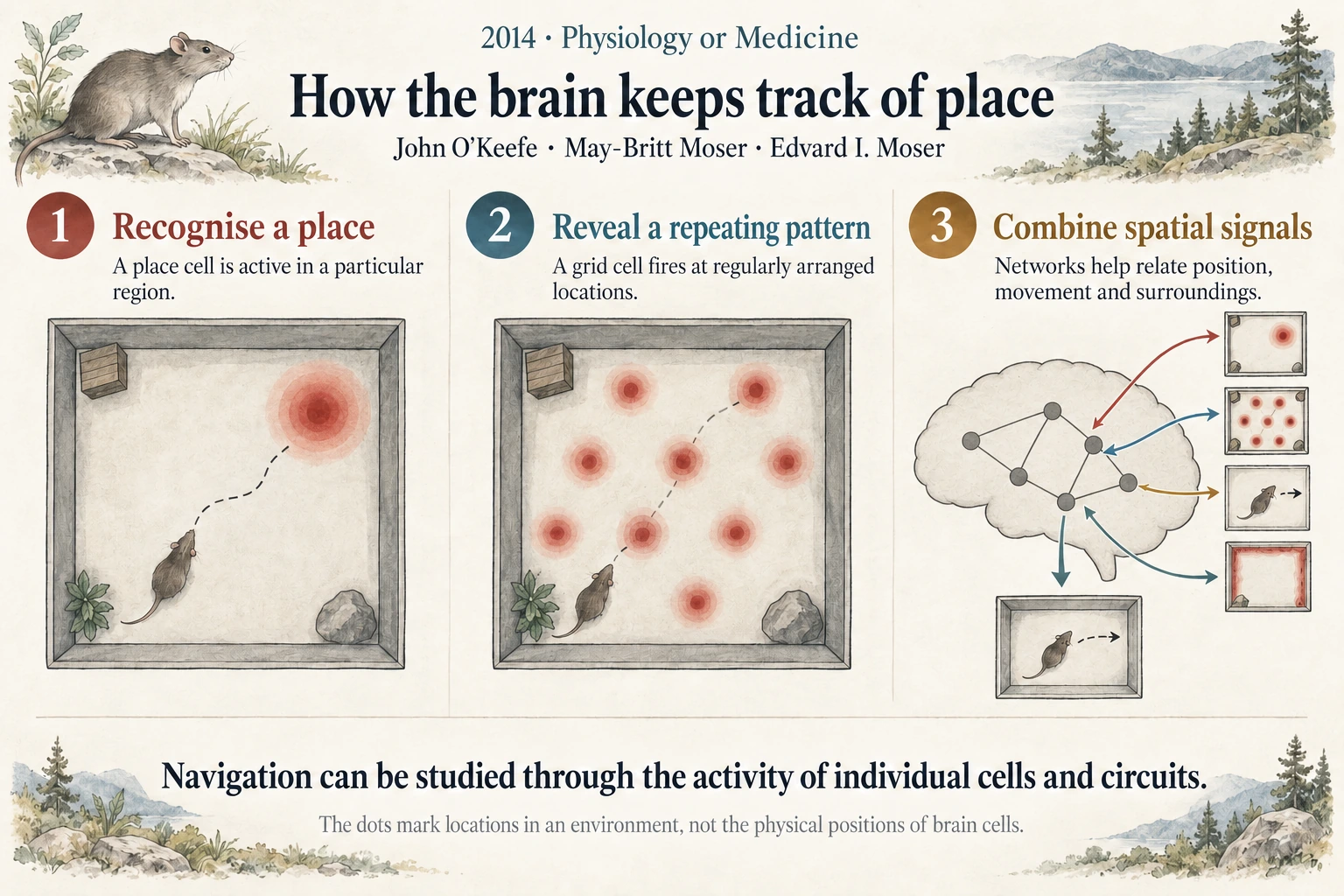
Infographic explaining How the brain keeps track of place
Original AI-generated infographic. A conceptual overview; the explanations and sources below provide context.
Read the poster text

Navigation can be studied through the activity of individual cells and circuits.

  1. Recognise a place

    A place cell is active in a particular region.

  2. Reveal a repeating pattern

    A grid cell fires at regularly arranged locations.

  3. Combine spatial signals

    Networks help relate position, movement and surroundings.

The dots mark locations in an environment, not the physical positions of brain cells.

01 · The discovery

The idea, in everyday language

Finding a familiar doorway requires more than recognising an image. An animal must relate where it is to places it has visited and to its own movement. O’Keefe recorded neurons in the hippocampus of freely moving rats. In 1971, he and Jonathan Dostrovsky reported cells whose activity depended on the animal’s location. One place cell could be especially active in one part of an environment, while others responded in different regions.

In 2005, May-Britt and Edvard Moser’s group found a different pattern in the nearby entorhinal cortex. A single grid cell became active at multiple locations, forming a repeating arrangement with approximately hexagonal symmetry. Different cells had different spatial patterns. Together with signals about head direction, boundaries and movement, these findings helped reveal a network for representing space. The grid is a map of firing locations in the environment, not the physical arrangement of cells in the brain.

Why it matters

The discoveries made an abstract question about knowing where we are accessible to experiments on particular neurons and circuits. They connected navigation with memory and opened ways to study how several kinds of information are combined. Related spatial signals have also been investigated in humans, linking animal experiments with broader questions about cognition.
02 · The people

Who brought the idea to life?

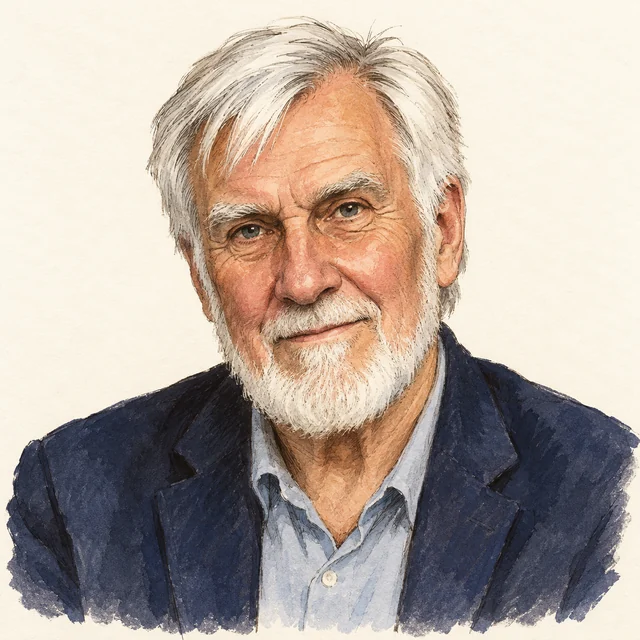
Illustrated portrait of John O’Keefe

John O’Keefe

Prize share · 1/2

In 1971, O’Keefe and his collaborator Jonathan Dostrovsky reported hippocampal neurons that fired in relation to where a rat was. Different place cells could be active in different parts of an environment. The finding supplied a cellular basis for investigating an internal representation of space and its relation to memory.

Read the biography ↗
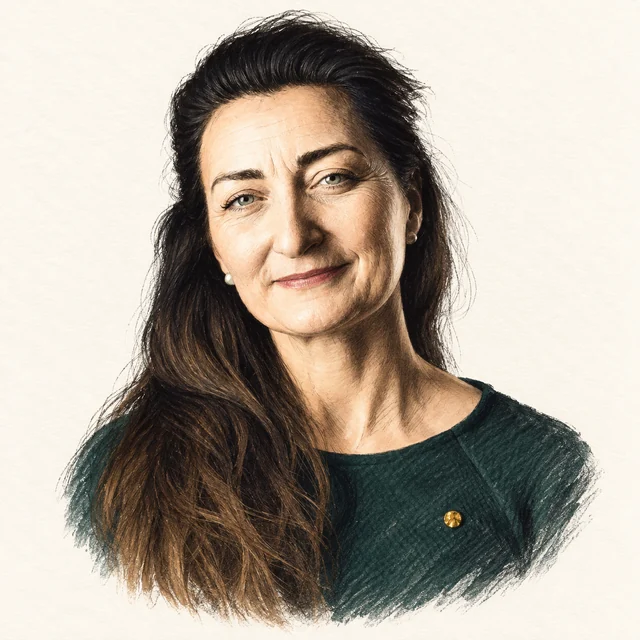
Illustrated portrait of May-Britt Moser

May-Britt Moser

Prize share · 1/4

In 2005, she and Edvard Moser’s team identified grid cells in the entorhinal cortex. One cell fired at multiple locations forming a repeating, approximately hexagonal pattern as a rat explored. The pattern describes locations in the animal’s environment, not a grid of neurons physically arranged inside the brain.

Read the biography ↗
Illustrated portrait of Edvard I. Moser

Edvard I. Moser

Prize share · 1/4

He shared in the discovery of entorhinal grid cells in 2005 and in subsequent research on the relationship between these cells and other navigation signals. Repeating spatial firing patterns, together with information about position, direction and boundaries, helped reveal a distributed neural system rather than a single brain cell acting as a complete map.

Read the biography ↗

03 · Years in the making

The path here

  1. 1971

    O’Keefe and Dostrovsky report location-related activity in hippocampal neurons.

  2. 2005

    The Moser group discovers grid-cell firing patterns in the entorhinal cortex.

  3. 2014

    The prize recognises cells contributing to the brain’s positioning system.

04 · Read further

From the original sources

Original explanations by Curionode, based on the official records below. Biographical details and affiliations refer to the award year.

  1. Official award announcement nobelprize.org
  2. Scientific background nobelprize.org

More in Physiology or Medicine

Browse this subject ↗