01 · The discovery
The idea, in everyday language
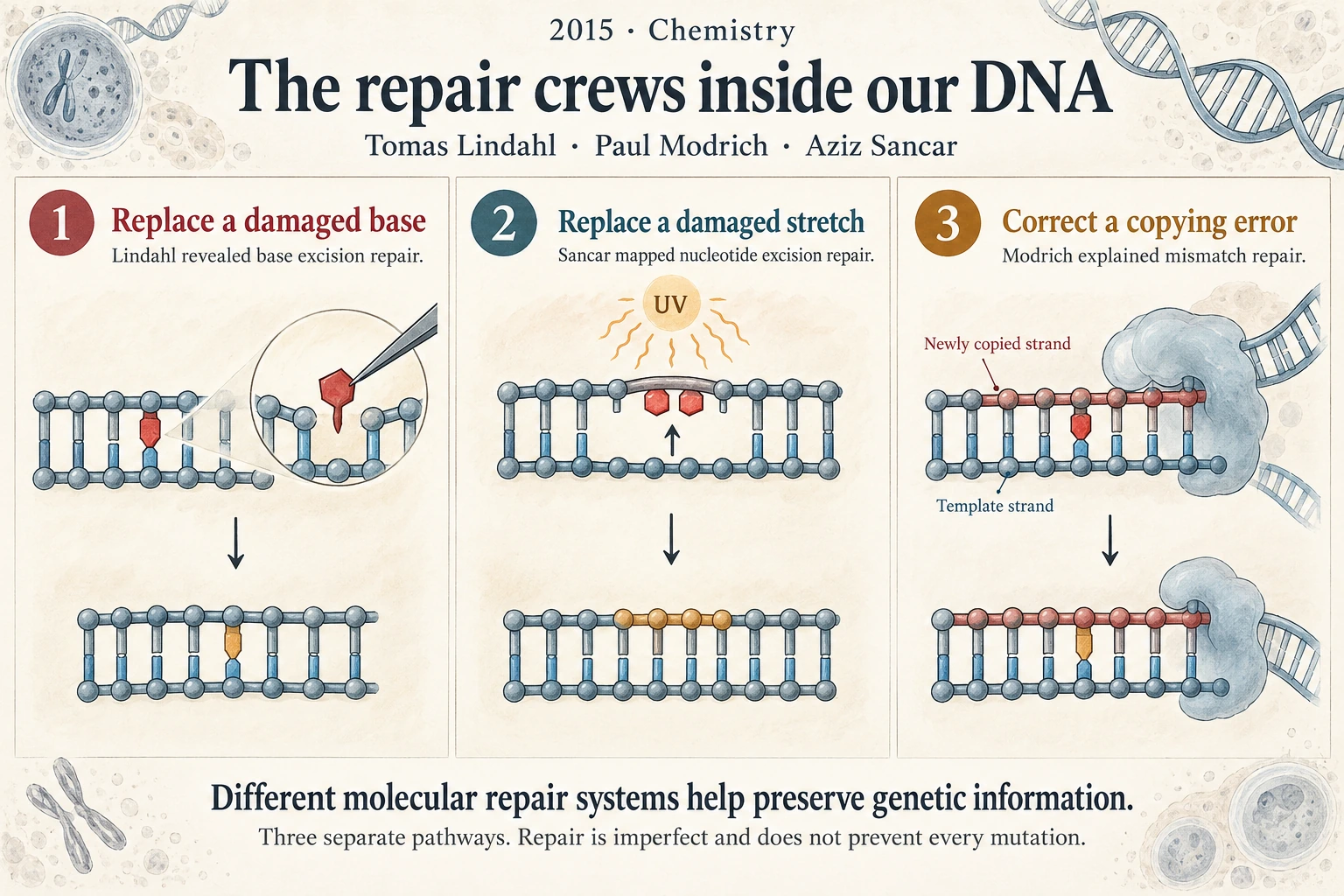
DNA stores information, but it is not chemically indestructible. Bases can change spontaneously, ultraviolet light can damage neighbouring bases, and copying can leave a wrong pairing. Lindahl showed why active maintenance is necessary and helped uncover base excision repair. An enzyme first removes a faulty base; other enzymes process the remaining site, replace the missing information and seal the strand.
The other laureates mapped different problems and solutions. Sancar investigated nucleotide excision repair, which cuts out a short stretch containing bulky damage and rebuilds it using the opposite strand as a guide. Modrich worked out how mismatch repair corrects copying errors. It identifies a mismatch, removes a section of the newly made strand, and makes a corrected replacement. These are distinct pathways, not three consecutive stages of one universal repair operation.
Why it matters
The work connected the chemistry of DNA with the long-term stability of genomes. It helped explain why inherited defects in particular repair systems can increase cancer risk and supplied a foundation for studying how cancer cells respond to treatments that damage DNA or interfere with repair.