01 · The discovery
The idea, in everyday language
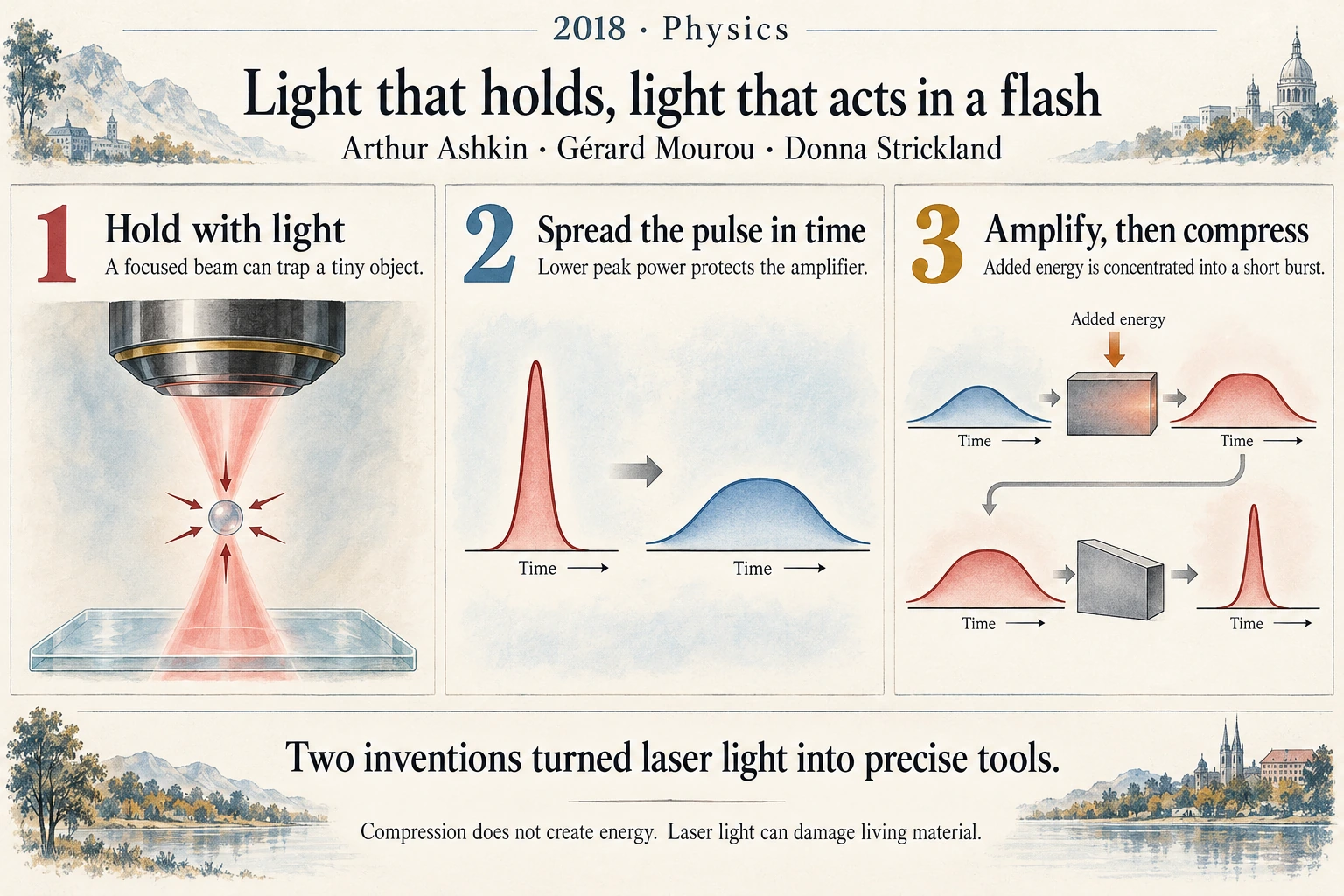
Light carries momentum, so it can exert a force when its direction changes. Arthur Ashkin found that a tightly focused laser could hold a tiny transparent object near its focus. The object is pulled towards the region of stronger light while other light forces push along the beam; a suitable arrangement creates a stable trap. These optical tweezers let researchers manipulate small objects and measure very small forces. Biological use requires appropriate wavelengths and powers: a laser that traps an object can also damage it.
A different problem faced Gérard Mourou and Donna Strickland. Amplifying an already short pulse could produce such high peak power that it destroyed the amplifier. Their solution was to stretch the pulse in time, add energy while its peak power was lower, then compress it again. Called chirped pulse amplification, or CPA, the method produces a short, intense burst. The amplifier supplies the extra energy; compression concentrates that energy into a shorter time rather than creating energy from nothing.
Why it matters
Optical traps made the motions and forces of biological machinery accessible to experiment, often through a small attached bead. CPA opened a route to powerful ultrafast lasers used to study rapid events and process materials precisely. Both contributions turn light into an instrument, but they are distinct inventions with different purposes.