01 · The discovery
The idea, in everyday language
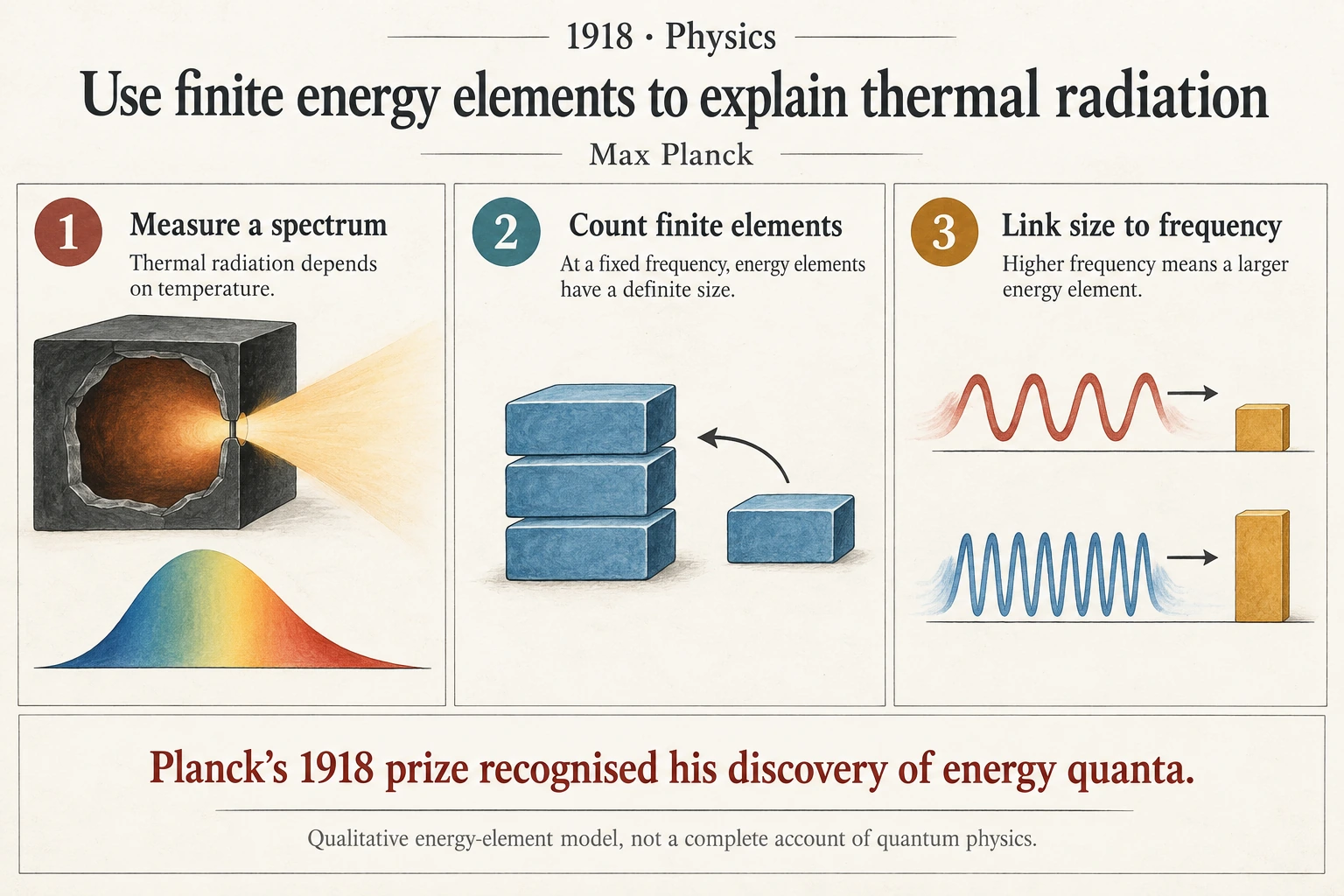
A body in thermal equilibrium emits radiation across a spectrum. An ideal black body absorbs all radiation that falls on it; its equilibrium spectrum depends on temperature rather than the material. Researchers needed a law that agreed with measurements across the full range, not only one part of it. New measurements in 1900 showed that Wien’s law did not provide that complete description.
Planck found a new radiation law and sought a theoretical derivation. In his counting argument, energy elements could not be made indefinitely small: their size had to remain the product of frequency and a universal constant, now called Planck’s constant. At a fixed frequency, the model uses finite portions rather than arbitrary continuously adjustable elements. The full implications took years to develop. The reserved 1918 Physics Prize was announced on 13 November 1919 and presented on 1 June 1920.
Why it matters
The radiation law connected theory with demanding thermal measurements, while the constant and the finite energy elements became central to a wider transformation of physics. Later work by Einstein and other researchers developed the meaning of quantisation. Planck’s achievement was a decisive beginning rather than a complete theory of every microscopic system.