01 · The discovery
The idea, in everyday language
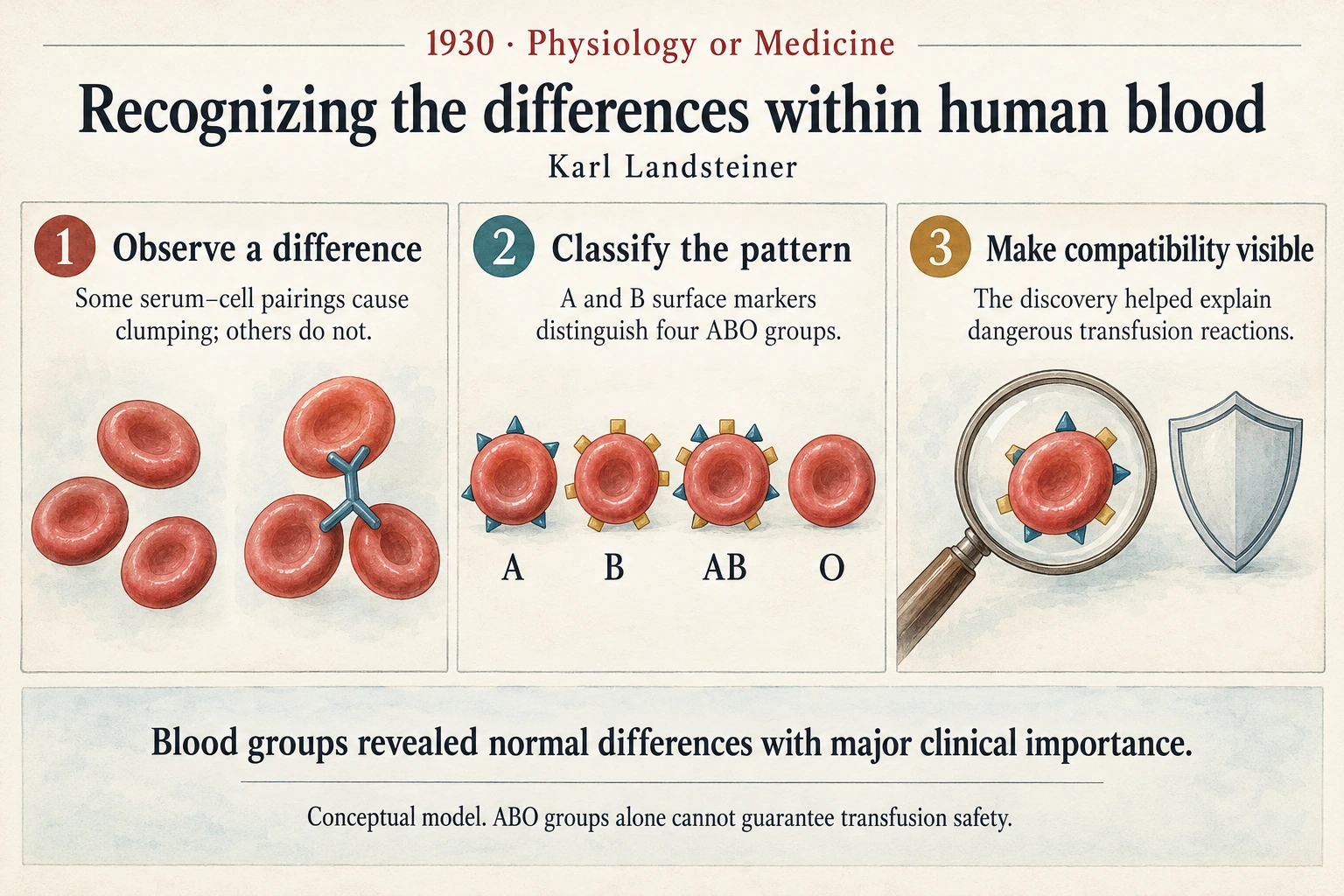
Healthy people’s blood can look alike while behaving differently in immune reactions. Landsteiner observed that some combinations of serum and red cells clumped, while others did not. In 1901 he distinguished three groups. Alfred von Decastello and Adriano Sturli identified the fourth group, AB, in 1902. This was a discovery of normal variation, not a division between healthy and diseased blood.
In the ABO system, red cells may carry A markers, B markers, both or neither. Antibodies that recognize incompatible markers can bind to red cells and contribute to clumping and destruction. The classification connected repeatable reaction patterns with differences on the cells. It became fundamental to understanding compatibility, while later research revealed further blood-group systems and additional complications.
Why it matters
The discovery gave transfusion medicine an essential biological foundation and helped establish immunological specificity as a subject of systematic study. Putting the finding to clinical use also required testing, practical methods and contributions by many other researchers and clinicians.