01 · The discovery
The idea, in everyday language
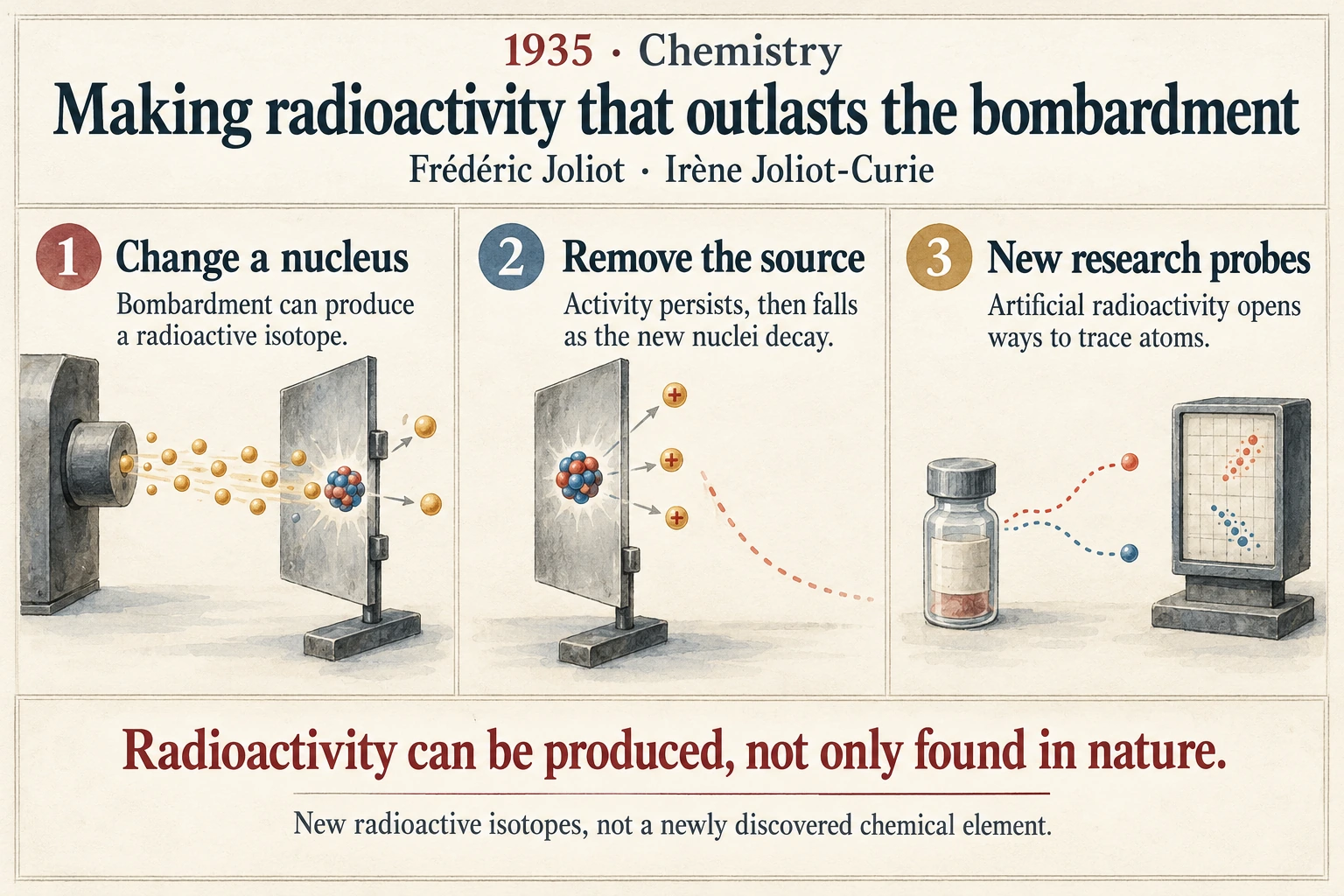
Radioactivity had been encountered in naturally occurring substances, while earlier bombardment experiments had already transformed some nuclei. The new question was whether an experiment could produce a substance that would itself remain radioactive. In 1934 the Joliot-Curies found that aluminium exposed to alpha particles continued to emit positrons after the source was removed. The activity then declined with time, as radioactive decay would predict. Related observations were made with boron and magnesium.
Chemical tests were crucial: the activity from irradiated aluminium followed a phosphorus product. The bombardment had created a radioactive isotope of phosphorus, whose nucleus subsequently decayed. Phosphorus was already a known chemical element; the novelty was an artificially produced radioactive form. The 1935 Chemistry Prize recognised this shared discovery in equal halves. It connected experimental nuclear transformation with chemical identification, and opened a route to new radioactive tracers.
Why it matters
Artificial radioactivity widened the range of isotopes available for research. Radiation can make a small amount of labelled material detectable, allowing atoms to be followed through a process. The 1935 ceremony discussed possible future physiological and medical uses; that prospect should be separated from later applications and from the original experiment.