c.curionodeThe Nobel Archive

1957 · Physics

When a mirror assumption meets an experiment

Lee and Yang questioned parity conservation in weak interactions and proposed tests that experiments showed it could fail.

ParityWeak interactionsTheory and experiment
1957Physics

Visual guide

The prize, pictured

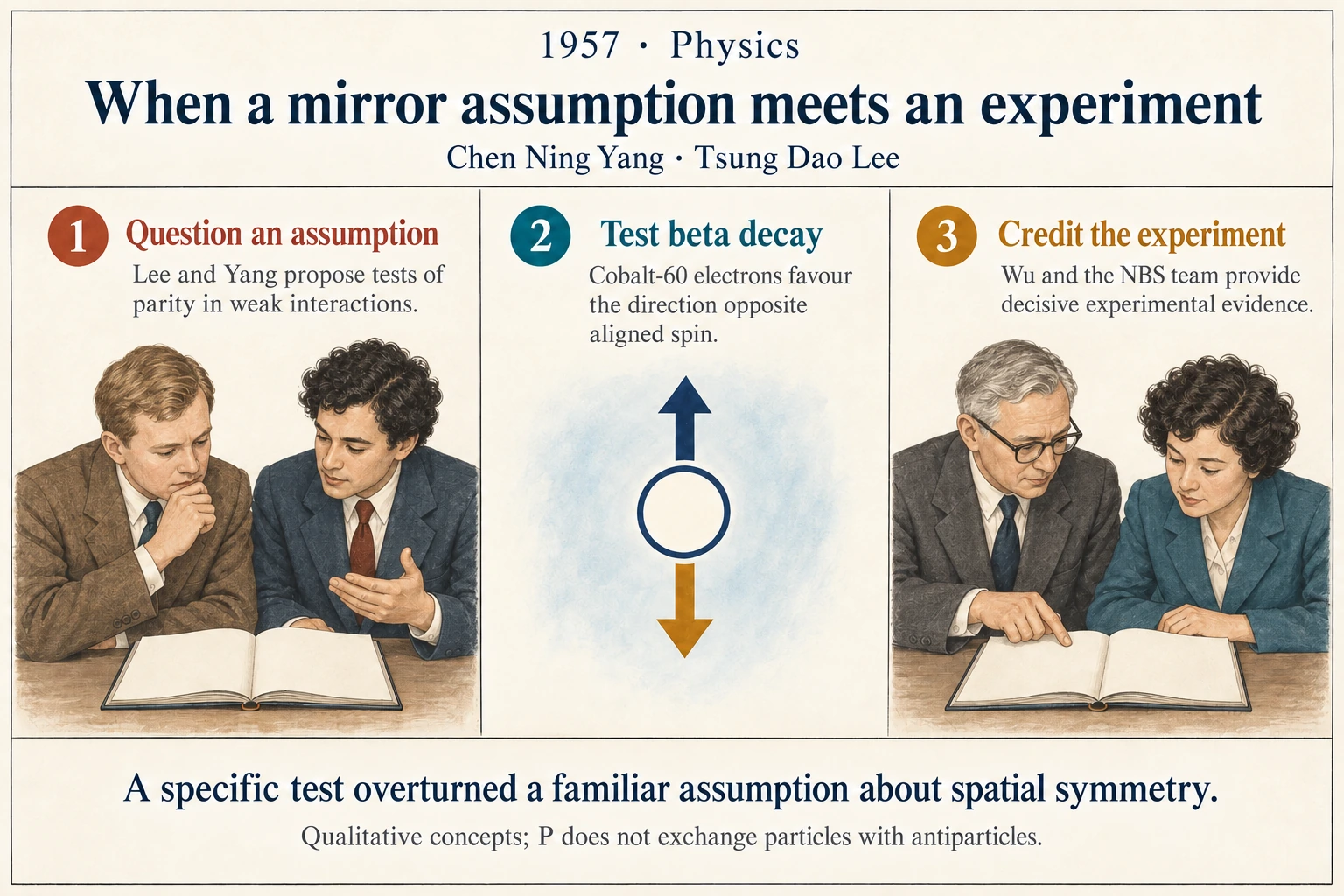
Infographic explaining When a mirror assumption meets an experiment
Original AI-generated infographic. A conceptual overview; the explanations and sources below provide context.
Read the poster text

A specific test overturned a familiar assumption about spatial symmetry.

  1. Question an assumption

    Lee and Yang propose tests of parity in weak interactions.

  2. Test beta decay

    Cobalt-60 electrons favour the direction opposite aligned spin.

  3. Credit the experiment

    Wu and the NBS team provide decisive experimental evidence.

Qualitative concepts; P does not exchange particles with antiparticles.

01 · The discovery

The idea, in everyday language

Physicists widely assumed that reflecting the spatial arrangement of a process would leave the underlying laws unchanged. This parity symmetry was well supported in other domains, but Lee and Yang’s 1956 review found no decisive evidence establishing it for weak interactions, such as beta decay. An accepted assumption needed a specific experimental test.

Their proposals helped prompt Wu’s experiment with Ernest Ambler, Raymond W. Hayward, Dale D. Hoppes and Ralph P. Hudson at the National Bureau of Standards. Electrons from cobalt-60 decay favoured the direction opposite the aligned nuclear spin. The asymmetry relative to spin could distinguish the process from its parity-reversed counterpart. Successful runs began in December 1956; the five-author report appeared in February 1957. Other experiments confirmed the failure of parity conservation in weak interactions.

Why it matters

The result changed an assumption about fundamental symmetry and helped redirect particle physics. Lee and Yang shared the 1957 prize equally for their theoretical investigation. The experiment’s five researchers made the test possible and are credited here, while the award’s two recipient entries remain distinct from the experimental team.
02 · The people

Who brought the idea to life?

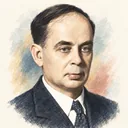
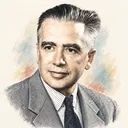
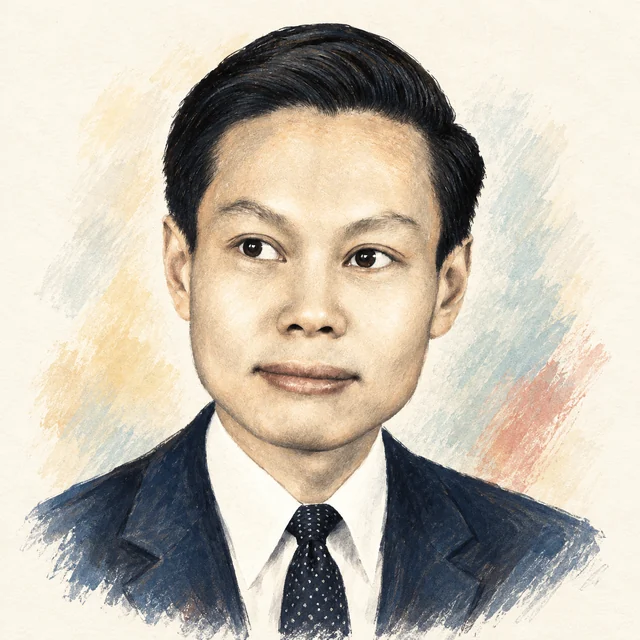
Illustrated portrait of Chen Ning Yang

Chen Ning Yang

Prize share · 1/2

Yang and Lee critically examined parity conservation in weak interactions and proposed decisive tests. Yang received one half of the Physics Prize.

Read the biography ↗
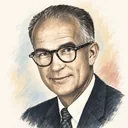
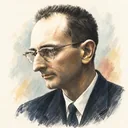
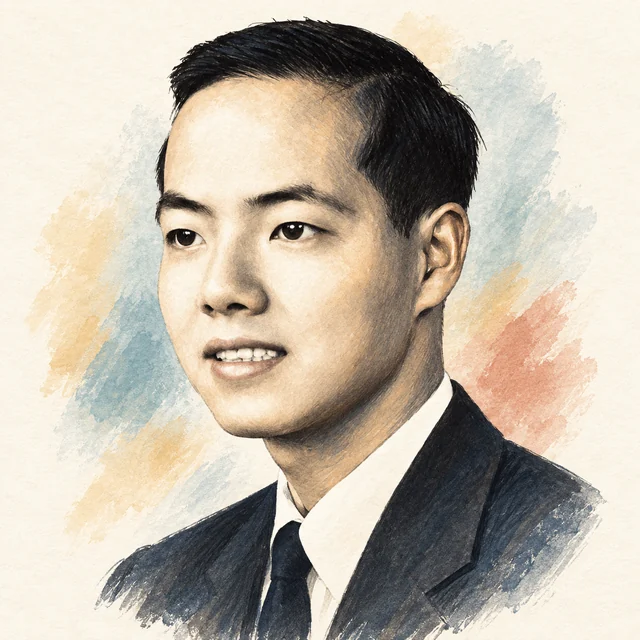
Illustrated portrait of Tsung Dao Lee

Tsung Dao Lee

Prize share · 1/2

Lee and Yang exposed the untested parity assumption in weak interactions and formulated experimental tests. Lee received one half of the Physics Prize.

Read the biography ↗

03 · Years in the making

The path here

  1. 1942–1944

    Yang completes degrees at Southwest Associated University and Tsinghua in wartime Kunming.

  2. 1948

    Yang completes his Chicago doctorate under Teller.

  3. 1950

    Lee completes his Chicago doctorate under Fermi.

  4. 1953

    Lee joins Columbia.

  5. 1955

    Yang becomes professor at the Institute for Advanced Study.

  6. 1956

    Lee becomes full professor; Lee and Yang publish their examination of parity conservation.

  7. December 1956

    Wu and the NBS team obtain successful cobalt-60 results.

  8. February 1957

    Wu, Ambler, Hayward, Hoppes and Hudson publish their experimental report.

  9. 1957

    Yang and Lee each receive one half of the Physics Prize.

04 · Read further

From the original sources

Original explanations by Curionode, based on the official records below. Biographical details and affiliations refer to the award year.

  1. Official award summary nobelprize.org
  2. Award ceremony speech nobelprize.org
  3. Lee–Yang original parity paper journals.aps.org
  4. Wu team original parity experiment journals.aps.org
  5. NIST parity experiment history nist.gov
  6. Official biography: Chen Ning Yang nobelprize.org
  7. Official biography: Tsung Dao Lee nobelprize.org