01 · The discovery
The idea, in everyday language
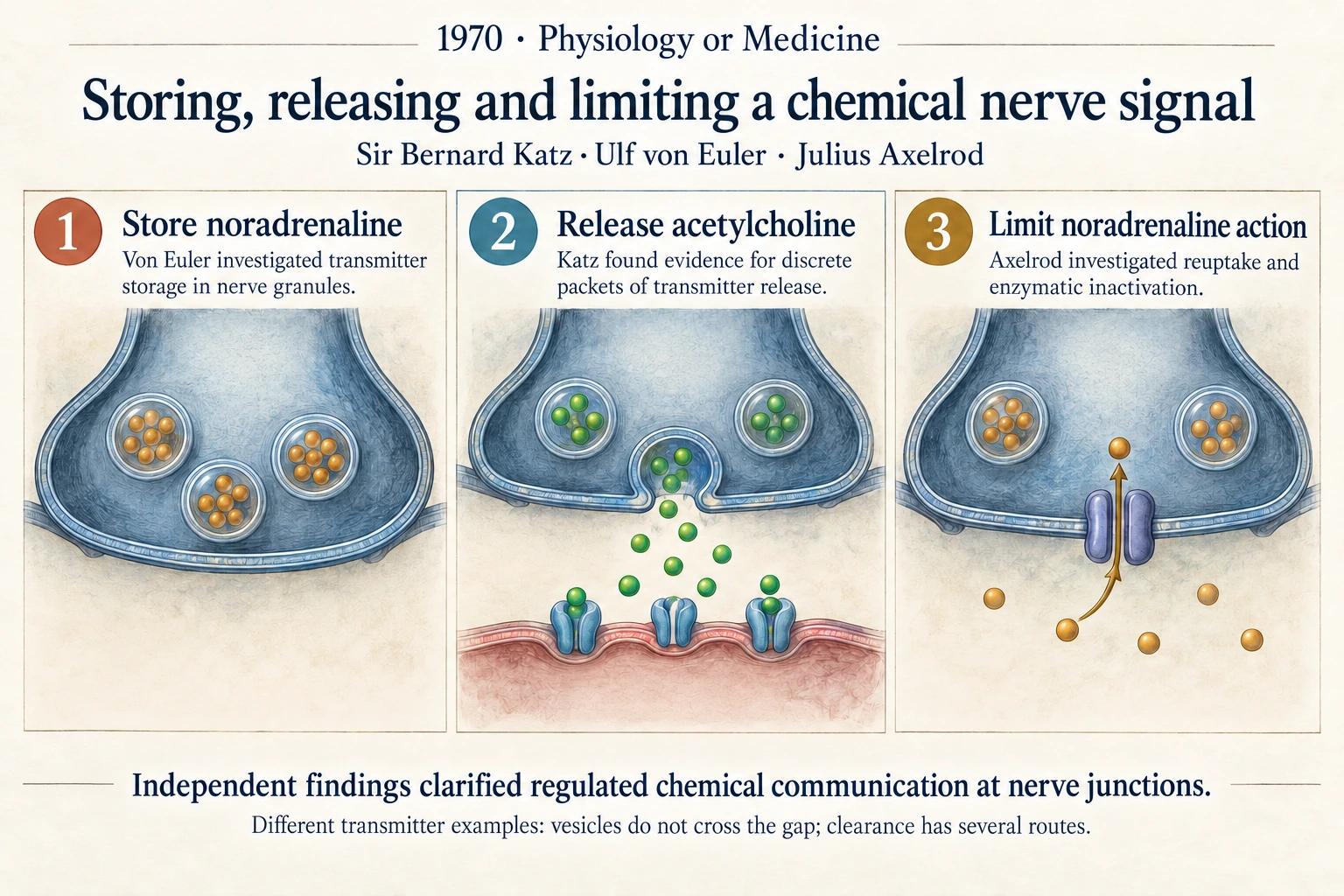
Von Euler identified noradrenaline as the transmitter of adrenergic nerves and, with colleagues including Hillarp, investigated its storage in small nerve granules. Katz studied a different transmitter, acetylcholine, at the nerve–muscle junction. Small electrical responses supported the idea that release occurs in discrete quanta containing many molecules.
Axelrod examined noradrenaline after release, investigating enzymatic inactivation and especially reuptake into nerve terminals. This helped explain how a signal could be limited and transmitter recovered. The laureates worked independently; their findings concerned complementary questions, rather than a single experiment using one substance.
Why it matters
The work strengthened neurophysiology and neuropharmacology by connecting nerve activity with regulated chemical transmission. It helped researchers ask how drugs could affect storage, release or transmitter clearance, without reducing the whole nervous system to one chemical.