c.curionodeThe Nobel Archive

1976 · Physics

Two experiments reveal a new particle

A sharp experimental signal appeared in two different settings in 1974. Richter’s electron–positron collisions and Ting’s proton-target experiment independently revealed the particle now called J/psi.

Particle discoveryIndependent evidenceCharm
1976Physics

Visual guide

The prize, pictured

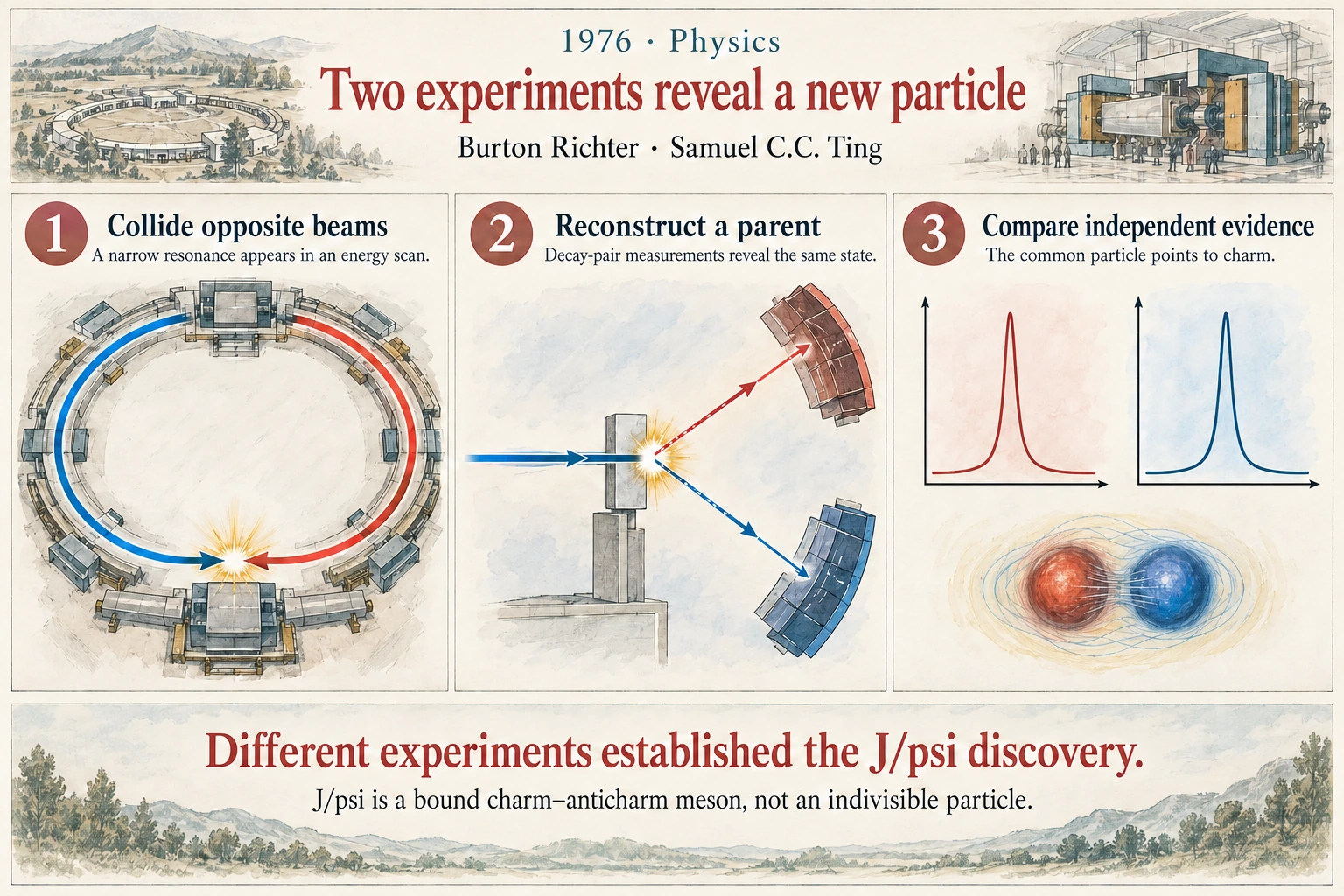
Infographic explaining Two experiments reveal a new particle
Original AI-generated infographic. A conceptual overview; the explanations and sources below provide context.
Read the poster text

Different experiments established the J/psi discovery.

  1. Collide opposite beams

    A narrow resonance appears in an energy scan.

  2. Reconstruct a parent

    Decay-pair measurements reveal the same state.

  3. Compare independent evidence

    The common particle points to charm.

J/psi is a bound charm–anticharm meson, not an indivisible particle.

01 · The discovery

The idea, in everyday language

At SLAC, Richter’s collaboration varied the energy of electrons and positrons colliding in the SPEAR storage ring. At a particular energy, particle production rose sharply: a narrow resonance signalled an unexpectedly long-lived state. At Brookhaven, Ting’s team directed protons into a stationary beryllium target and selected rare electron–positron pairs from a large background. Their measured energies and momenta allowed the team to infer the mass of a parent particle. These were independent experiments with different methods, not two stages of one apparatus.

The two teams compared their findings and announced the discovery on 11 November 1974. What Richter called psi and Ting called J were the same state. Its properties helped establish the charm quark and changed the interpretation of particle families. In modern language, J/psi is a meson containing a charm quark and its antiquark, bound by the strong interaction. The older prize motivation’s description as an elementary particle belongs to the historical vocabulary of the announcement. Detecting a composite state supplied evidence about its constituents; the experiments did not photograph isolated charm quarks.

Why it matters

The discovery opened a new programme of studying charmonium and strengthened the quark account of matter. It illustrates why sharply resolved measurements and independent experimental approaches can change a theoretical picture. The 1976 prize gave equal shares to Richter and Ting, recognising their collaborations’ pioneering discoveries.

02 · The people

Who brought the idea to life?

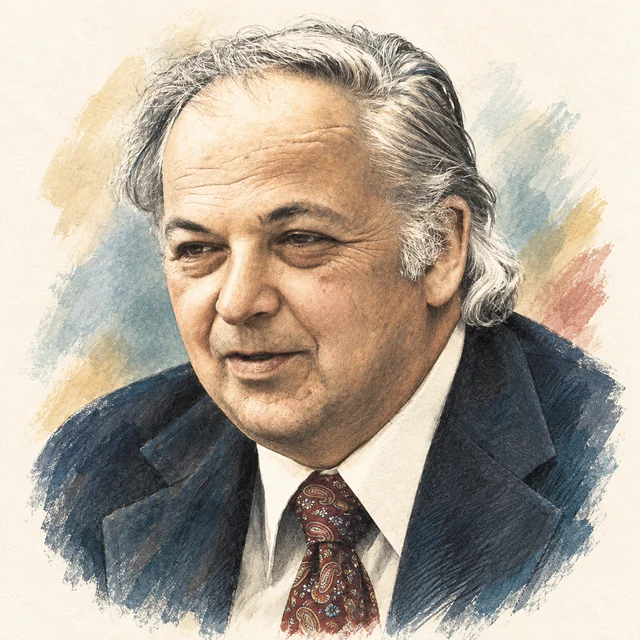
Illustrated portrait of Burton Richter

Burton Richter

Prize share · 1/2

Richter’s SLAC/Berkeley collaboration found the psi resonance in electron–positron collisions at SPEAR. He shared the Physics Prize equally with Ting, whose different experiment independently found the same charm–anticharm bound particle.

Read the biography ↗
Illustrated portrait of Samuel C.C. Ting

Samuel C.C. Ting

Prize share · 1/2

Ting’s group used a proton beam and a fixed beryllium target at Brookhaven, inferring the J particle from its decay products. He received half the Physics Prize alongside Richter for independent discoveries of J/psi.

Read the biography ↗

03 · Years in the making

The path here

  1. 1963

    Richter moves to SLAC and develops plans for a high-energy electron–positron ring.

  2. 1969

    Ting joins MIT after precision experiments in Europe and the United States.

  3. 1971

    Ting begins the Brookhaven search for heavier particles.

  4. 1974

    The teams independently discover J and psi and announce the common state on 11 November.

  5. 1976

    Richter and Ting share the Physics Prize equally.

04 · Read further

From the original sources

Original explanations by Curionode, based on the official records below. Biographical details and affiliations refer to the award year.

  1. Official announcement nobelprize.org
  2. Brookhaven: independent J discovery bnl.gov
  3. SLAC: the two 1974 discoveries www6.slac.stanford.edu