c.curionodeThe Nobel Archive

1983 · Physiology or Medicine

A genome whose parts can move

McClintock read maize chromosomes and kernel patterns together. Her experiments revealed mobile genetic elements that can change gene activity.

Mobile DNAAc/DsMaize genetics
1983Physiology or Medicine

Visual guide

The prize, pictured

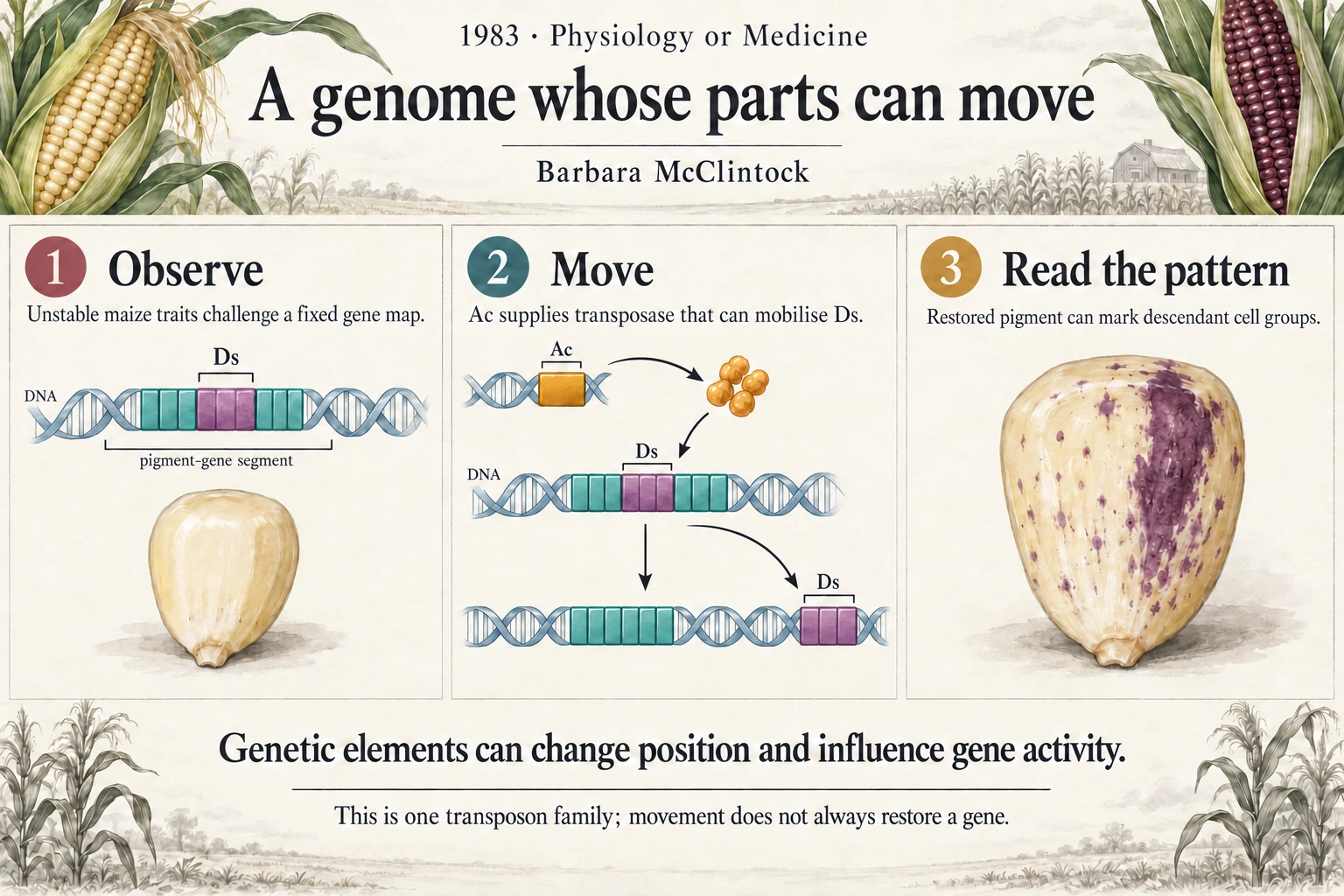
Infographic explaining A genome whose parts can move
Original AI-generated infographic. A conceptual overview; the explanations and sources below provide context.
Read the poster text

Genetic elements can change position and influence gene activity.

  1. Observe

    Unstable maize traits challenge a fixed gene map.

  2. Move

    Ac supplies transposase that can mobilise Ds.

  3. Read the pattern

    Restored pigment can mark descendant cell groups.

This is one transposon family; movement does not always restore a gene.

01 · The discovery

The idea, in everyday language

Classical maps located inherited traits along chromosomes, but some maize traits behaved unstably. McClintock combined breeding, microscope observations and the timing of coloured sectors to explain elements that change position. In a pigmentation example, insertion of Ds into a gene can disrupt its function. Excision in a developing cell can restore pigment, and descendants of that cell form a coloured patch.

Her Ac/Ds system has an important dependency. Later molecular research established that autonomous Ac encodes transposase, which can mobilise Ac and nonautonomous Ds. Ds does not supply a functional transposase of its own. If pigment function is restored, an early event can yield a larger sector than a late event because more descendant cells inherit the change. The patterns are clues to developmental history, not just decoration.

Why it matters

Mobile elements made the genome a more dynamic subject: changes in position can affect expression, mutations and genome organisation. Her finding emerged from basic plant genetics and matters across biology. It does not by itself establish a treatment or imply that every human disease is caused by transposition.


02 · The people

Who brought the idea to life?

Illustrated portrait of Barbara McClintock

Barbara McClintock

Prize share · 1

McClintock discovered that genetic elements can change position and affect gene activity. The Ac/Ds system explained unstable pigmentation patterns in maize by combining chromosome observations with inheritance experiments. Later molecular work clarified the transposase mechanism. Her findings changed the picture of a genome as a fixed arrangement of genes; they did not show that every gene moves or that every movement has the same effect.

Read the biography ↗

03 · Years in the making

The path here

  1. 1927

    McClintock completes her Cornell doctorate in chromosome research.

  2. 1942

    She joins the Carnegie research staff at Cold Spring Harbor.

  3. 1983

    The full Medicine Prize recognises mobile genetic elements.

04 · Read further

From the original sources

Original explanations by Curionode, based on the official records below. Biographical details and affiliations refer to the award year.

  1. Official announcement nobelprize.org
  2. Cold Spring Harbor: mobile DNA dnalc.cshl.edu
  3. Cold Spring Harbor: McClintock biography dnalc.cshl.edu
  4. Molecular research on maize Ac/Ds pmc.ncbi.nlm.nih.gov

More in Physiology or Medicine

Browse this subject ↗