01 · The discovery
The idea, in everyday language
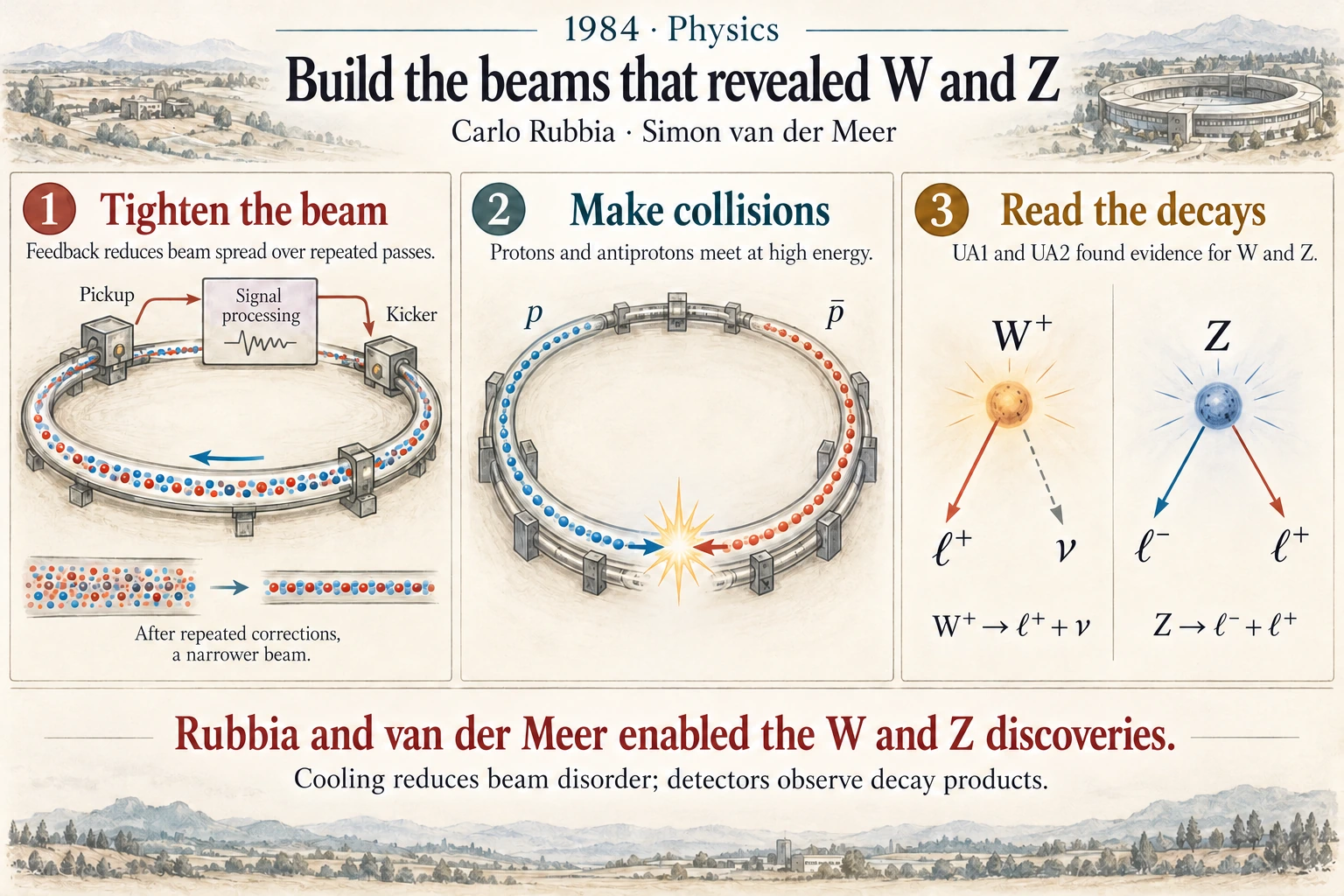
Electroweak theory predicted heavy W and Z bosons. Producing them required enough collision energy and enough useful collisions. Rubbia, Cline and McIntyre proposed converting CERN’s SPS into a proton–antiproton collider. Antiprotons were difficult to accumulate into sufficiently dense beams.
Van der Meer’s stochastic cooling measured deviations in samples of circulating particles and applied corrective fields farther along the ring. Repeated passes reduced energy spread and angular divergence. The collider began operating in 1981; UA1, led by Rubbia, and UA2 observed W and Z bosons in 1983 through their decay products. The 1984 prize recognised both experimental leadership and an enabling accelerator technique.
Why it matters
The discoveries tested a central prediction of electroweak theory, linking the weak and electromagnetic interactions. They also demonstrated how accelerator engineering and large detector collaborations can make new observations possible. Detailed studies continued at later colliders.