01 · The discovery
The idea, in everyday language
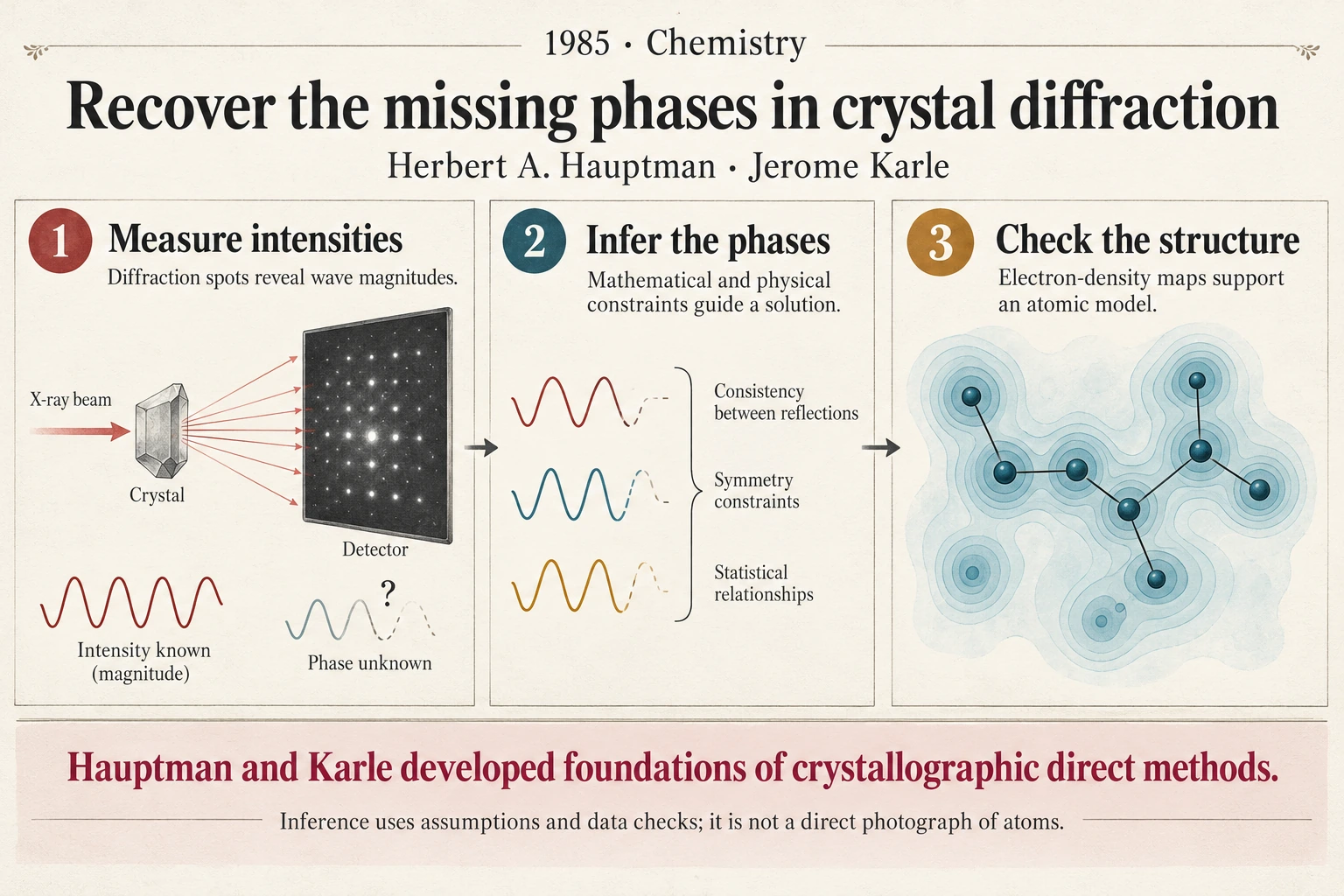
X-rays scattered by a crystal make a diffraction pattern. Detectors measure the intensities of the spots, which tell us about the magnitudes of scattered waves. A reconstruction also needs their relative phases, information usually absent from those intensity measurements. This is the crystallographic phase problem.
Hauptman and Karle developed direct methods using mathematical relationships and physical constraints, including nonnegative electron density and the atomic nature of structures. Statistical relationships among reflections help infer possible phases. Computing an electron-density map, fitting an atomic model and checking it against data turn those inferences into a structure determination. Isabella Karle and other crystallographers made crucial experimental and practical contributions.
Why it matters
Direct methods made many small-molecule crystal structures much easier to determine. Chemical bonding, molecular shape and material properties could be studied with structural evidence. The 1953 joint monograph was an important foundation; later theory, experiments and computing broadened the methods.