01 · The discovery
The idea, in everyday language
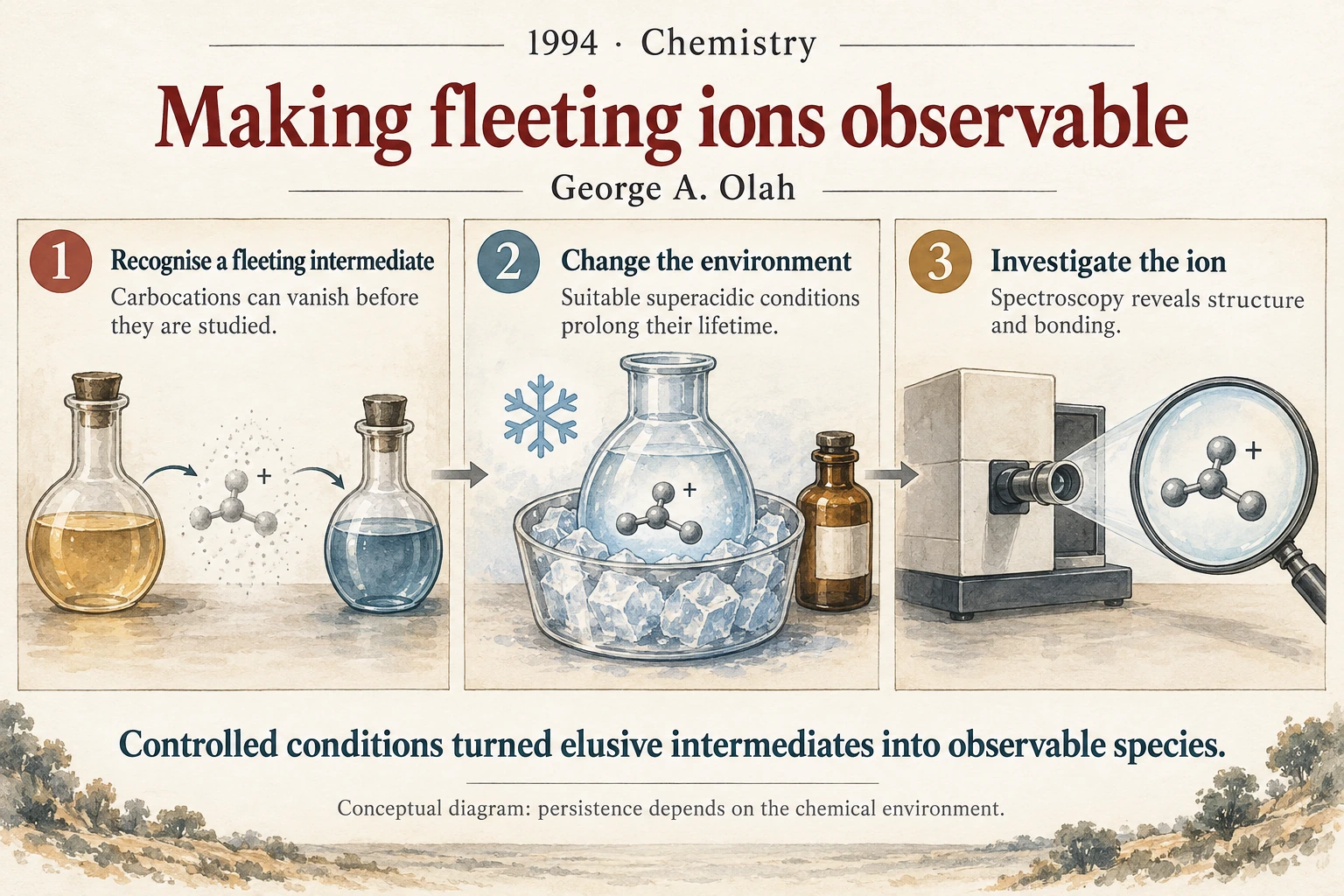
A chemical reaction can pass through intermediate species that vanish before ordinary instruments can examine them. Carbocations are positively charged carbon-containing species important in many organic reactions. Their existence had been inferred from reaction behaviour, but their short lifetimes made their structure and bonding difficult to test directly.
Olah and collaborators changed the experimental conditions. Superacids helped generate the ions, while weakly nucleophilic media and low temperatures limited reactions that would quickly consume them. With sufficient lifetimes and concentrations, spectroscopy could investigate the ions themselves. This approach exposed a wide variety of structures, including nonclassical ions in which bonding and charge are shared in ways a simple localised picture misses.
Why it matters
The work strengthened understanding of organic reaction mechanisms and the bonding of carbocations. It also enabled new transformations of hydrocarbons, including rearrangements and catalytic processes. The practical importance comes from linking what an intermediate is to how a reaction proceeds, rather than treating it as a hypothetical step that cannot be examined.