01 · The discovery
The idea, in everyday language
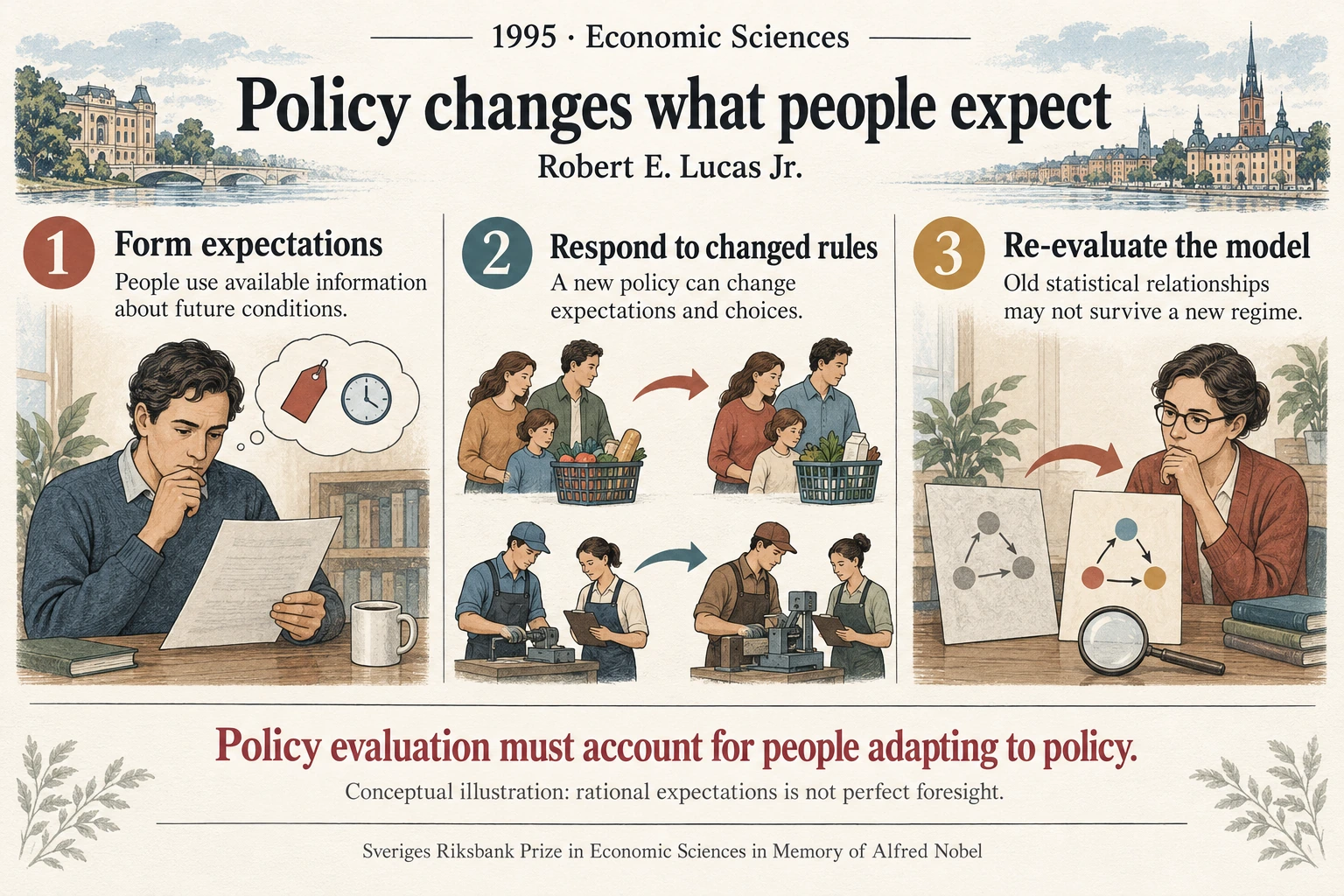
An economic policy acts on people who can anticipate it. Households and firms form expectations about prices, wages and future conditions, and those expectations shape what they do now. Building on Muth’s rational-expectations hypothesis, Lucas made this forward-looking behaviour central to macroeconomic models. Expectations use the information specified in the model; they do not grant people perfect knowledge of future events.
The Lucas critique explains a problem with using yesterday’s statistical relationships to evaluate tomorrow’s policy regime. A relationship estimated under an old rule may partly reflect how people adapted to that rule. Change the rule, and their decisions can change too. A model that simply holds the old relationship fixed may therefore give a misleading forecast. Lucas argued for analysing choices, constraints and expectations when comparing policy regimes.
Why it matters
The work transformed macroeconomic modelling and the evaluation of economic policy. It strengthened the demand to connect aggregate outcomes with individual decisions and to distinguish anticipated policies from surprises. Later models retained attention to expectations while also studying learning, limited information, sticky prices and other frictions.