c.curionodeThe Nobel Archive

2008 · Chemistry

A light to follow inside living cells

Green fluorescent protein turned a jellyfish molecule into a genetically encoded research tool.

GFPfluorescencebiological imaging
2008Chemistry

Visual guide

The prize, pictured

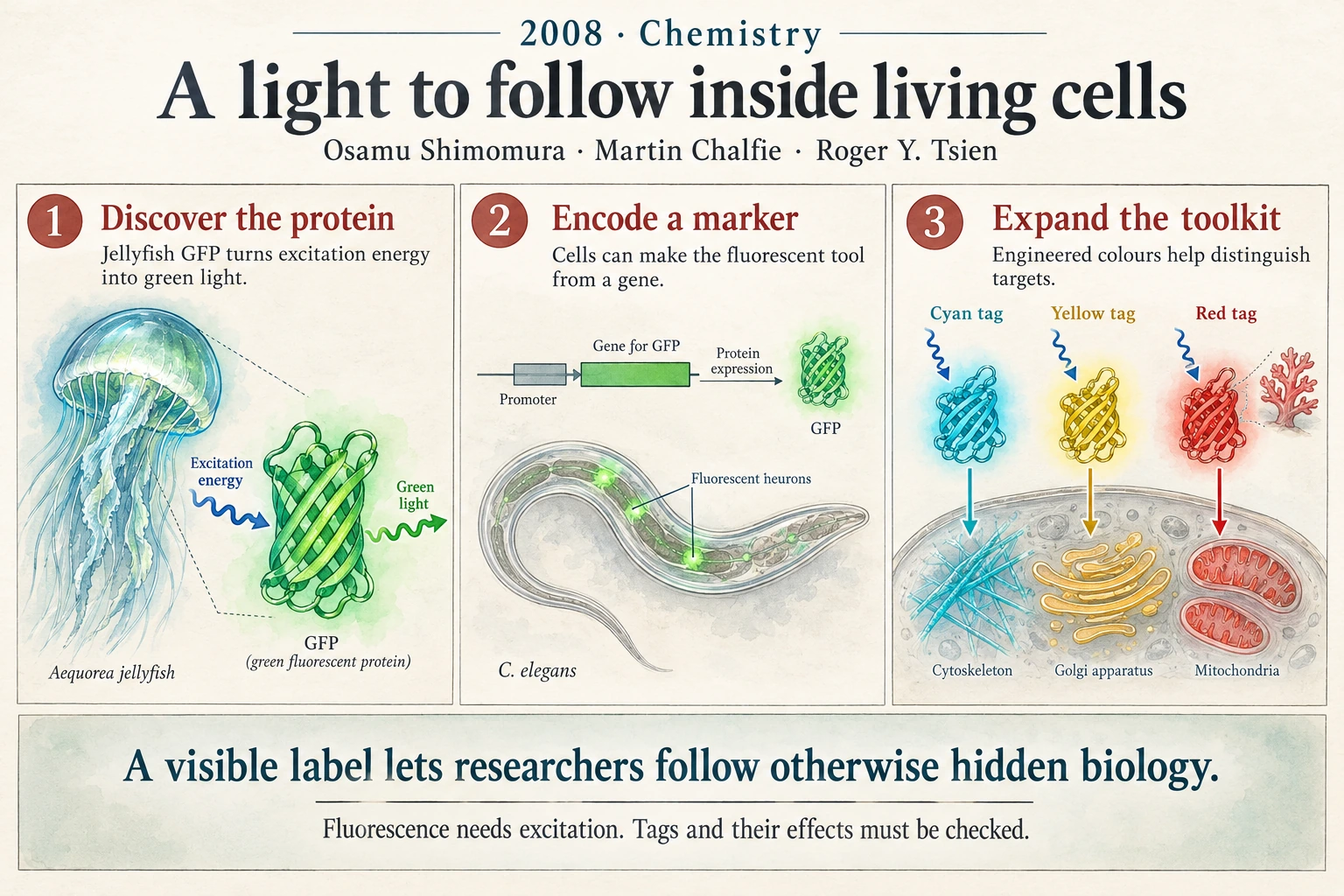
Infographic explaining A light to follow inside living cells
Original AI-generated infographic. A conceptual overview; the explanations and sources below provide context.
Read the poster text

A visible label lets researchers follow otherwise hidden biology.

  1. Discover the protein

    Jellyfish GFP turns excitation energy into green light.

  2. Encode a marker

    Cells can make the fluorescent tool from a gene.

  3. Expand the toolkit

    Engineered colours help distinguish targets.

Fluorescence needs excitation. Tags and their effects must be checked.

01 · The discovery

The idea, in everyday language

Many important events inside a cell are difficult to see. Shimomura isolated a protein from a jellyfish that emits green light after receiving excitation energy. Chalfie and colleagues showed that cells of other organisms could make a working version from its gene. Researchers gained a marker that could be produced inside the system being studied, instead of having to introduce a separate dye into each target.

The marker can be used in different ways. A gene-control sequence can switch on GFP to report where it is active, or the GFP sequence can be joined to a target protein’s sequence so the cell produces a fluorescent fusion. Tsien explained and engineered fluorescence, improving the toolkit and expanding its colours. Related proteins from other organisms, including red proteins derived from coral, extended the range further.

Why it matters

Fluorescent proteins made it possible to follow gene activity, protein location and cell behaviour in living systems. Different colours allow several targets to be distinguished, and specialised designs can report changes in cellular conditions. The prize illustrates how curiosity about a marine organism can become a general experimental method through many people’s contributions.


02 · The people

Who brought the idea to life?

Illustrated portrait of Osamu Shimomura

Osamu Shimomura

Prize share · 1/3

The team isolated green fluorescent protein, reported in 1962 alongside its studies of aequorin. GFP absorbs excitation energy and emits green light; it is distinct from aequorin, which participates in the jellyfish’s chemical light-producing system. Shimomura’s later chemical work helped identify GFP’s light-emitting group. This basic research supplied the protein that others would develop into a powerful biological marker.

Read the biography ↗
Illustrated portrait of Martin Chalfie

Martin Chalfie

Prize share · 1/3

Using GFP DNA supplied by Douglas Prasher, Chalfie and colleagues showed that the protein could fluoresce in other organisms without an additional jellyfish enzyme system. Their 1994 paper demonstrated its use in bacteria and the worm’s touch-receptor neurons. The work established GFP as a genetically encoded reporter. A reporter can indicate gene activity or label a protein, but those are different experimental designs and each needs appropriate controls.

Read the biography ↗
Illustrated portrait of Roger Y. Tsien

Roger Y. Tsien

Prize share · 1/3

Tsien helped explain how GFP’s fluorescent group forms and used changes in its amino-acid sequence to improve brightness and produce new colours. His group also developed useful red fluorescent proteins from a different, coral-derived starting point. The expanded palette let researchers distinguish multiple targets. The colours are engineered labels, not the natural visible colours of every protein, and not every fluorescent protein is simply a green GFP recoloured.

Read the biography ↗

03 · Years in the making

The path here

  1. 1962

    Shimomura and colleagues reported the green protein isolated during jellyfish research.

  2. 1994

    Chalfie and colleagues demonstrated GFP as a marker in bacteria and a transparent nematode.

  3. 1990s

    Tsien’s work on fluorescent-protein chemistry and engineering expanded the imaging toolkit.

04 · Read further

From the original sources

Original explanations by Curionode, based on the official records below. Biographical details and affiliations refer to the award year.

  1. Official announcement nobelprize.org
  2. Popular science background nobelprize.org
  3. Columbia: Chalfie and fluorescent markers columbia.edu

More in Chemistry

Browse this subject ↗