01 · The discovery
The idea, in everyday language
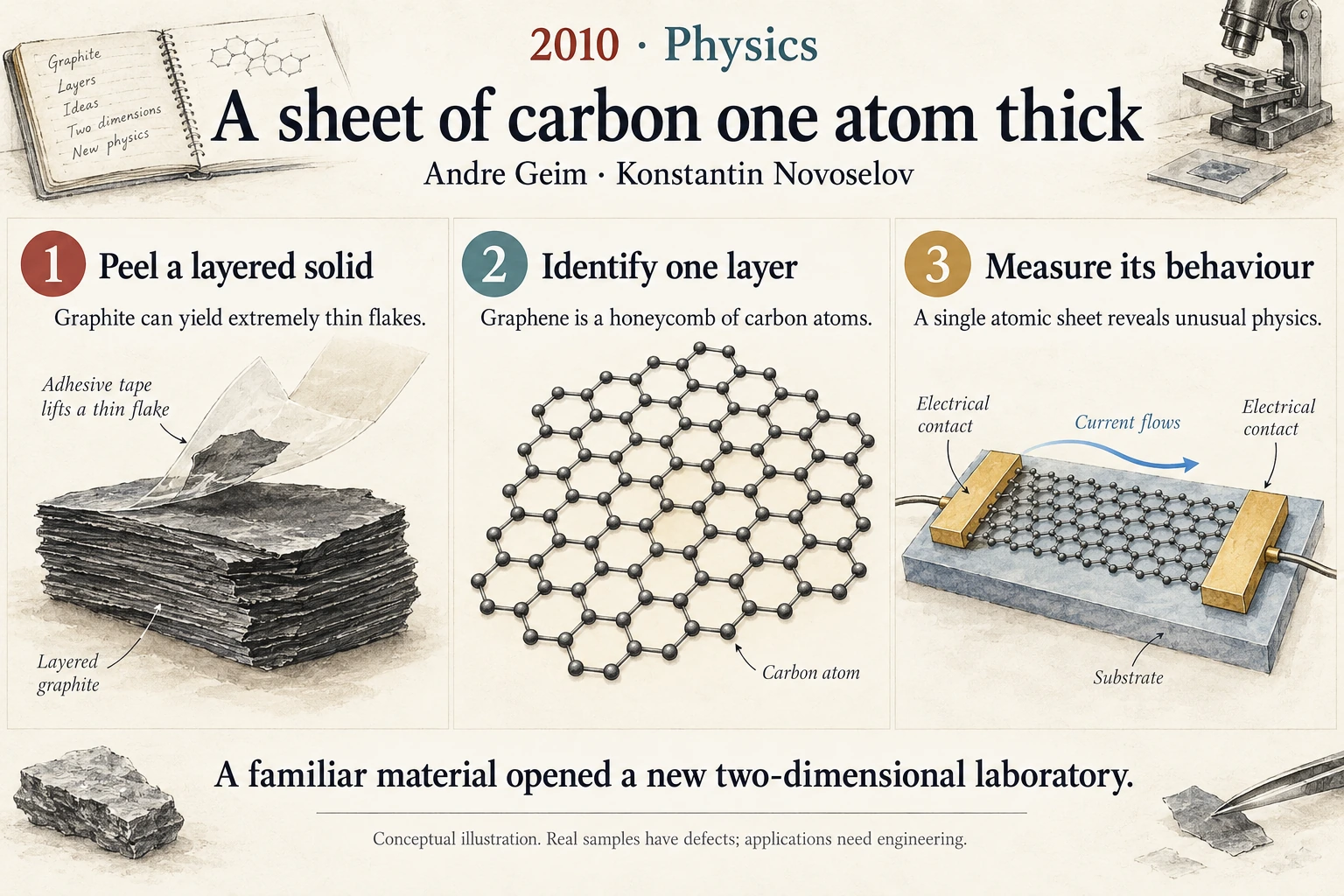
Graphite, the material in a pencil, consists of many carbon sheets stacked together. Inside each sheet, carbon atoms form a strongly bonded honeycomb network; the attraction between neighbouring sheets is much weaker. Geim and Novoselov’s team peeled graphite into thin flakes, identified single layers on a suitable surface and attached electrical contacts. In 2004 they reported experiments on atomically thin carbon films.
The single layer, graphene, was much more than a thinner piece of an ordinary solid. Its electronic structure lets charge carriers behave in ways described by equations resembling those for massless particles. Measuring the material provided a tabletop setting for unusual quantum effects and launched a much broader search for useful atomically thin materials. The electrons themselves do not lose their fundamental rest mass or move at the speed of light.
Why it matters
The experiments gave researchers a new material platform for studying electronic transport, mechanical strength and light–matter interactions. They also inspired work on sensors, conductive films, composites and other two-dimensional crystals. Turning a striking laboratory property into a reliable product requires control over defects, interfaces, manufacturing and cost.