01 · The discovery
The idea, in everyday language
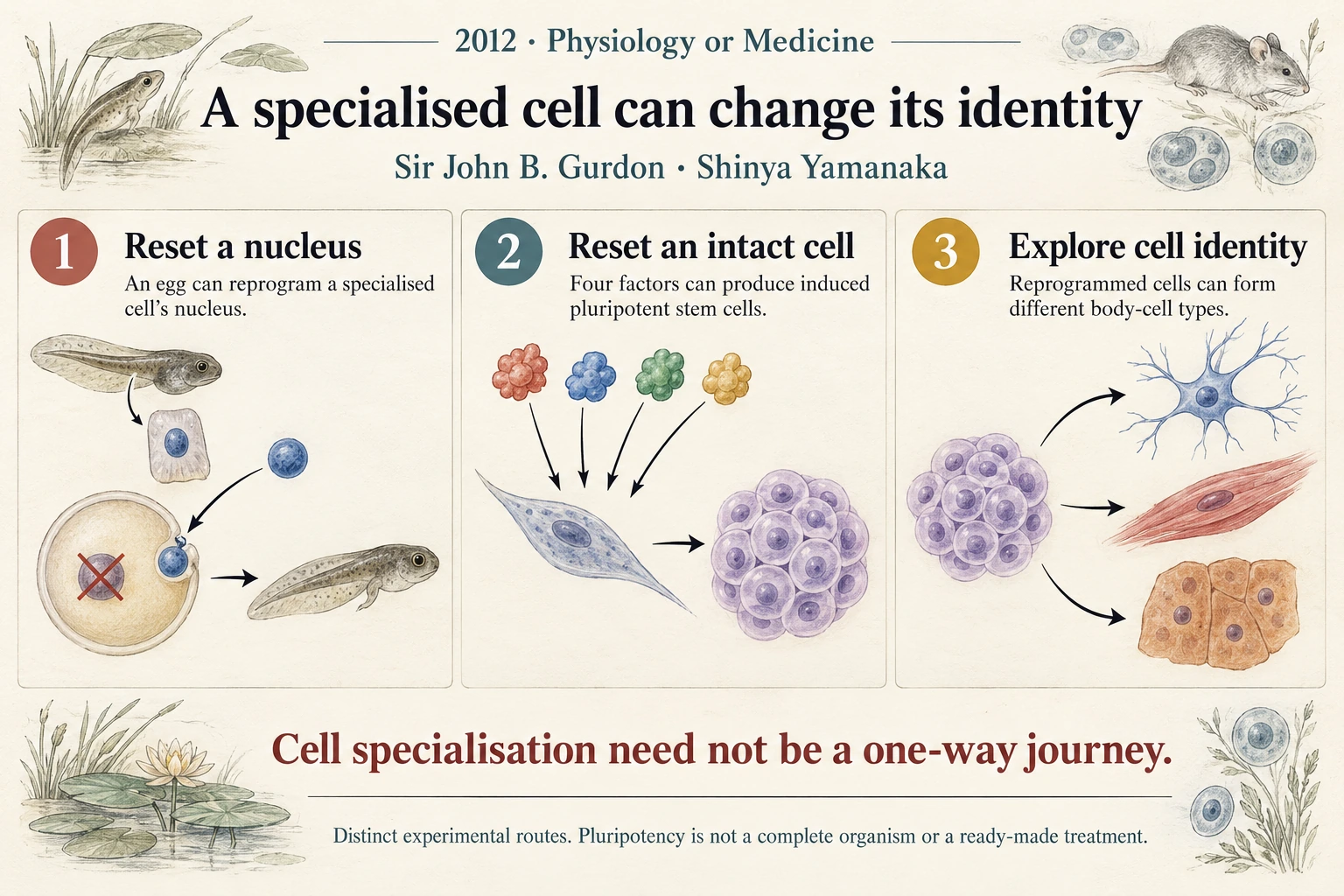
A developing body produces many kinds of cells from the same starting material. For a long time, it was unclear whether specialisation permanently removed genetic possibilities. Gurdon transferred nuclei from differentiated tadpole intestinal cells into frog eggs whose own nuclear contribution had been inactivated. Some developed into normal tadpoles. The specialised nucleus had retained information needed for other cell types; the egg’s environment could change how that information was used.
Yamanaka asked whether an intact specialised cell could be reset without an egg. In 2006 he and Kazutoshi Takahashi introduced a combination of four factors into mouse fibroblasts and produced induced pluripotent stem cells, or iPS cells. These could give rise to different body-cell types. The two discoveries used different methods but overturned the same assumption: differentiation does not necessarily lock a cell into one identity forever.
Why it matters
Researchers can use reprogrammed cells to investigate development, model disease and test how cells respond to compounds. A patient’s cells can provide a route to studying otherwise inaccessible cell types in culture. The work also established a foundation for regenerative-medicine research, where the identity, maturity and safety of any replacement cells matter greatly.