01 · The discovery
The idea, in everyday language
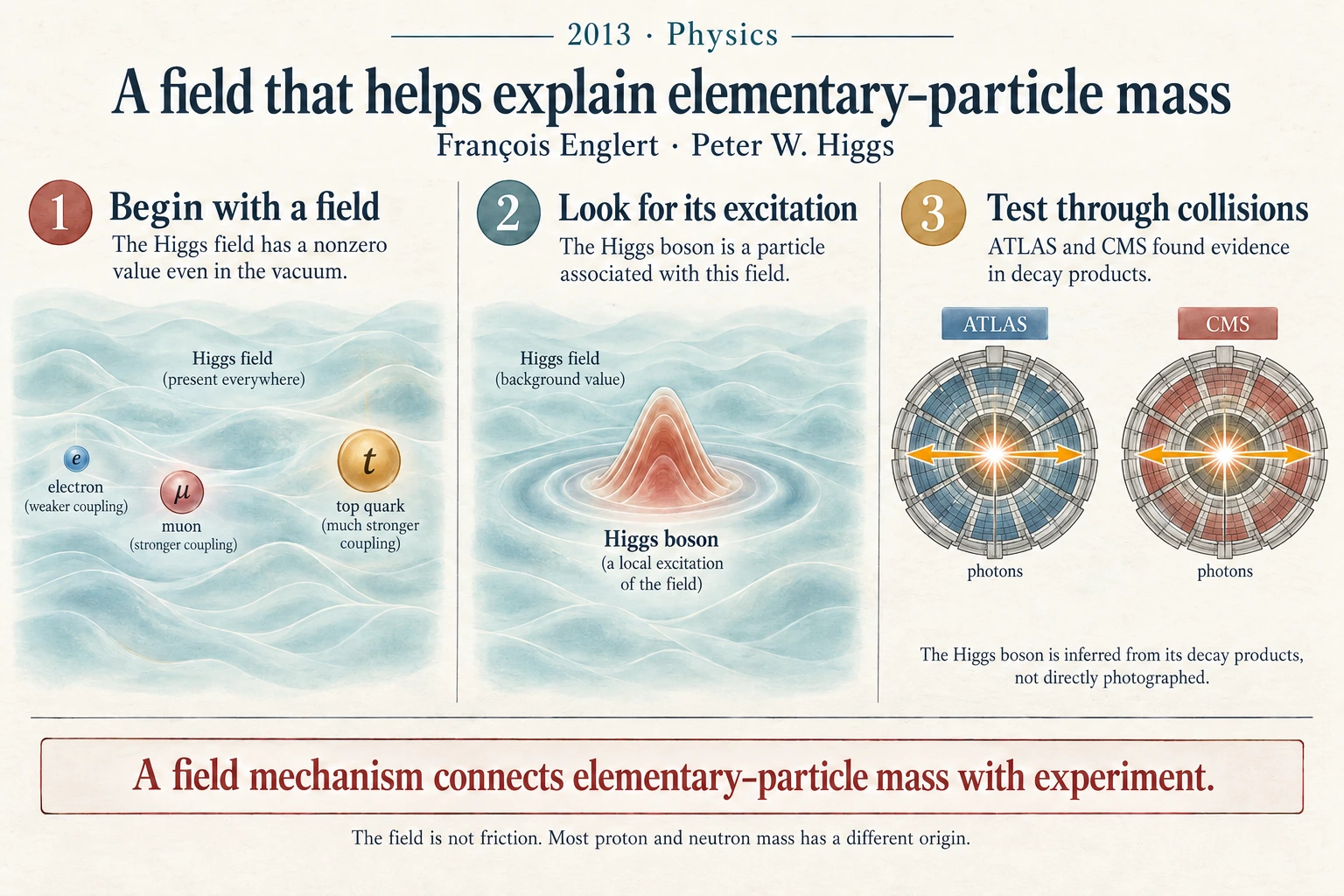
The equations describing fundamental forces rely on symmetries: relationships that remain unchanged when the mathematical description is transformed. Simply inserting masses for the weak force’s carriers creates problems. Englert and Robert Brout, and independently Higgs, showed a way forward. A field can have a nonzero value even in its lowest-energy state, the vacuum. Its interaction with other fields allows massive particles to appear without abandoning the theory’s underlying structure.
In the Standard Model, this mechanism accounts for the masses of the W and Z bosons; related interactions with the Higgs field give charged elementary matter particles their masses. The field also has an observable excitation, the Higgs boson. ATLAS and CMS searched for the products of its short-lived decays in many proton collisions at CERN’s Large Hadron Collider. On 4 July 2012 they announced a new boson; subsequent measurements supported its identification as a Higgs particle. The prize honoured the theoretical mechanism, with explicit recognition of the experimental discovery that tested it.
Why it matters
The result connected a mathematical solution with measurable evidence and completed a long-missing part of the Standard Model. It gave experiments a new object whose interactions could be studied to test the theory more closely. This was the work of a large international research community, building on theoretical and experimental developments over decades.