01 · The discovery
The idea, in everyday language
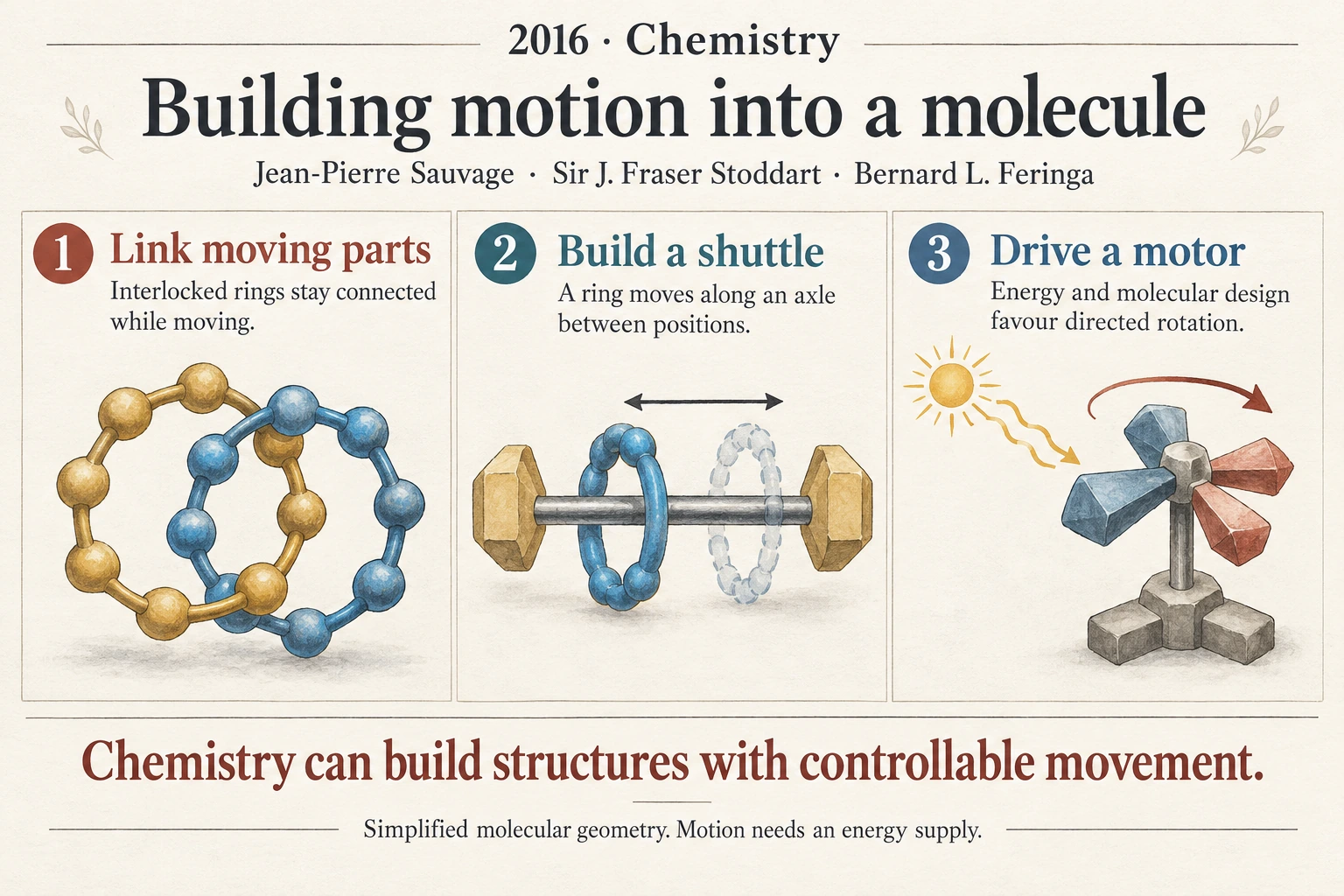
A tiny object is not automatically a machine. Its parts must move relative to one another in a useful, controllable way. Sauvage used a copper ion to help assemble two molecular rings that were linked like chain links. Each ring retained its own chemical framework; the rings stayed together because of their interlocking shape. Stoddart developed a ring threaded on a molecular axle. The ring could move between positions, giving chemists a route to shuttles and switches.
Feringa tackled directed rotation. Molecules jostle randomly, so merely making something that can rotate does not produce a motor. His group designed a molecule whose shape and sequence of light-driven and thermal changes favour rotation in one direction. These achievements provided complementary components for molecular machinery. Supplying energy and choosing the right molecular structure made controlled motion possible.
Why it matters
The work expanded chemistry from building structures to controlling their movement. Researchers used these ideas in experimental switches, lifts, responsive materials and systems that pass molecular motion to larger objects. The contribution was a versatile toolbox for further research, with practical uses still requiring engineering and testing.