01 · The discovery
The idea, in everyday language
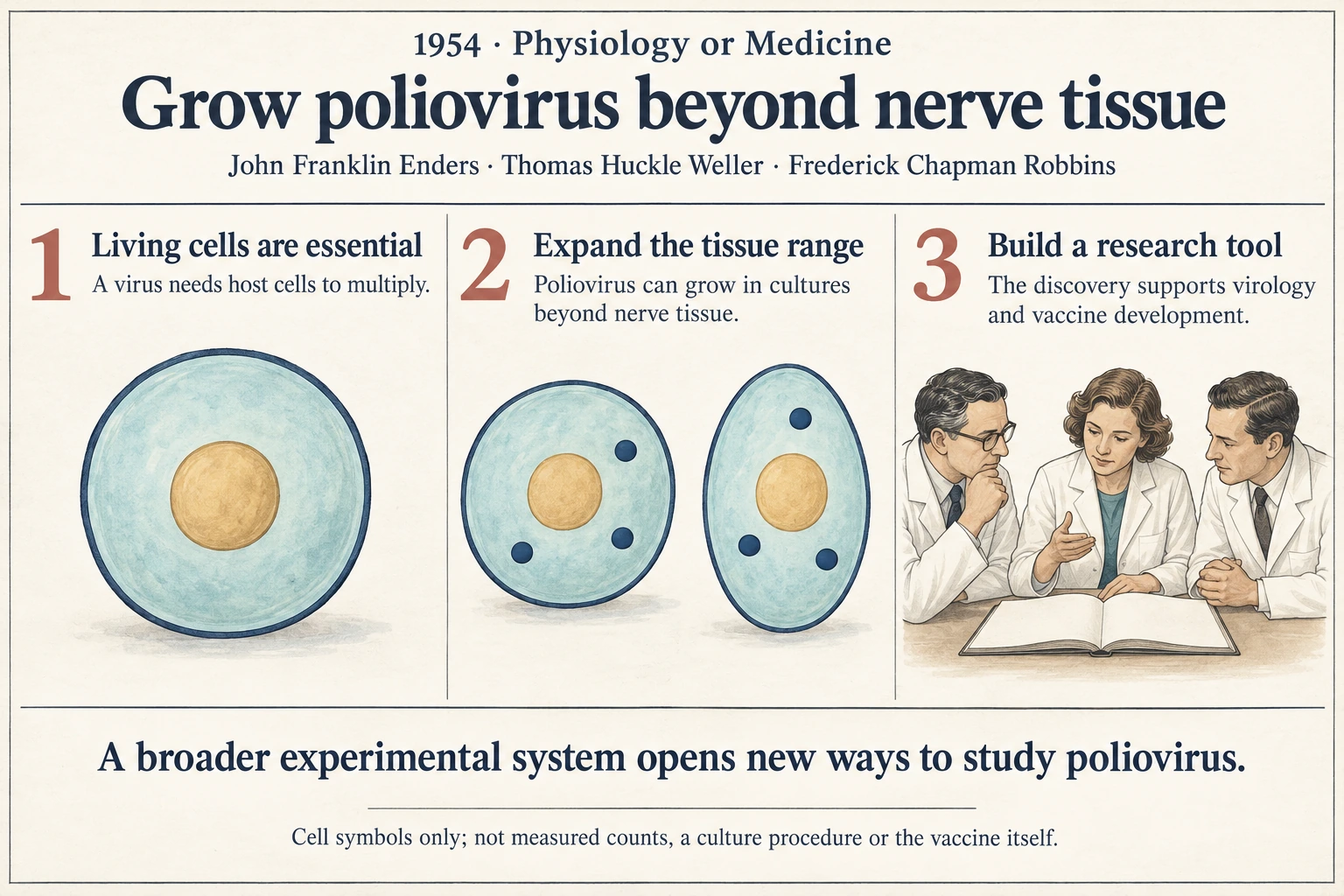
Could poliovirus grow outside the nervous tissues with which the disease was associated? Earlier limited results had supported a restrictive view. In 1949 Enders, Weller and Robbins reported growth in cultures of different human tissues, including non-neural tissues. This overturned an important experimental barrier without implying that viruses can multiply in lifeless nutrient broth: they require living cells.
Changes in infected cells gave researchers a way to recognise viral activity, and comparisons using specific immune serum helped identify the virus. Tissue culture supported isolation, experimental investigation and immunity studies, reducing dependence on indirect observations in whole animals. The three collaborators each received one third of the 1954 prize for the discovery of poliovirus growth in cultures of various tissue types. Their work built on earlier tissue culture and cultivation of other viruses.
Why it matters
The discovery expanded practical virology and helped make poliovirus research and vaccine development possible on a wider scale. The culture work should be distinguished from Salk’s and Sabin’s vaccine programmes and from later testing, manufacture and public-health delivery. Research tools and a proven vaccine are different achievements.