c.curionodeThe Nobel Archive

1975 · Economic Sciences

Making the most of limited resources

A production plan must fit available materials, labour and equipment. Kantorovich and Koopmans developed ways to analyse efficient choices under constraints and interpret the value of scarce resources.

The Sveriges Riksbank Prize in Economic Sciences in Memory of Alfred Nobel.

Resource allocationOptimisationShadow valuations
1975Economic Sciences

Visual guide

The prize, pictured

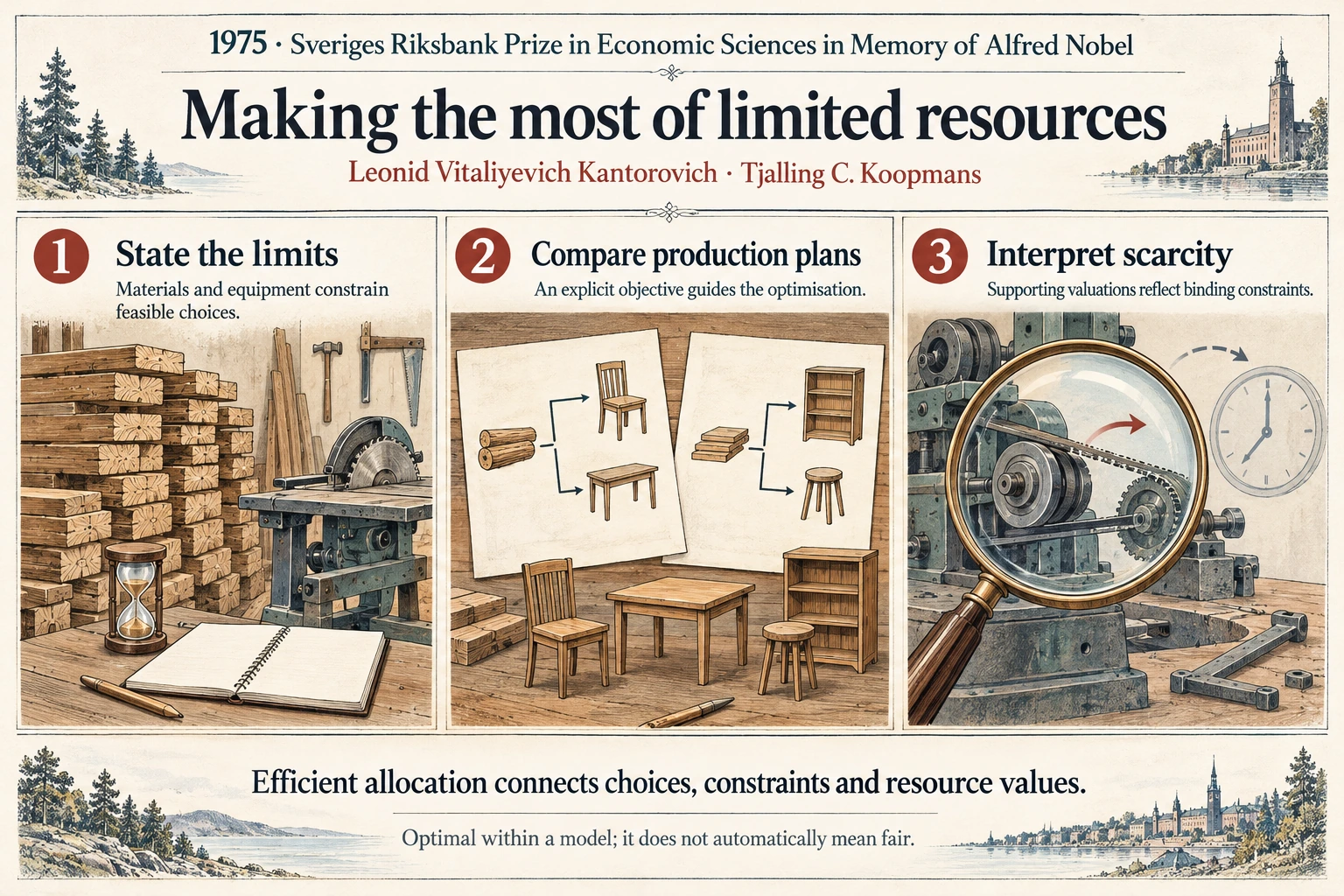
Infographic explaining Making the most of limited resources
Original AI-generated infographic. A conceptual overview; the explanations and sources below provide context.
Read the poster text

Efficient allocation connects choices, constraints and resource values.

  1. State the limits

    Materials and equipment constrain feasible choices.

  2. Compare production plans

    An explicit objective guides the optimisation.

  3. Interpret scarcity

    Supporting valuations reflect binding constraints.

Optimal within a model; it does not automatically mean fair.

01 · The discovery

The idea, in everyday language

An allocation problem starts with a specified objective and a set of possible activities. Each activity uses inputs and produces outputs; limited resources restrict which combinations are feasible. Kantorovich’s work, prompted by a plywood-production problem, gave mathematical form to such decisions. Linear programming can compare feasible combinations systematically rather than relying on a vague instruction to use resources well. The mathematical optimum is relative to the model’s objective and assumptions.

Koopmans developed activity analysis and connected efficient production with supporting calculation prices. Shadow valuations describe how relaxing a binding resource constraint would affect the model’s objective near the optimum. They are not automatically the prices observed in a market, nor a measure of every social value. Independent developments by Dantzig and other researchers strengthened the field. The laureates worked in different economic settings, and each received one half of the full Sveriges Riksbank Prize in Economic Sciences in Memory of Alfred Nobel.

Why it matters

The theory gave researchers and planners tools for comparing production possibilities, transport choices and allocation over time. It connected mathematical optimisation with an economic interpretation of scarcity. Its uses extend across institutional settings, while actual decisions still require evidence and judgement.
02 · The people

Who brought the idea to life?

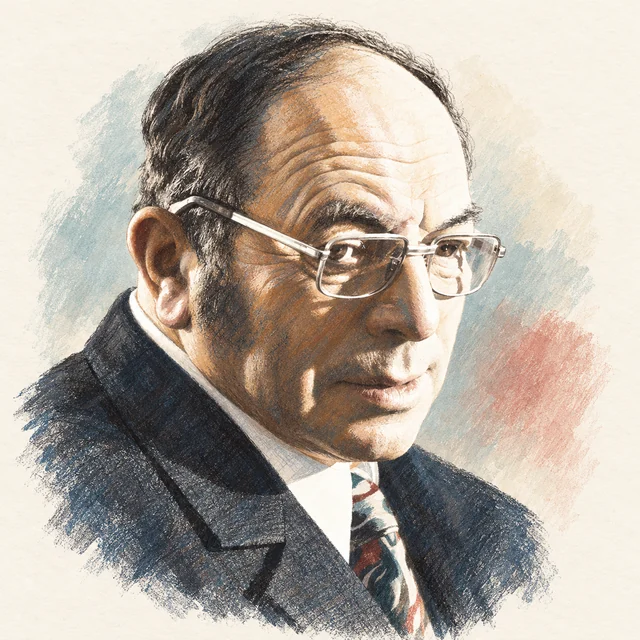
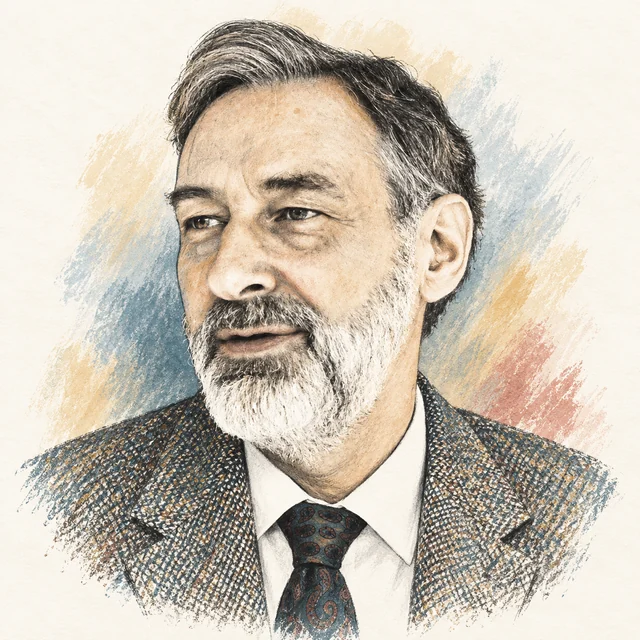
Illustrated portrait of Tjalling C. Koopmans

Tjalling C. Koopmans

Prize share · 1/2

Koopmans developed activity analysis, linking production possibilities, efficient allocation and supporting valuations. He received half the Economic Sciences memorial prize for resource-allocation theory.

Read the biography ↗

03 · Years in the making

The path here

  1. 1938

    A plywood-production consultation prompts Kantorovich’s allocation work.

  2. 1939

    His booklet sets out mathematical production-planning methods.

  3. 1942

    Koopmans analyses shipping routes and their shadow costs.

  4. 1947

    Discussions with Dantzig help broaden Koopmans’s activity analysis.

  5. 1955

    Koopmans moves with Cowles colleagues to Yale.

  6. 1959

    Kantorovich publishes The Best Use of Economic Resources.

  7. 1975

    The two researchers share the Economic Sciences memorial prize.

04 · Read further

From the original sources

Original explanations by Curionode, based on the official records below. Biographical details and affiliations refer to the award year.

  1. Official announcement nobelprize.org

More in Economic Sciences

Browse this subject ↗