01 · The discovery
The idea, in everyday language
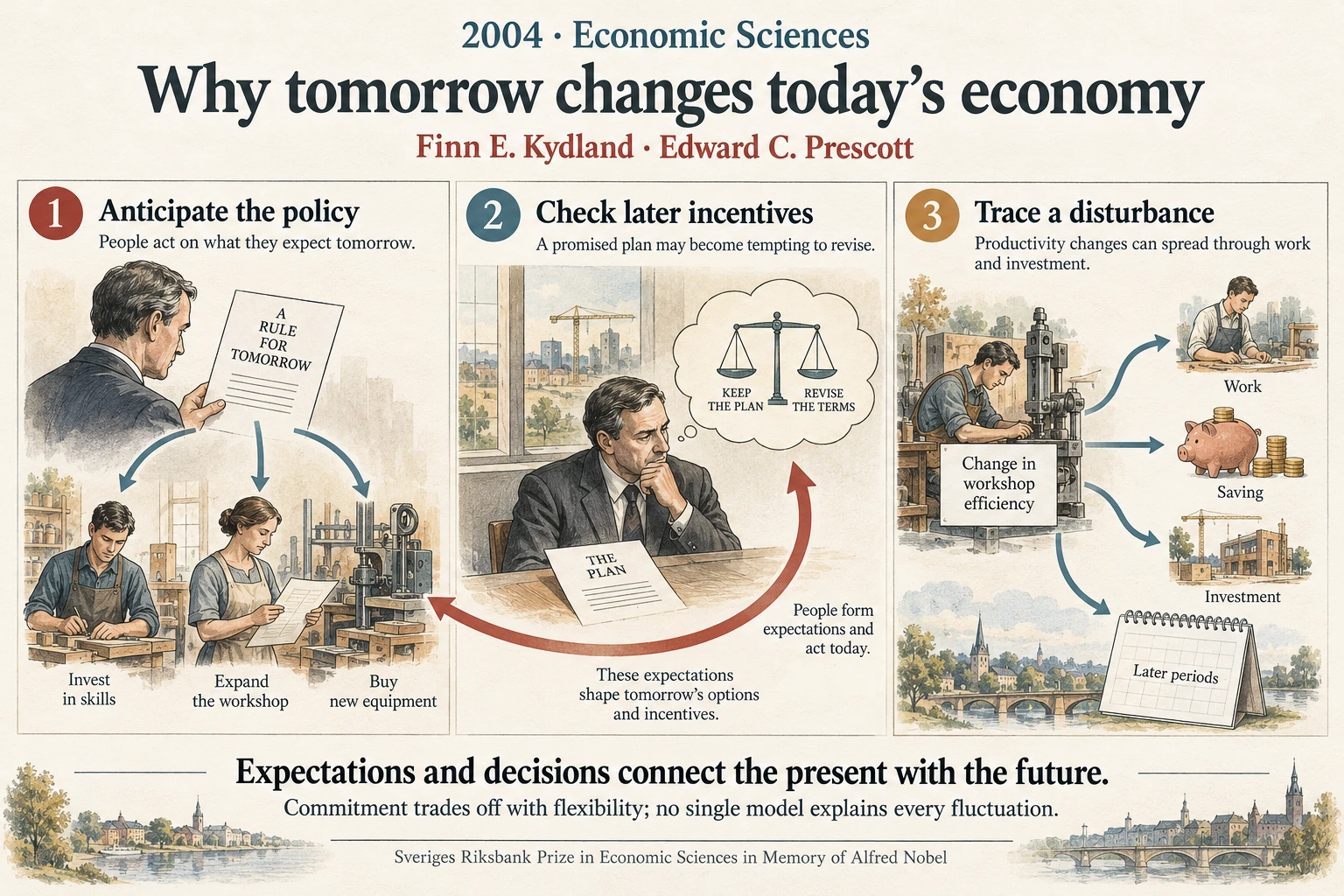
A government may announce a policy that looks desirable before households and firms make their decisions. Once people have acted, the government may face an incentive to change course. If people anticipate that temptation, the original announcement may lose credibility. Kydland and Prescott’s 1977 analysis showed how this time-consistency problem can arise even when policymakers seek a good outcome rather than deliberately deceive anyone.
Their second major contribution concerned business cycles. A 1982 model linked decisions about consumption, work, saving and investment with changes in productivity. Forward-looking choices and the gradual formation of capital spread a disturbance across time. The model demonstrated how supply-side changes could generate patterns resembling several features of observed fluctuations, bringing short-run cycles and long-run growth into a common framework.
Why it matters
The work shifted attention toward institutions that make policy commitments credible and toward models built from decisions made by households and firms. Later research adapted the methods to include demand shocks, sticky prices and other frictions. The influence rests both on particular results and on a way of asking how expectations and choices interact over time.