01 · The discovery
The idea, in everyday language
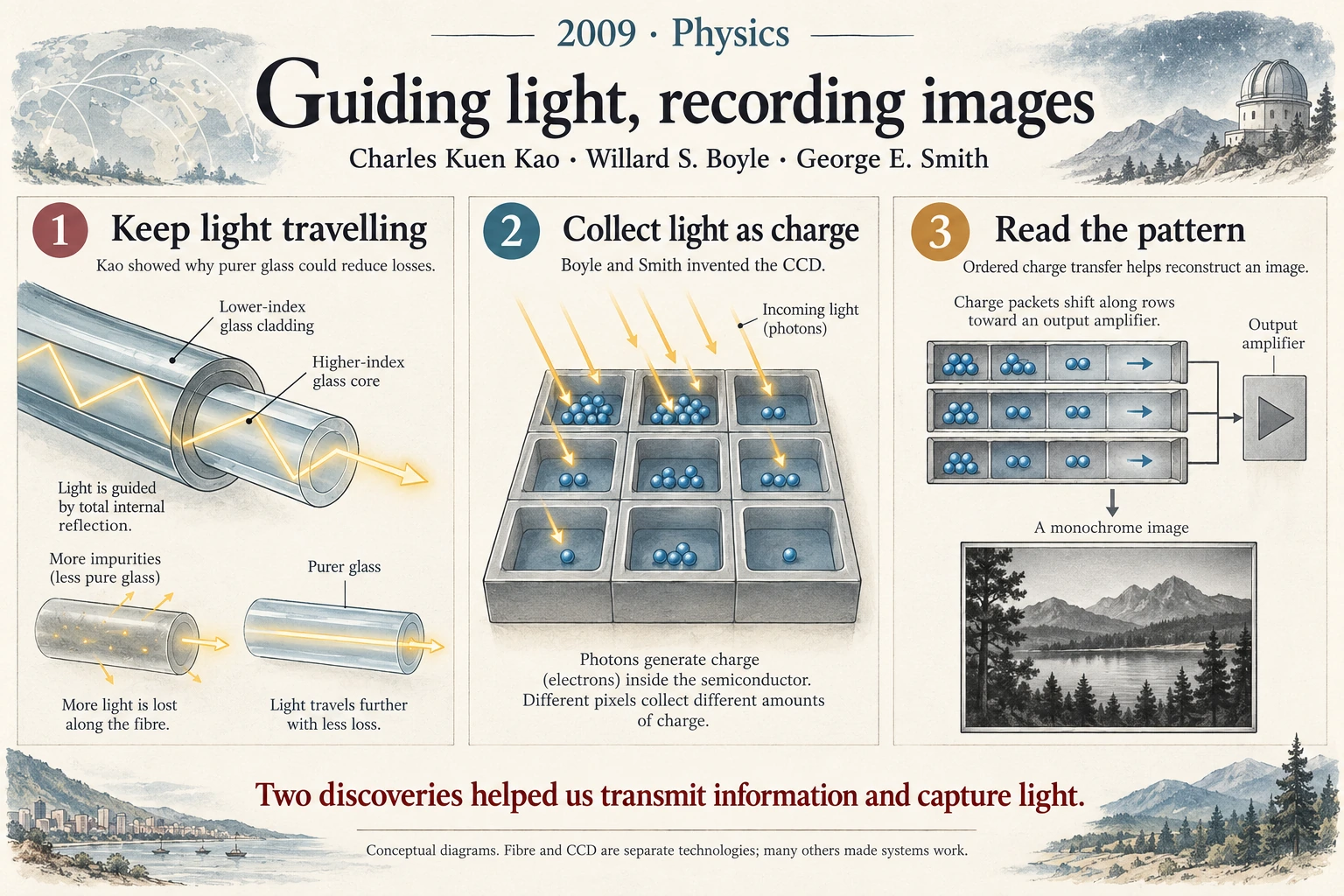
A glass fibre can guide light, but early fibres lost too much of it to carry useful signals over long distances. Kao, working with George Hockham, showed that much of the obstacle came from impurities in the glass. His analysis pointed toward exceptionally pure material and helped turn optical communication into a practical research target. Making low-loss fibres, lasers, amplifiers and complete networks required many further contributors.
Boyle and Smith’s contribution was different: the charge-coupled device, or CCD. Light falling on a semiconductor generates electrical charge. A sensor stores that charge at many positions and transfers the packets in an ordered sequence to an output. Measuring them reconstructs the pattern of brightness across the image. The two achievements meet in modern information systems, but the optical fibre and CCD are separate inventions.
Why it matters
Low-loss optical fibres became a foundation of high-capacity communication. CCDs enabled sensitive electronic imaging in cameras, astronomy and other scientific instruments. Together with many other technologies, these advances made it easier to capture, process and transmit visual information.