01 · The discovery
The idea, in everyday language
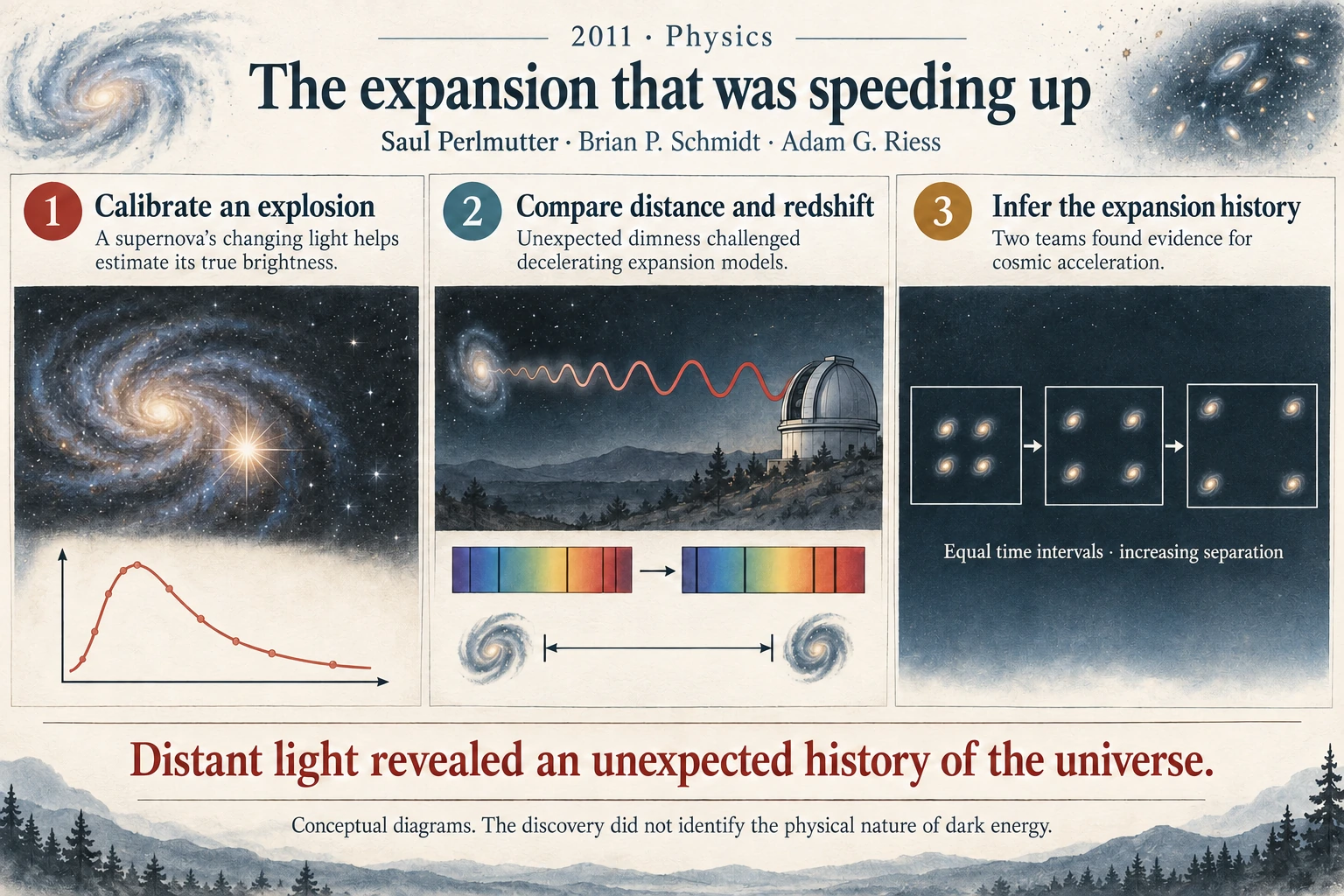
To ask how the universe expands, astronomers need both a measure of distance and a record of how much space has stretched since light began its journey. Type Ia supernovae provided unusually bright distance markers. They are not identical bulbs: researchers calibrated their brightness using the way their light changed with time and colour. Comparing this estimated intrinsic brightness with the light reaching Earth gave a distance estimate.
Perlmutter’s Supernova Cosmology Project and the High-Z team led by Schmidt, with Riess playing a central analytical role, compared these distances with redshift. The distant explosions were dimmer than expected in the decelerating models the teams were testing. After checking alternative explanations, they inferred that the expansion had accelerated. Agreement between independent teams made a surprising result harder to dismiss.
Why it matters
The discovery transformed cosmology by showing that matter’s gravitational attraction was not enough to explain the observed expansion history within the standard framework. Dark energy became a central question: a name for the component invoked to account for acceleration, whose physical nature remained to be established. The measurement opened a research problem rather than closing it.