c.curionodeThe Nobel Archive

2015 · Physics

The particles that change identity

Underground detectors showed that neutrinos change type during their journey—and cannot all be massless.

neutrino oscillationsparticle massunderground detectors
2015Physics

Visual guide

The prize, pictured

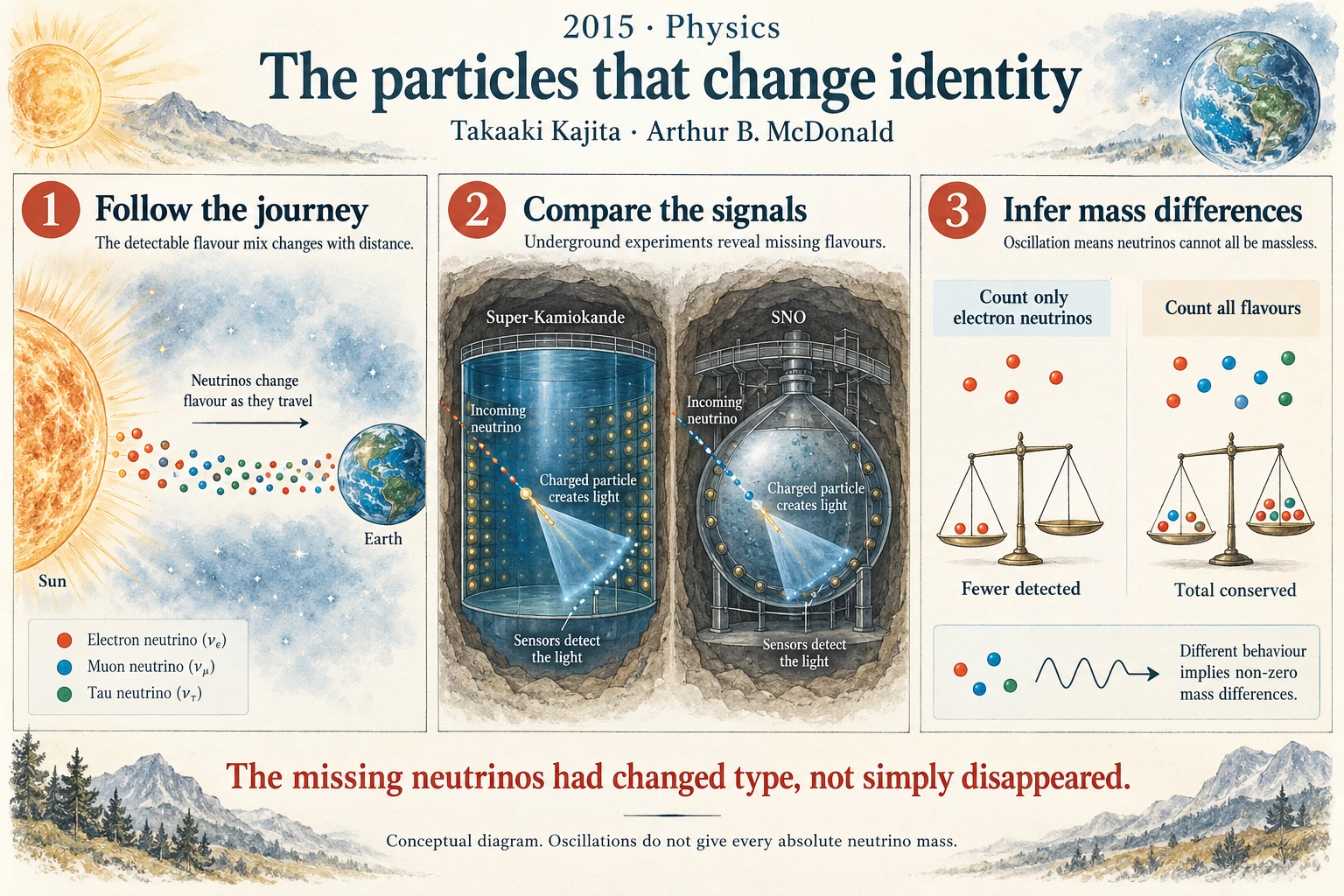
Infographic explaining The particles that change identity
Original AI-generated infographic. A conceptual overview; the explanations and sources below provide context.
Read the poster text

The missing neutrinos had changed type, not simply disappeared.

  1. Follow the journey

    The detectable flavour mix changes with distance.

  2. Compare the signals

    Underground experiments reveal missing flavours.

  3. Infer mass differences

    Oscillation means neutrinos cannot all be massless.

Conceptual diagram. Oscillations do not give every absolute neutrino mass.

01 · The discovery

The idea, in everyday language

Neutrinos are tiny particles that rarely interact with matter. They come in three detectable types, called flavours: electron, muon and tau. For decades, experiments counted fewer electron neutrinos from the Sun than calculations predicted. Was the model of the Sun wrong, or were the experiments missing something about the particles? A detector sensitive mainly to one flavour could not settle the question by itself.

Two large collaborations found complementary answers. At Super-Kamiokande, Kajita and colleagues compared atmospheric neutrinos travelling different distances. Their 1998 results showed a shortage of muon neutrinos after the longer journey through Earth. At the Sudbury Neutrino Observatory, McDonald’s team used heavy water to compare electron-neutrino signals with measurements sensitive to other flavours too. Results beginning in 2001 showed that solar neutrinos were changing flavour, rather than simply vanishing. This quantum process is called neutrino oscillation.

Why it matters

Oscillations require differences between neutrino masses. That finding showed that the original Standard Model, which treated neutrinos as massless, needed extending. It also gave researchers a new way to investigate fundamental particles and interpret messengers arriving from the Sun, atmosphere and more distant sources.


02 · The people

Who brought the idea to life?

Illustrated portrait of Takaaki Kajita

Takaaki Kajita

Prize share · 1/2

In 1998 he presented evidence that atmospheric muon neutrinos changed type during travel. Neutrinos arriving after a long journey through Earth showed a different pattern from those travelling a shorter distance from above. Oscillations require differences between neutrino masses, revealing physics beyond the original massless-neutrino picture.

Read the biography ↗
Illustrated portrait of Arthur B. McDonald

Arthur B. McDonald

Prize share · 1/2

The SNO team compared signals sensitive to electron neutrinos with measurements that could include all three active types. Results beginning in 2001 showed that the missing solar electron neutrinos had changed type. The Sun’s total neutrino output could agree with expectations even though an electron-only count was low.

Read the biography ↗

03 · Years in the making

The path here

  1. 1998

    Super-Kamiokande reports evidence for atmospheric neutrino oscillations.

  2. 2001

    SNO presents evidence that solar electron neutrinos change flavour.

  3. 2015

    Kajita and McDonald share the Physics Prize.

04 · Read further

From the original sources

Original explanations by Curionode, based on the official records below. Biographical details and affiliations refer to the award year.

  1. Official award announcement nobelprize.org
  2. Nobel Committee’s accessible background nobelprize.org