01 · The discovery
The idea, in everyday language
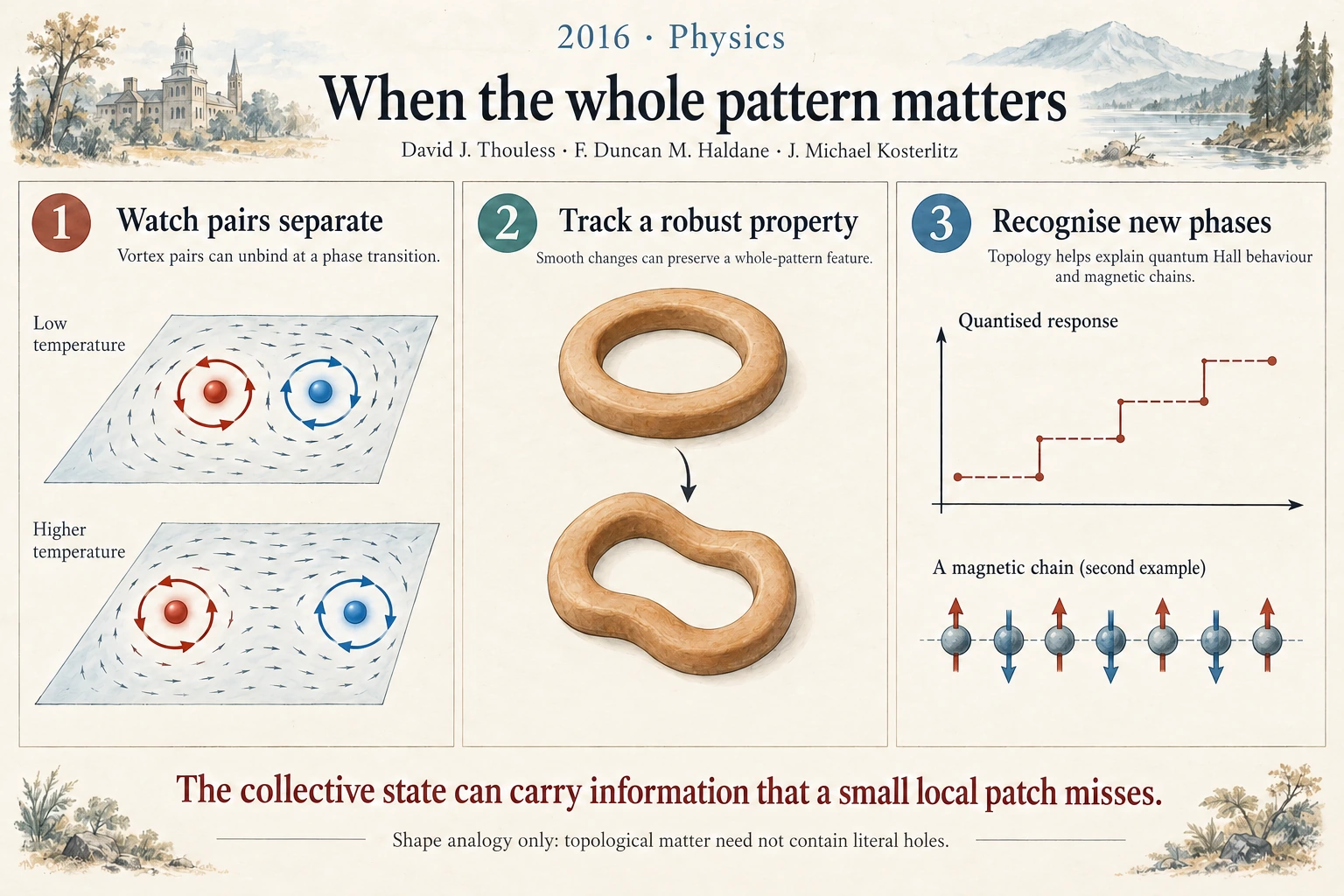
Water freezing is a familiar change of phase. In very thin materials, however, a different kind of transition can happen. Imagine arrows on a sheet recording a local direction. Around certain points the arrows wind all the way round: these are vortices. Kosterlitz and Thouless showed that opposite vortices can bind together at low temperature. When they separate, the collective behaviour changes, even though the usual description in terms of ordinary long-range order does not apply.
Topology studies features that survive smooth changes. Thouless and collaborators used it to explain why the electrical response in the integer quantum Hall effect comes in extraordinarily precise steps. Haldane showed that quantum chains of tiny magnets have different properties depending on their spin, and devised a model for a quantum Hall state without net magnetic flux. Together these ideas revealed distinctions between phases that cannot be read off from one small patch of a material.
Why it matters
The discoveries supplied new ways to classify matter and understand collective behaviour. They helped open a large research programme on topological materials, including unusual boundary behaviour and possible electronic applications. The prize recognised theoretical foundations, rather than the invention of a finished quantum computer.