01 · The discovery
The idea, in everyday language
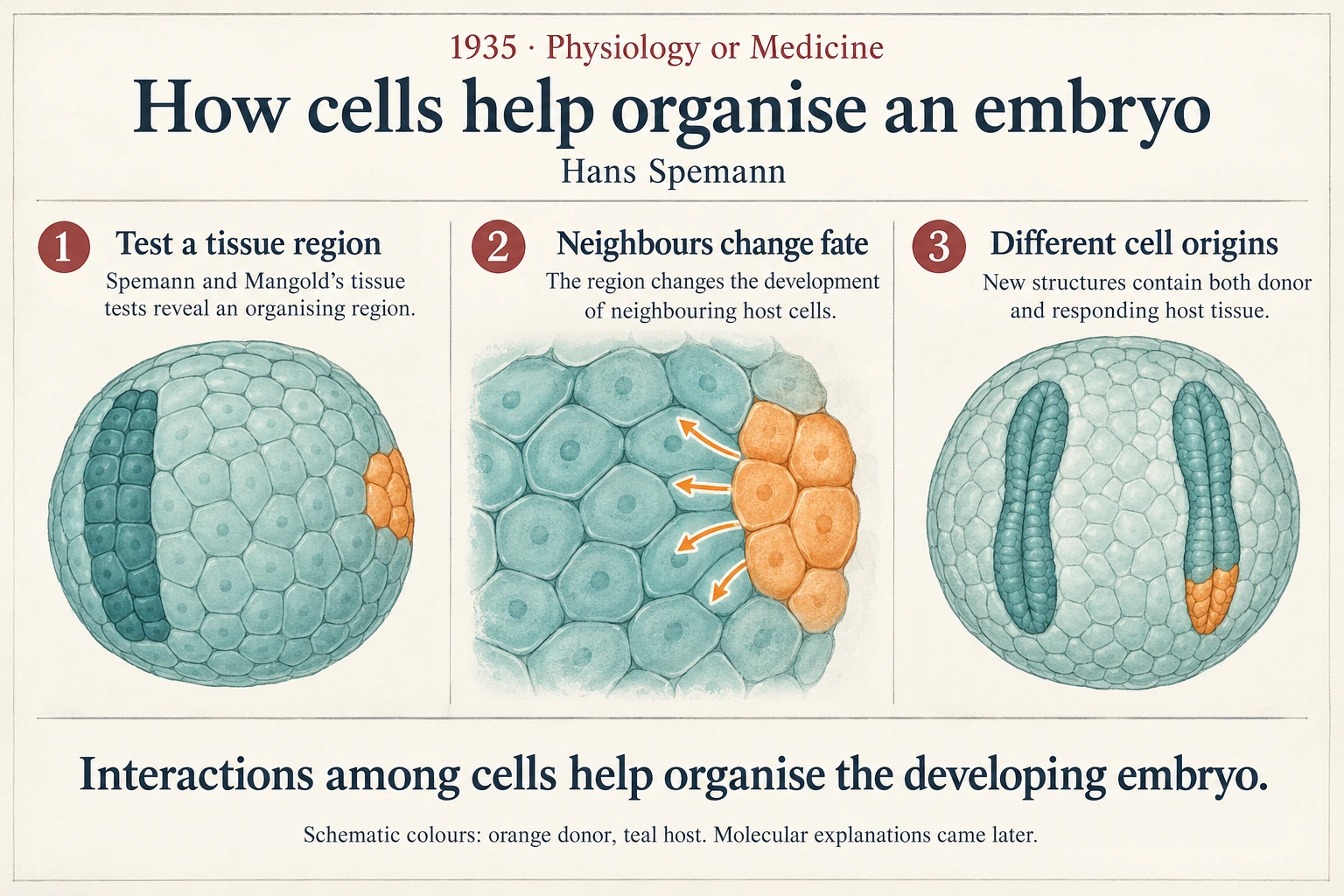
As an embryo develops, cells acquire different roles and form tissues in particular places. Were those roles fixed from the beginning, or could the surroundings change them? Spemann developed ways to test that question in amphibian embryos. His doctoral student Hilde Mangold carried out decisive experiments in 1921–1922; their joint report appeared in 1924. A small region at the dorsal lip of the blastopore, placed elsewhere in a newt embryo, could induce additional embryonic structures.
The cells’ origins mattered. Using newt species with different pigmentation helped distinguish donor tissue from the host. The added tissue did not simply grow into every part of a second body: it also influenced surrounding host cells to take different developmental paths, including forming neural structures. The special region became known as an organiser. The discovery established embryonic induction as something that could be investigated experimentally. Spemann received the 1935 Medicine Prize, while an account of the research must also recognise Mangold’s essential experimental contribution.
Why it matters
The work gave developmental biology a way to study how tissues influence one another. Later molecular research identified signalling mechanisms and connected them with gene regulation. Those later explanations grew from a phenomenon that could first be observed and tested without knowing all its chemical details.