01 · The discovery
The idea, in everyday language
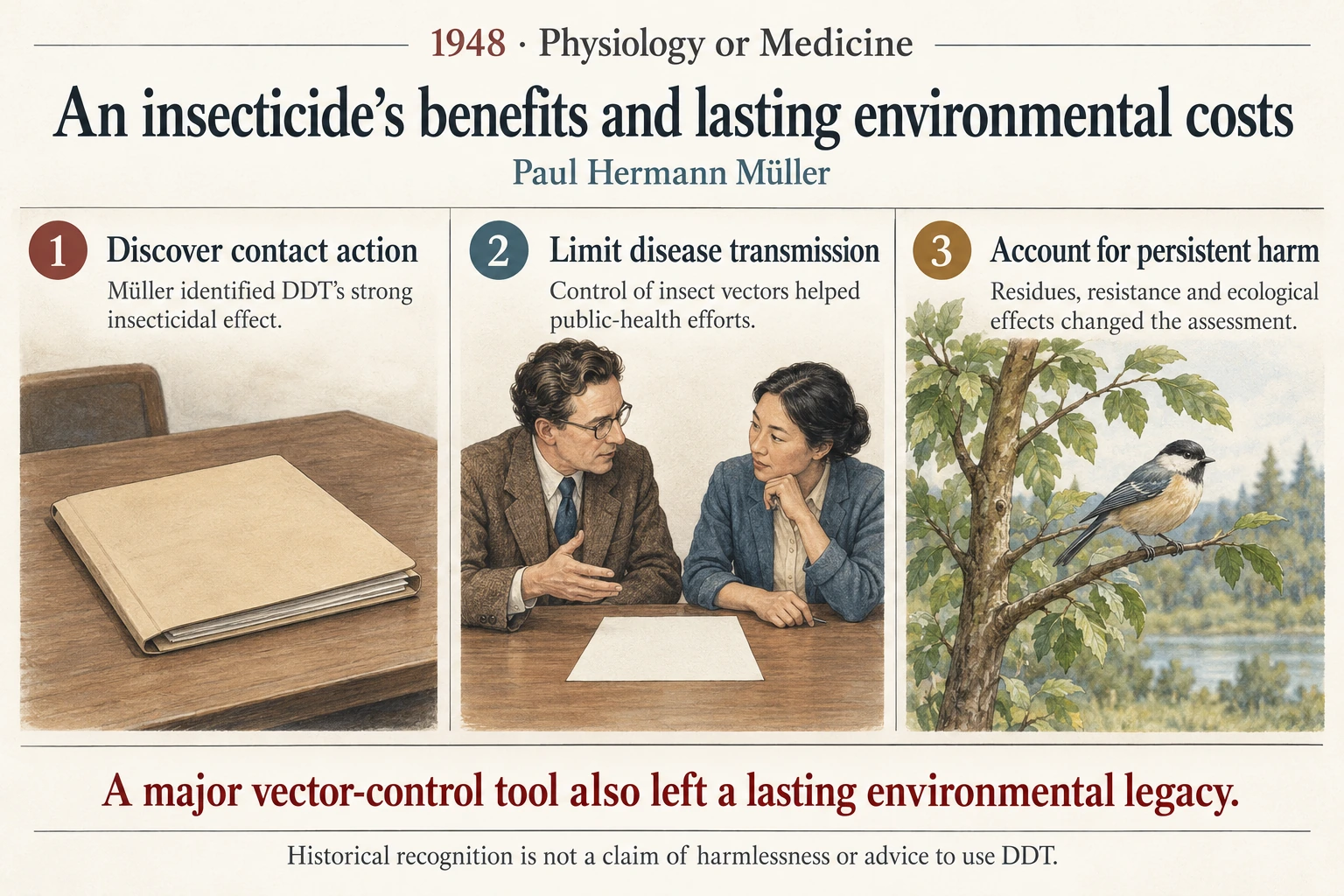
Could controlling an insect reduce the transmission of a disease it carries? Müller’s 1939 discovery showed that DDT, an already known chemical compound, acted strongly as a contact insecticide against several arthropods. The distinction matters: he discovered its insecticidal properties, rather than first synthesising the substance. The Swiss patent in 1940 and marketed formulations in 1942 were later stages.
DDT became important in programmes against insects carrying malaria and epidemic typhus, alongside other public-health efforts. It did not directly cure the diseases in people. The same persistence that made it attractive for insect control became a major problem: residues remained in the environment and accumulated in organisms. Research connected DDT’s breakdown product DDE with eggshell thinning and impaired reproduction in affected birds. Insect resistance also limited effectiveness.
Why it matters
The 1948 award recognised an important historical tool for controlling disease vectors, developed by an industrial chemist. The later environmental history also shows why immediate effectiveness is insufficient for evaluating a widely used chemical. Effects on ecosystems, exposure beyond the target and changing resistance must remain visible.