c.curionodeThe Nobel Archive

2002 · Economic Sciences

Putting economic behaviour to the test

Kahneman brought psychology into the study of decisions; Smith made laboratory markets a tool for testing economic ideas.

The Sveriges Riksbank Prize in Economic Sciences in Memory of Alfred Nobel.

decision-makingprospect theoryexperimentsmarket design
2002Economic Sciences

Visual guide

The prize, pictured

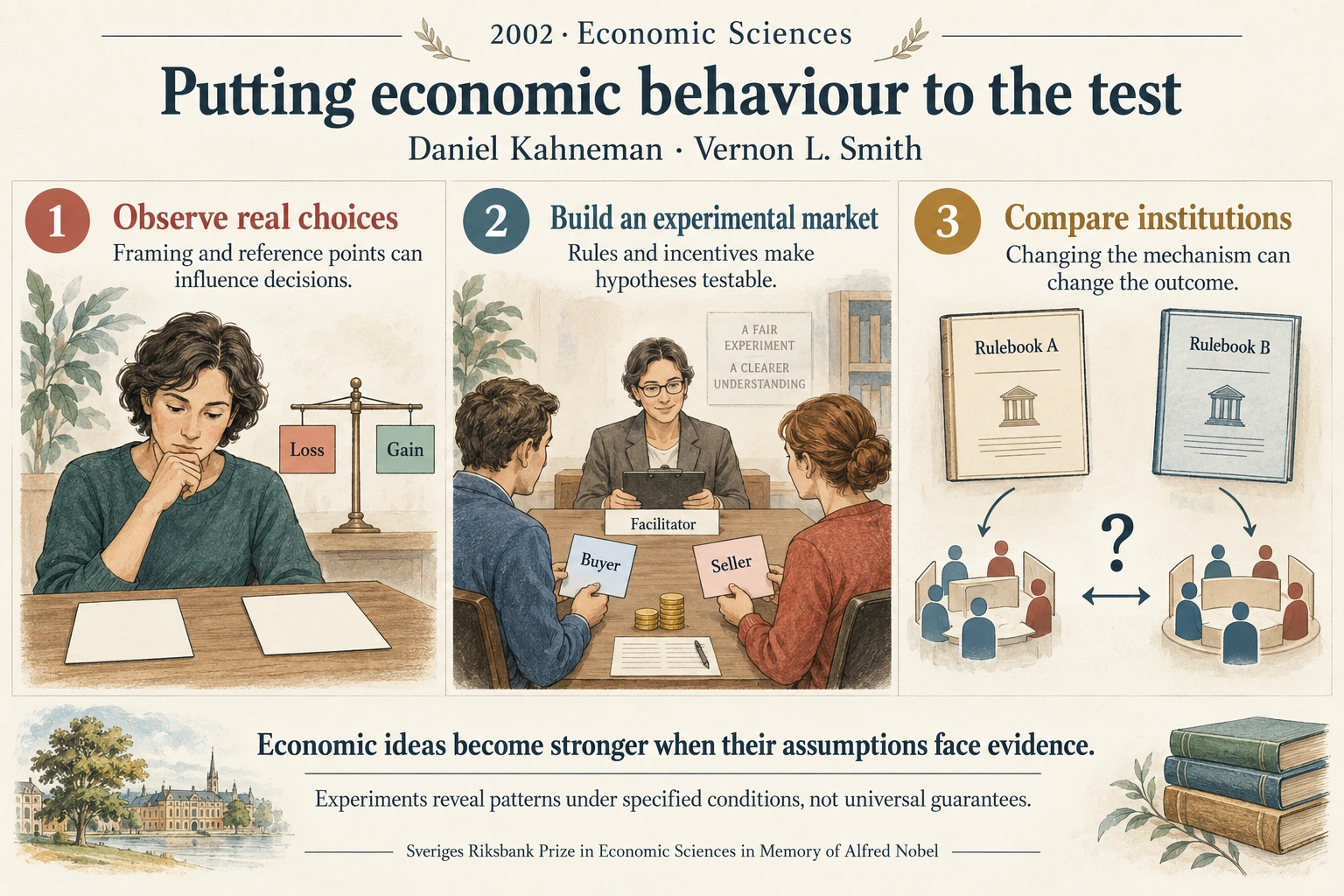
Infographic explaining Putting economic behaviour to the test
Original AI-generated infographic. A conceptual overview; the explanations and sources below provide context.
Read the poster text

Economic ideas become stronger when their assumptions face evidence.

  1. Observe real choices

    Framing and reference points can influence decisions.

  2. Build an experimental market

    Rules and incentives make hypotheses testable.

  3. Compare institutions

    Changing the mechanism can change the outcome.

Experiments reveal patterns under specified conditions, not universal guarantees.

01 · The discovery

The idea, in everyday language

Economic models often begin with assumptions about how people evaluate choices. Kahneman, working closely with Amos Tversky, used psychological experiments to examine those assumptions. Their research showed systematic effects of mental shortcuts, reference points and framing. Prospect theory described choices under risk in ways that could account for patterns standard expected-utility models struggled to explain.

Smith approached economic behaviour through controlled markets. Participants became buyers and sellers under specified rules and incentives, allowing researchers to compare outcomes with theory and vary the institution itself. Some markets coordinated prices remarkably well even when no participant knew the whole situation. Other experiments showed that changing the trading rules could change the outcome.

Why it matters

The contributions widened the evidence used in economics. Psychology helped explain recurring departures from idealised choice, while market experiments made institutional design open to controlled comparison. Their influence reaches research on auctions, market rules and decision-making. Together they encouraged economists to ask which assumptions work, under what conditions, and what changes when people or institutions behave differently.
02 · The people

Who brought the idea to life?

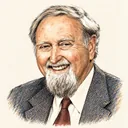
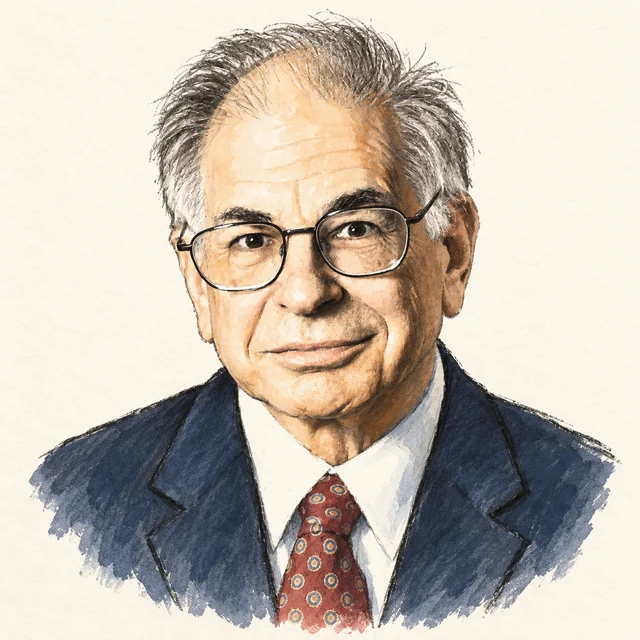
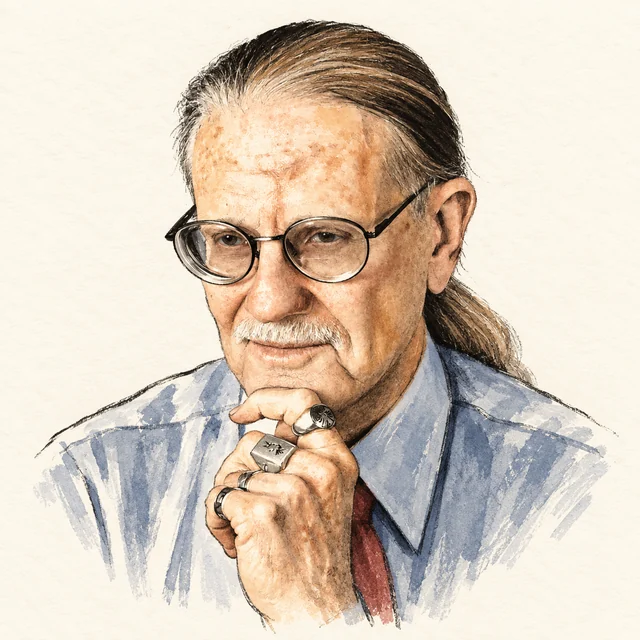
Illustrated portrait of Daniel Kahneman

Daniel Kahneman

Prize share · 1/2

Kahneman and Tversky identified systematic patterns in judgment and developed prospect theory, published in 1979, to describe choices involving risk. People often evaluate outcomes as gains and losses relative to a reference point, with losses weighing more heavily than comparable gains in many studied settings. Their work also showed how framing and mental shortcuts affect decisions. These are context-sensitive patterns, not a claim that every person behaves identically or that all intuitive decisions are mistaken.

Read the biography ↗
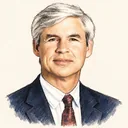
Illustrated portrait of Vernon L. Smith

Vernon L. Smith

Prize share · 1/2

Smith gave participants the roles of buyers and sellers, with explicit rules and financial incentives. He compared outcomes with theoretical predictions and investigated how changing market rules changed the results. His work established methods for inducing values through rewards and for testing auction and trading mechanisms. Some experiments showed surprisingly effective price coordination; others exposed differences between institutions. The lesson was to test the mechanism and its assumptions, rather than assume all markets behave alike.

Read the biography ↗

03 · Years in the making

The path here

  1. 1962

    Smith published early experimental results on competitive market behaviour.

  2. 1979

    Kahneman and Tversky published prospect theory.

  3. 2002

    The prize recognised psychological insights and laboratory experiments in economics.

04 · Read further

From the original sources

Original explanations by Curionode, based on the official records below. Biographical details and affiliations refer to the award year.

  1. Official announcement nobelprize.org
  2. Popular science background nobelprize.org

More in Economic Sciences

Browse this subject ↗