01 · The discovery
The idea, in everyday language
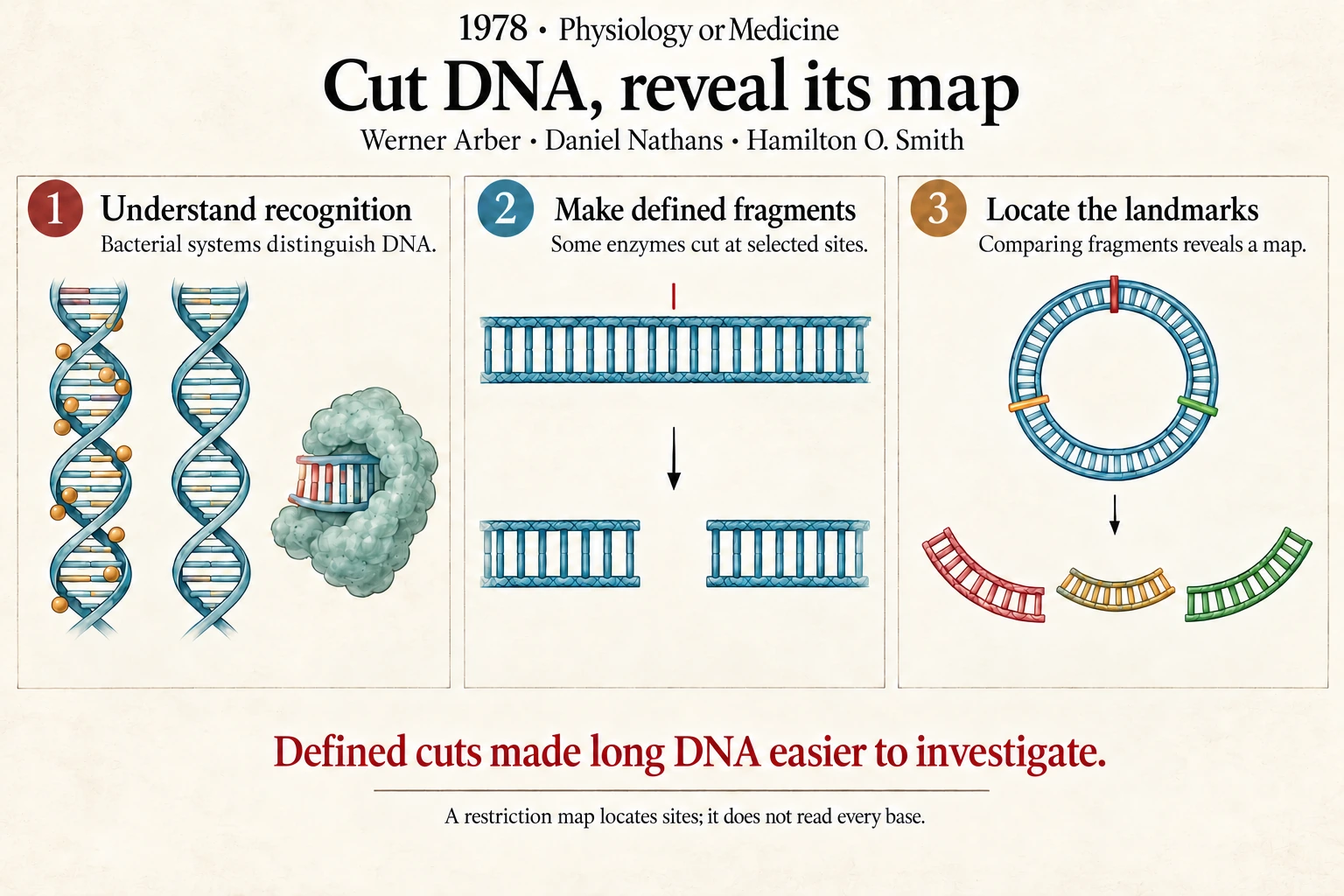
Arber and colleagues investigated why some bacteria restrict incoming phages while chemically modifying their own DNA. This linked recognition, DNA cutting and protection. Smith and colleagues isolated a simpler restriction enzyme from Haemophilus influenzae and characterised cleavage at a defined recognition site in work published in 1970.
Nathans and colleagues used site-specific enzymes to dissect SV40 DNA. Reproducible fragments could be separated, compared and placed in order through additional digests. This produced cleavage maps and helped locate genetic functions. Recognition principles, enzyme characterisation and mapping applications were distinct contributions built through several teams.
Why it matters
Restriction enzymes became fundamental tools for molecular genetics, DNA analysis and, with additional techniques, the construction of new DNA combinations. A bacterial process became an experimental resource for investigating genes.