c.curionodeThe Nobel Archive

1981 · Physiology or Medicine

How brain circuits organize information

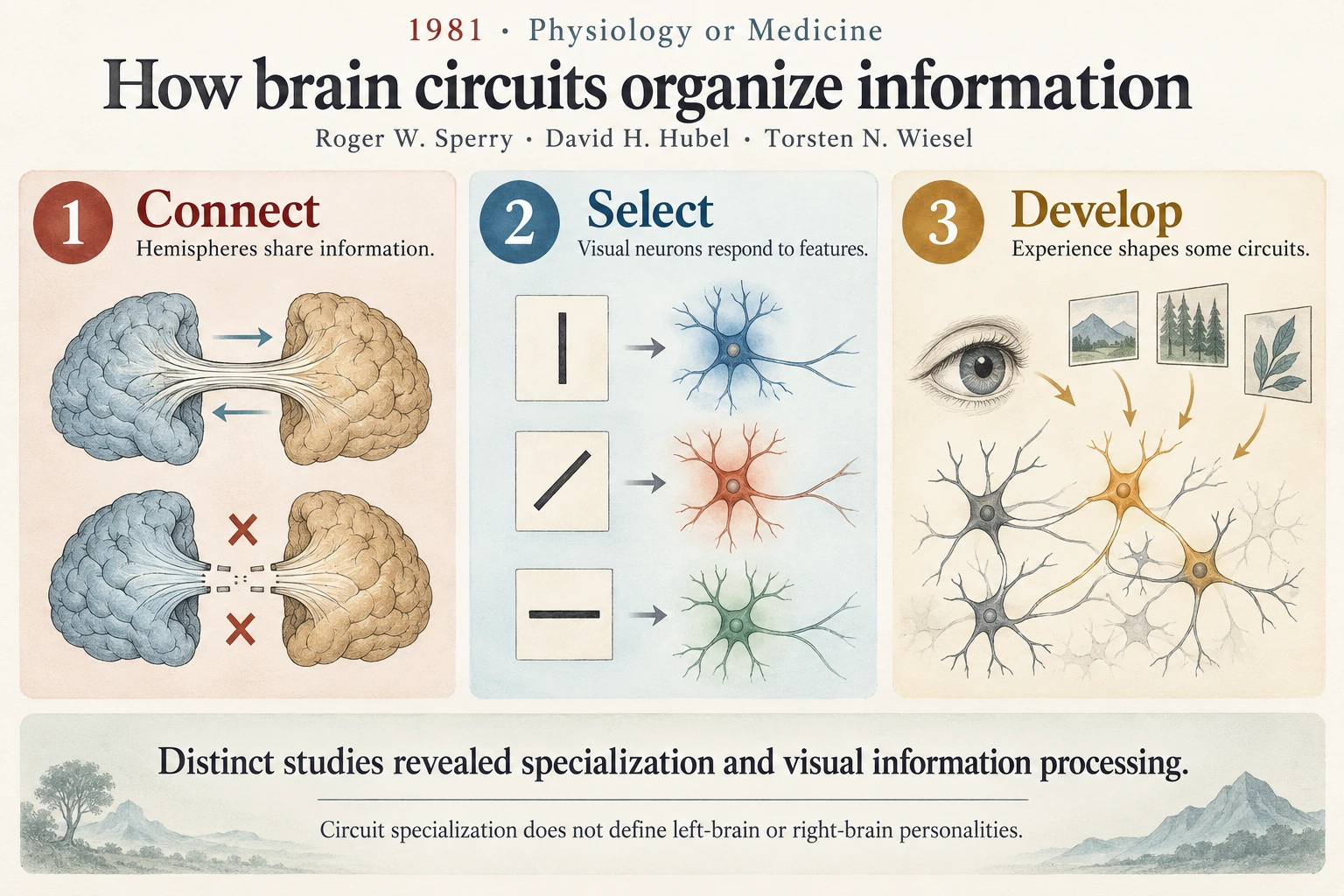
Sperry studied communication and specialization between brain hemispheres. Hubel and Wiesel examined how visual-cortex circuits respond to features and develop through experience.

Brain specializationVisual cortexExperience and development
1981Physiology or Medicine

Visual guide

The prize, pictured

Infographic explaining How brain circuits organize information
Original AI-generated infographic. A conceptual overview; the explanations and sources below provide context.
Read the poster text

Distinct studies revealed specialization and visual information processing.

  1. Connect

    Hemispheres share information.

  2. Select

    Visual neurons respond to features.

  3. Develop

    Experience shapes some circuits.

Circuit specialization does not define left-brain or right-brain personalities.

01 · The discovery

The idea, in everyday language

The brain contains many interacting circuits, so locating a function requires more than naming a region. Sperry’s split-brain research studied animals and people whose corpus callosum, a major connection between the cerebral hemispheres, had been divided. In some patients this surgery was used to limit severe epilepsy. Controlled tasks exposed differences in what each side could process and report when ordinary communication between the sides was reduced.

Hubel and Wiesel recorded individual neurons in the visual cortex of cats and monkeys while presenting simple patterns. Many cells responded strongly to an edge at a particular orientation rather than to light anywhere in the visual field. Related experiments revealed organized cortical circuitry and how altered visual experience early in development could change it. Together these studies made information processing a question about connections, selective responses and experience.

Why it matters

Sperry received half the prize for hemispheric specialization; Hubel and Wiesel each received a quarter for visual information processing. The work helped connect behaviour with neural circuitry and made experience-dependent development experimentally accessible. Collaborators including Gazzaniga, Bogen and Kuffler were important to these programmes. Findings from animal experiments and selected patients need careful interpretation when applied more widely.
02 · The people

Who brought the idea to life?

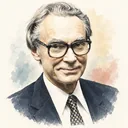
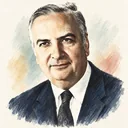
Illustrated portrait of Roger W. Sperry

Roger W. Sperry

Prize share · 1/2

Sperry investigated functional specialization of the cerebral hemispheres, using carefully controlled tasks in split-brain research. He received one half of the Medicine Prize. The findings describe particular functions and experimental conditions; they do not divide people into logical left-brain and creative right-brain personality types.

Read the biography ↗
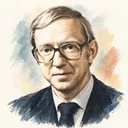
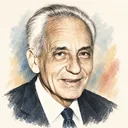
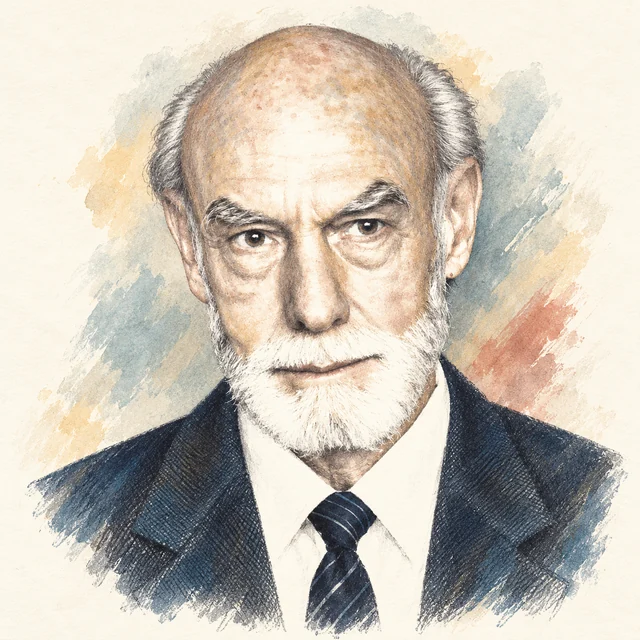
Illustrated portrait of David H. Hubel

David H. Hubel

Prize share · 1/4

Hubel and Wiesel revealed how neurons in the visual cortex respond selectively to features such as oriented edges, and how visual experience affects developing circuitry. Hubel received one quarter of the Medicine Prize, as did Wiesel; Sperry received the other half for hemispheric specialization. The experiments do not imply one neuron alone explains complete vision.

Read the biography ↗
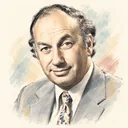
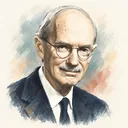
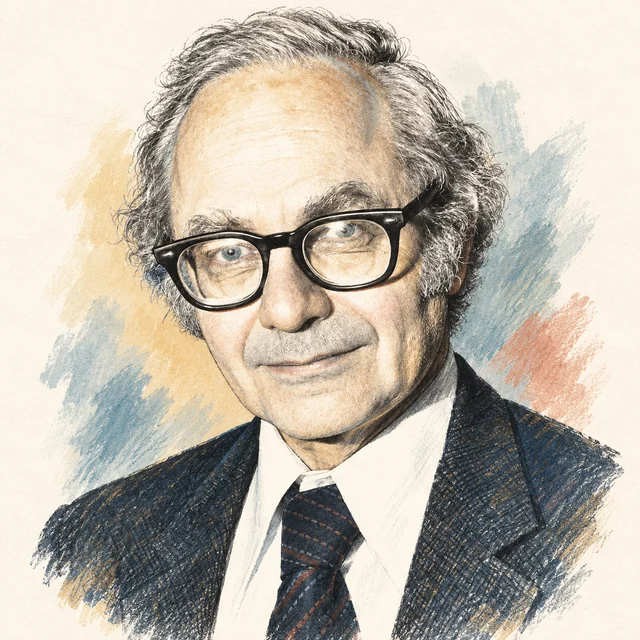
Illustrated portrait of Torsten N. Wiesel

Torsten N. Wiesel

Prize share · 1/4

Wiesel and Hubel studied information processing in the visual system, including orientation selectivity, cortical organization and experience-dependent development. Wiesel received one quarter of the Medicine Prize. Their evidence on sensitive developmental periods came from particular experimental settings, not proof that all visual capacity is fixed at birth or that later plasticity is impossible.

Read the biography ↗

03 · Years in the making

The path here

  1. 1941

    Sperry completes his Chicago doctorate.

  2. 1954

    He joins Caltech.

  3. 1958

    Hubel and Wiesel begin working together at Johns Hopkins.

  4. 1959

    Kuffler’s laboratory moves to Harvard Medical School.

  5. 1981

    The prize recognises distinct studies of hemispheres and visual processing.

  6. 1983

    Wiesel later moves to Rockefeller University.

04 · Read further

From the original sources

Original explanations by Curionode, based on the official records below. Biographical details and affiliations refer to the award year.

  1. Official announcement nobelprize.org
  2. Nielsen and colleagues: testing whole-brain lateralization (2013) journals.plos.org

More in Physiology or Medicine

Browse this subject ↗